

Sometimes I think the most revealing moment for any infrastructure project isn't the whitepaper. It isn't the mainnet launch either. It's when they release something that creates a genuine contradiction inside their own architecture…. and then have to explain their way out of it.
That's what the OctoClaw cloud configuration feels like to me right now.
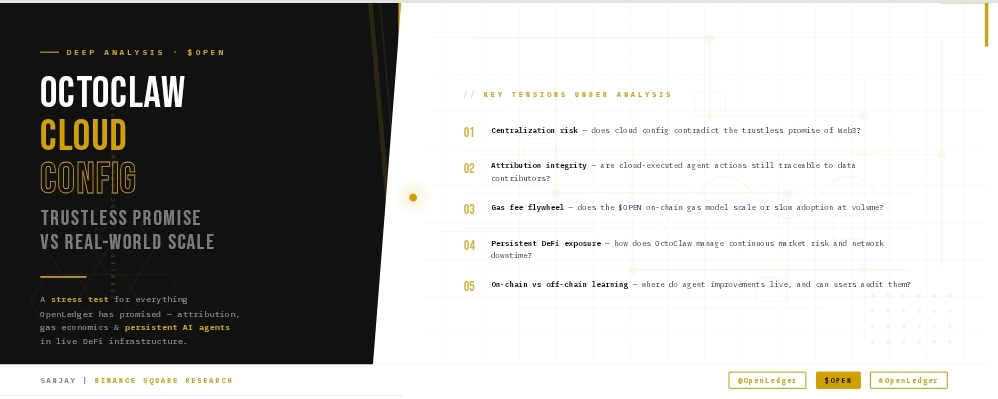
And I mean this with full respect because what @OpenLedgerDatanet is attempting with OctoClaw is genuinely ambitious. Running persistent AI agents that operate continuously, executing on-chain actions, interacting with DeFi protocols, processing real market data in real time…. that's not a demo. That is infrastructure. But here is the uncomfortable part that I can not stop thinking about it
The moment you move OctoClaw into cloud config hosted, always-on, managed you have introduced a centralization layer into a system that was philosophically built around trustless execution. Web3's entire value proposition is that no single entity controls the rails. Yet a cloud-resident agent by definition depends on someone's server. Someone's uptime. Someone's infrastructure decision. And if that infrastructure belongs to OpenLedger…. then the "trustless" framing becomes complicated. Not wrong, necessarily. Just… complicated in ways that deserve honest conversation.
The attribution question makes it even more interesting.
OpenLedger's Proof of Attribution engine is one of the more serious attempts I've seen at solving the data contribution problem. The gradient attribution model, the Suffix-Array-Based Token Attribution system these are real technical approaches to a genuinely hard problem. But here's what I keep asking myself: if OctoClaw is executing agent actions inside cloud config, are those actions still traceable back to original data contributors? Because on-chain execution has a clear audit trail. Cloud execution…. has logs. And logs are not the same thing as attribution. The gap between those two words matters enormously if $OPEN rewards are supposed to flow to the right people.
Then there's the gas model question, which honestly might be the most practically important one.
Every agent action that hits the chain costs gas. That's not a design flaw that's just how on-chain accountability works. But multiply that across thousands of OctoClaw instances running in cloud config, executing continuously, and you're looking at a fee structure that could either become a beautiful flywheel…. or a quiet adoption killer. Because institutional users will do the math. If the compute costs of cloud config plus gas fees per action starts approaching the value generated…. the economics break. And the project that survives isn't always the most technically elegant one. It's the one that gets the unit economics right at scale.
Scale also introduces a risk I find genuinely underexplored persistence.
A cloud-configured OctoClaw agent that runs continuously in DeFi isn't just a tool. It's a position. A relationship with live market risk that doesn't pause when you close your laptop. And the question of how OctoClaw handles risk management stop conditions, drawdown limits, circuit breakers during chain congestion or network downtime is not a secondary feature. It's the thing that determines whether institutional users trust it with real capital. Because one high-visibility failure during a volatile market event could set back adoption more than any technical limitation.
And maybe the most quietly interesting question of all…
If OctoClaw learns from its past actions in cloud config improving its behavior over time based on what worked and what didn't where do those learnings live? On-chain storage is expensive. Off-chain storage is opaque. And if the model improves based on off-chain memory that users can't audit…. then the "verifiable AI agent" narrative starts to drift. Not collapse. Just drift. In ways that matter to builders who care about these things.
I don't think OpenLedger has bad answers to these questions. I think they may have answers that aren't fully public yet. And honestly, that's the most interesting place to watch a project from the moment between shipping something real and explaining all its implications.
OctoClaw cloud config is a real unlock. For institutional users, for persistent automation, for serious DeFi integration. But it's also a test. Of the attribution engine. Of the gas economics. Of the trustless promise. The architecture will either hold under pressure…. or reveal exactly which parts were theoretical.
And we are probably about to find out 😯
