
The more I read about AI infrastructure lately, the more I feel like the real issue is not intelligence itself. Models are already improving faster than most people can adapt to. The uncomfortable part is that the systems creating all this value still have very weak ways of recognizing the people behind the process.
That gap is probably what made OpenLedger stay in my head longer than most AI-related crypto projects.
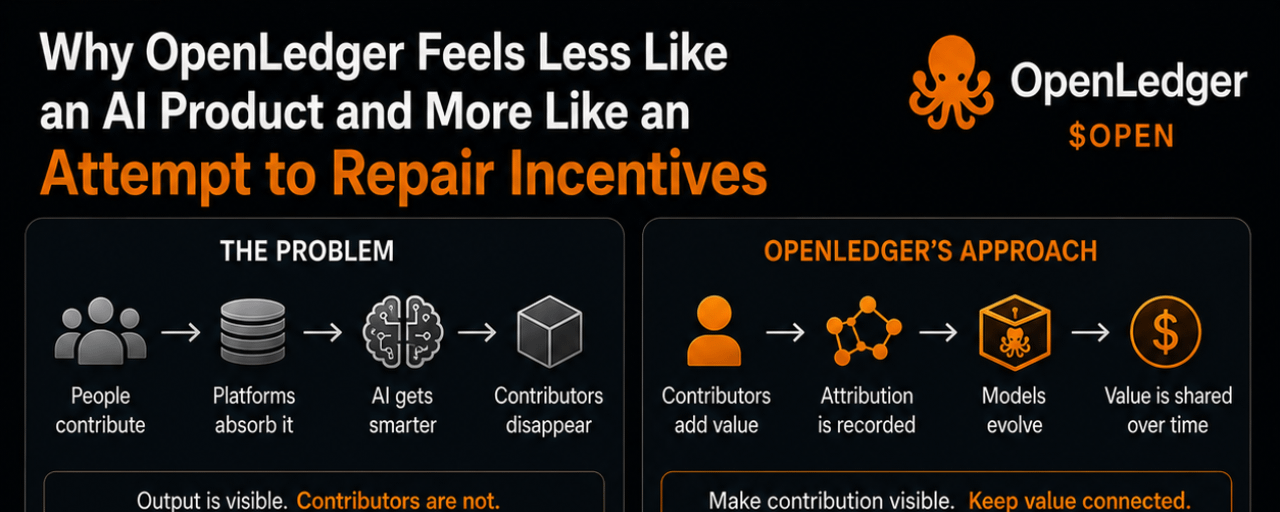
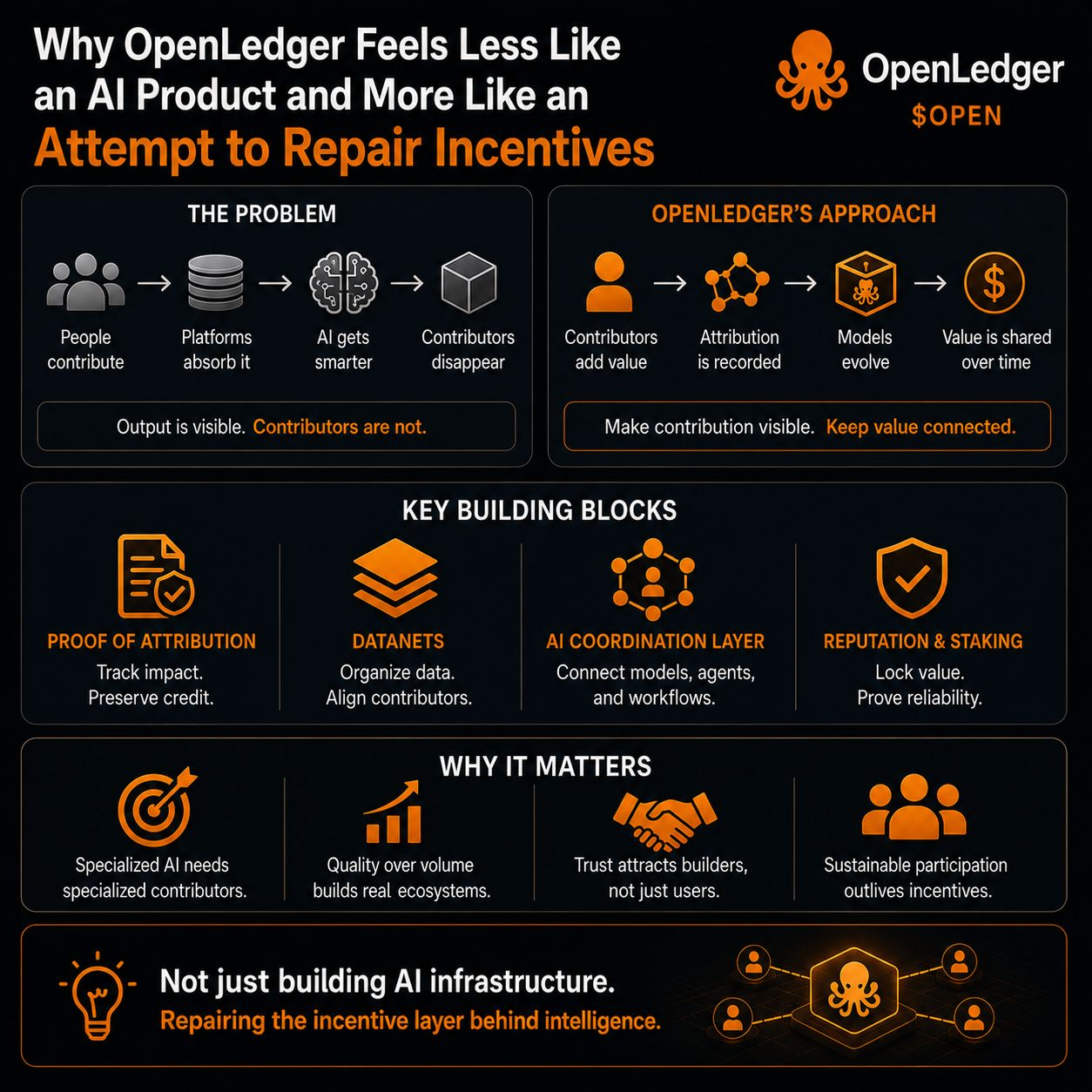
Most platforms today treat data as something that gets absorbed and forgotten. Users contribute information, feedback, corrections, rankings, behavior patterns, and countless invisible refinements, but once the final model becomes useful, the chain of contribution almost disappears entirely.
The output becomes visible.
The people behind the output do not.
What I find interesting about OpenLedger is that the project seems built around reversing that direction. Not by trying to “decentralize AI” in the usual marketing sense, but by creating systems where attribution remains attached to intelligence as models evolve.
That’s where concepts like Proof of Attribution and Datanets start making more sense to me.
At first those names sound like typical crypto terminology. But underneath the branding, the core idea is actually pretty straightforward: if a dataset, contributor, or refinement process materially improves a model, the system should preserve some trace of that contribution instead of collapsing everything into a black box.
And honestly, that changes how participation works.
In most AI systems, users are basically consumers. They interact with models, maybe improve them indirectly, then move on without any lasting relationship to the infrastructure itself. OpenLedger seems to be experimenting with a different structure where contributors remain economically and operationally connected to the ecosystem over time.
That creates a very different kind of behavior loop.
People stop treating data like disposable input and start thinking more carefully about quality, organization, maintenance, and specialization. At least in theory. Whether that behavior scales properly is still an open question, but I think the direction itself is important.
Because AI systems are drifting toward specialization much faster than people expected.
General-purpose models still matter obviously, but more industries now want highly specific intelligence trained around finance, legal work, governance, healthcare, automation, onchain analysis, research coordination, and domain-focused workflows.
Those systems become dependent on niche contributors.
And niche contributors usually want stronger attribution than “thanks for helping improve the model.”
That’s where OpenLedger starts looking more coherent to me than many projects chasing AI narratives right now. The ecosystem appears less focused on raw hype and more focused on coordination infrastructure around contribution itself.
Another thing I noticed is that the project feels surprisingly cautious for crypto.
A lot of protocols aggressively oversimplify risk because they want growth at any cost. OpenLedger feels different in that sense. Even the way the ecosystem expands seems relatively measured. There’s more emphasis on observability, tooling, integrations, staking surfaces, explorers, and operational layers than on endless speculative storytelling.
That restraint actually stood out to me.
Because infrastructure projects usually fail when incentives move faster than reliability.
If contribution systems become too easy to exploit, people optimize around rewards instead of usefulness. Low-quality data floods the network. Reputation systems become noisy. Governance turns reactive. Everything starts looking active while the underlying quality quietly weakens.
You can already see that pattern across large parts of crypto.
OpenLedger at least appears aware that these problems exist.
The technical side reflects that too. The attribution mechanisms don’t seem framed as one magical universal solution. Different model sizes require different approaches, different tracking assumptions, and different ways of handling contribution. That level of nuance matters because it suggests the architecture is being designed around real-world limitations instead of purely around elegant narratives.
And honestly, systems that survive usually think about edge cases early.
What I also keep noticing is how the ecosystem conversations themselves seem to evolve over time. Early participation naturally focused on rewards, campaigns, speculation, and positioning because that’s how crypto culture works. But gradually the attention appears to shift toward more operational questions.
Can outside teams integrate this reliably?
Can contributors verify attribution properly?
Can datasets maintain long-term usefulness?
Can AI workflows become composable without losing accountability?
Those are infrastructure questions, not hype questions.
And infrastructure questions only become important once people start imagining the system existing long term.
That’s why I think OpenLedger’s direction feels more significant than just another AI token cycle.
The project seems built around the assumption that intelligence itself becomes an economy. And if that happens, then ownership, attribution, provenance, contribution tracking, and coordination layers become foundational systems underneath everything else.
Not glamorous systems.
Necessary systems.
The token side also becomes easier to understand through that lens.
A lot of crypto still treats tokens mainly as speculative objects because that’s what markets trained people to focus on. But OPEN feels more interesting when viewed as a coordination mechanism tied to governance, participation, model quality, and contributor alignment across the network.
Whether that alignment works sustainably is still impossible to know.
Execution is still the hardest part.
Open ecosystems are messy. Human behavior constantly changes incentives. Contributors optimize faster than systems evolve. AI coordination itself becomes more complicated the larger networks grow.
But I think OpenLedger at least understands the actual difficulty of the problem it’s trying to solve.
And that alone separates it from many projects pretending AI infrastructure is only about bigger models or faster automation.
The real challenge may end up being something much quieter: building systems where contributors remain visible long enough for trust, ownership, and usefulness to compound together instead of disappearing into extraction cycles.
That’s the part of OpenLedger I keep coming back to.
Not the hype.
The attempt to make contribution matter after the intelligence already exists.