
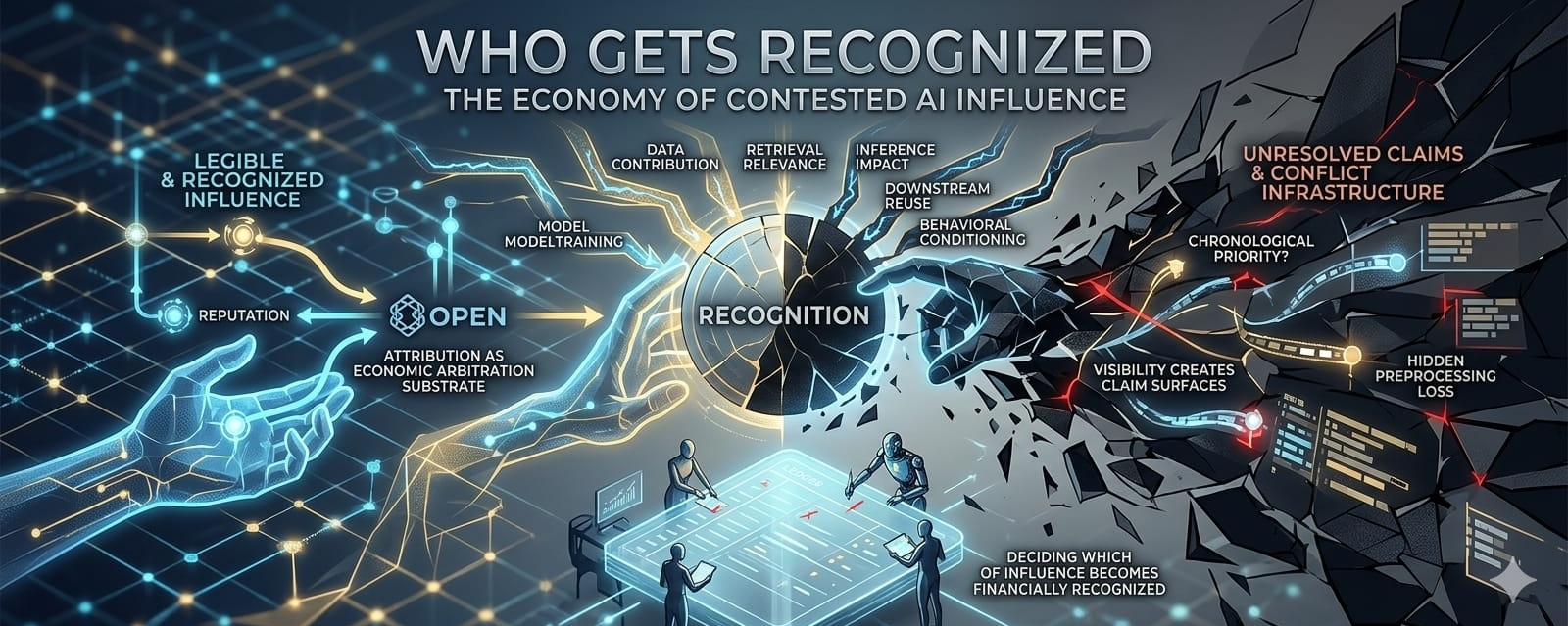
I keep feeling like people are looking at AI attribution from the safest possible angle because it sounds cleaner that way. The common narrative is simple enough to understand: contributors provide valuable data, models learn from it, attribution systems track influence, and tokens eventually distribute value more fairly across the ecosystem. On paper, it feels logical. Transparent even. But the more I think about OpenLedger and the role open could actually play inside future AI infrastructure, the more I feel like attribution itself may not be the real story. The real story may begin after attribution becomes economically meaningful.
Because the moment influence starts carrying financial consequence, attribution stops behaving like neutral infrastructure. It starts behaving like conflict infrastructure.
That shift sounds subtle until you really sit with it. A system can record provenance. A protocol can surface contribution trails. AI networks can emit attestations, confidence layers, reputation scores, and proof systems that make machine influence visible enough for downstream applications to consume. But none of that automatically resolves disagreement. In many ways, it may actually manufacture new forms of disagreement that did not previously exist. Visibility creates claim surfaces. The second a contribution becomes measurable, someone can attach ownership logic to it. And once ownership logic touches recurring payouts, royalties, model access, licensing, or reputational advantage, disagreement stops being theoretical. It becomes economic behavior.
That is the part I cannot stop thinking about.
Most people still speak about attribution as if it captures some objective version of truth, but I do not think systems work that way. Attribution systems do not capture total influence. They capture the version of influence that survives the visibility boundaries of the protocol itself. That distinction matters more than people realize. A contributor may have materially shaped model behavior months earlier through foundational datasets, while another contributor may have created signals that affected retrieval or inference closer to the output layer. Both may have influenced the final result in different ways. But which influence becomes recognized? Which layer becomes economically actionable? Which contribution survives preprocessing, weighting systems, schema restrictions, or eligibility filters? Those are not philosophical questions anymore once money enters the loop.
And that is why $OPEN starts feeling less like a simple utility token to me and more like the foundation of something stranger — a machine-readable dispute economy around AI influence itself.
Not courtroom disputes. Not legal arbitration in the traditional sense. Something much more native to digital systems. A continuous financial coordination layer for unresolved contribution claims. Because if attribution becomes financially important, conflict is no longer an edge case. Conflict becomes infrastructure load.
Think about how creator ecosystems already work today. Rankings appear objective from the outside. An account becomes “top creator,” a post becomes “high quality,” an algorithm rewards “originality.” But almost nobody sees the invisible filtering logic underneath those decisions. Nobody fully sees what behaviors were excluded, what forms of creativity became machine-legible, what signals survived moderation layers, or what definitions of originality were structurally preferred by the scoring model itself. The output looks stable. The pathway rarely is.
AI attribution may evolve exactly the same way.
A protocol may only recognize the contributions it was designed to observe. Everything outside that observation boundary may remain structurally real but economically invisible. And markets are perfectly capable of treating visible claims as complete even when they are not. That happens constantly across financial systems, ranking systems, and digital economies. Usability almost always outranks certainty. If a contribution becomes legible enough for downstream applications to consume, the ecosystem starts behaving as if the claim itself is settled — not because it is perfectly true, but because it is operationally useful.
That difference feels extremely important.
Because what happens when multiple contributors claim influence over the same AI behavior? Who decides whether importance comes from chronological contribution, training weight, retrieval relevance, inference impact, downstream reuse, or observed utility? What exactly becomes the recognized object inside the attribution layer? And if attribution states evolve later, can previous payouts be replayed? Can prior claims be invalidated? Or does the first economically accepted version of visibility become financially permanent even if the underlying contribution history was incomplete?
The object may look stable from the outside. The consequence may not be.
That is what makes this entire category feel larger than most people currently frame it. AI systems compress enormous amounts of layered influence into outputs that appear clean and singular once generated. A response appears. An image exists. A model performs an action. But underneath that simplicity may sit overlapping histories of data contribution, fine-tuning influence, retrieval context, behavioral conditioning, synthetic reinforcement, and recursive reuse loops that no system can perfectly reconstruct forever. At scale, attribution may become less about discovering truth and more about deciding which version of influence the market is willing to recognize.
And maybe that is where OpenLedger becomes important in a way most people are not fully discussing yet.
Maybe it is not only building infrastructure that makes AI contribution visible. Maybe it is helping define which contribution states become financially recognized in the first place. That is a far more powerful role. Not attribution as passive transparency, but attribution as economic arbitration substrate. A system that does not necessarily eliminate disagreement, but standardizes how disagreement becomes machine-readable, priced, delayed, weighted, settled, or financially propagated across AI ecosystems.
I honestly cannot tell yet whether that sounds incredibly elegant or deeply dangerous.
Because if AI economies continue moving toward recurring value flows tied to machine influence, then unresolved contribution conflict may become permanent background pressure inside the internet itself. And in that world, $OPEN may not simply coordinate AI data participation.
It may coordinate the market structure of contested influence.
