Artificial intelligence has achieved remarkable progress over the past decade. Large-scale models have demonstrated the ability to generate content, solve complex problems, and automate tasks across countless industries.
However, beneath these technological breakthroughs lies a growing structural problem.
The infrastructure supporting AI development remains largely centralized.
Data contributors provide valuable information.
Researchers improve model capabilities.
Developers build applications on top of AI systems.
Yet the ownership of these contributions is often unclear, and the economic value generated rarely flows back to those who helped create it.
This challenge becomes even more significant as AI shifts toward specialized models.
Unlike general-purpose systems trained on massive internet datasets, specialized AI depends on carefully curated domain-specific information. These datasets require continuous contributions, validation, and improvement from communities and experts.
Without transparent attribution, sustaining these ecosystems becomes increasingly difficult.
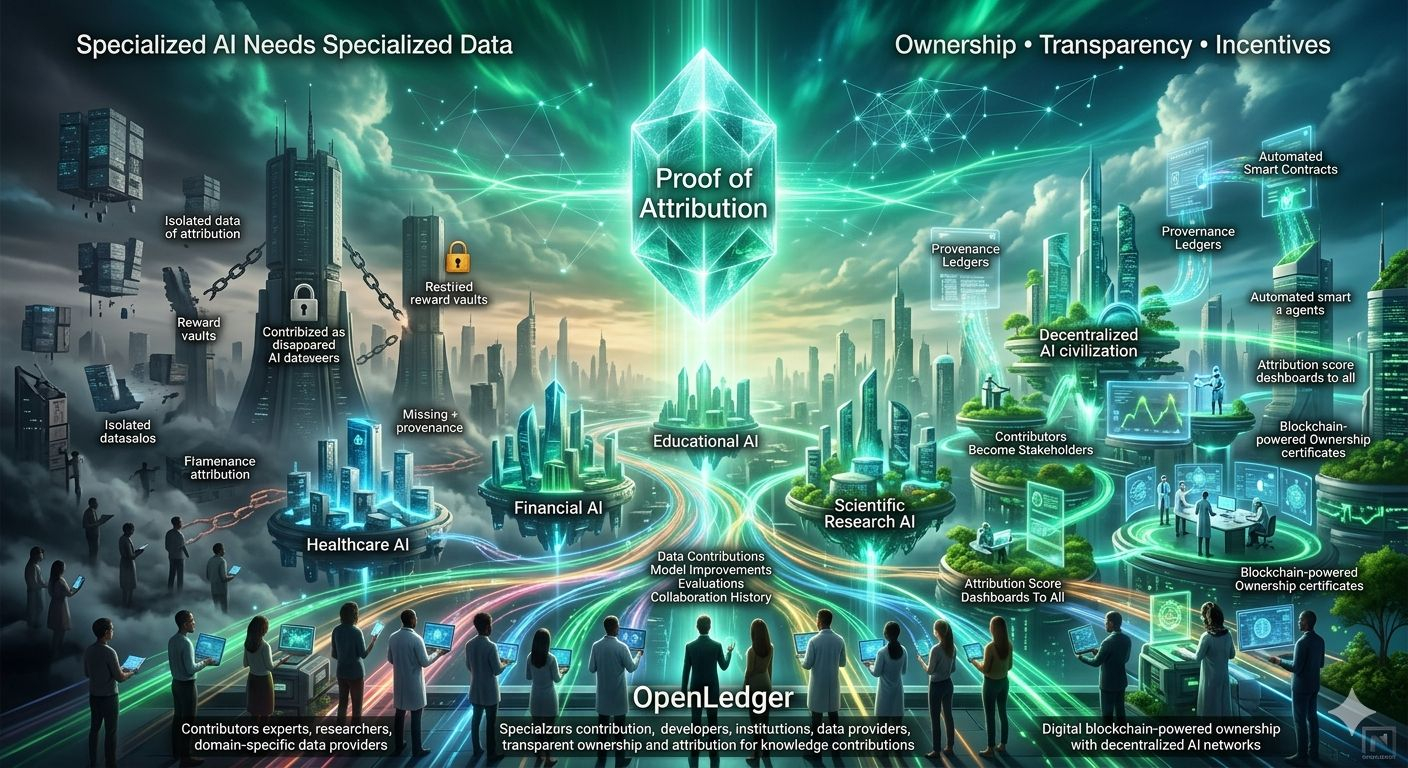
OpenLedger argues that blockchain technology can solve this problem by introducing a new coordination layer for artificial intelligence.
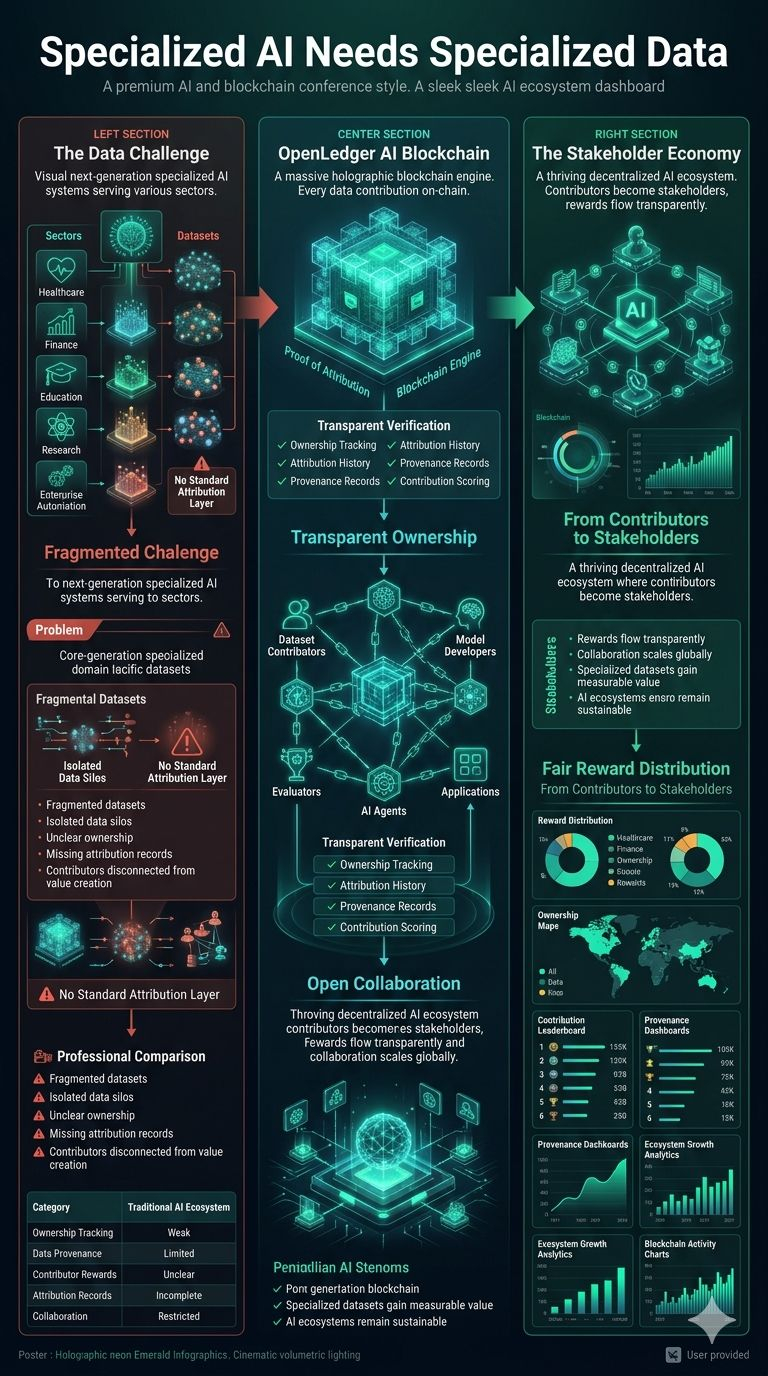
Its AI Blockchain records contributions throughout the AI lifecycle, creating a permanent and verifiable history of participation.
Every dataset contribution, model refinement, evaluation, and collaboration can be linked to its original source.
This creates a system where ownership is preserved rather than lost inside centralized platforms.
The implications are significant.
First, contributors gain visibility into the value they create.
Second, attribution becomes transparent and verifiable.
Third, incentive structures can be aligned more effectively, encouraging long-term participation and higher-quality contributions.
Perhaps most importantly, OpenLedger promotes open collaboration.
Instead of restricting AI development to a limited group of organizations, contributors across the ecosystem can participate while maintaining ownership of their work.
This model transforms AI development from a closed process into a collaborative network where value creation is shared more fairly.
As AI adoption accelerates globally, infrastructure capable of supporting transparency, ownership, and accountability may become increasingly important.
OpenLedger is positioning itself around the belief that the future of AI should not only be intelligent but also open, traceable, and collectively owned.
In that future, blockchain is not merely a financial tool.
It becomes the foundation for coordination, attribution, and trust across the entire AI economy.