
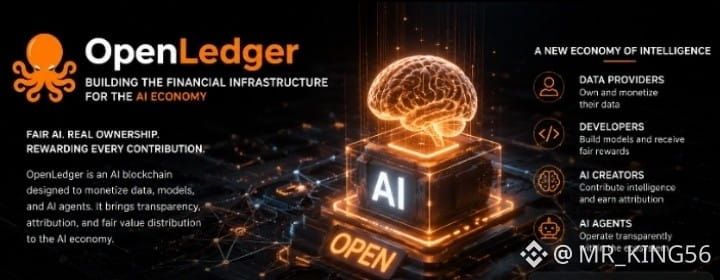

I had one of those quiet moments recently where an AI response made me stop for a second. The answer was smooth, fast, and honestly impressive, but something about it felt strange. I kept thinking about the people behind that intelligence. The data came from somewhere. Someone trained the model. Someone helped shape the system. Yet most of those people remain invisible while the value keeps moving upward. That is what made OpenLedger stand out to me. It is positioning itself as an AI blockchain focused on monetizing data, models, and AI agents, but underneath that idea is a much deeper question about ownership and recognition.
Most conversations around AI focus on speed, power, or automation. Very few people talk about where the actual value begins. AI does not magically appear out of nowhere. It learns from human behavior, human knowledge, and human contribution. The strange part is that the internet has normalized this imbalance. Millions of people contribute to systems every day without ever knowing what their contribution is worth. OpenLedger feels different because it is trying to make those invisible layers visible again.
That is the part I think many people overlook. This is not only about technology. It is about attribution. It is about proving where intelligence comes from and who helped create it. OpenLedger is trying to build a structure where data providers, developers, and AI creators are not treated like background noise inside the machine. Instead, their contributions can become part of an economy that is transparent and measurable.
And honestly, that idea feels more important than another project promising the future of AI. We already have enough hype in this space. What we do not have is a clean system for value distribution. Right now, AI grows faster than the rules around it. The builders benefit. The platforms scale. But the original sources of intelligence often disappear into the background.
That creates a quiet tension inside the AI economy.
Intelligence is valuable.
But invisible contribution is still invisible.
And invisible systems eventually create distrust.
What makes OpenLedger interesting is that it seems to recognize this problem early. Instead of treating AI like a closed product, it approaches it more like an ecosystem where contribution should be traceable and rewarded. That shift changes the conversation completely. Suddenly, data is not just raw material. Models are not just software. AI agents are not just tools. They become economic assets connected to real participation.
I remember talking with a friend a few months ago about how strange the internet feels now. We create content, train algorithms with our behavior, interact with AI systems every day, and still rarely know where the value actually flows. That conversation stayed in my mind because it made me realize something simple. People are becoming part of intelligent systems without having ownership inside them.
Maybe that is the bigger opportunity OpenLedger is trying to explore.
Not louder AI.
Fairer AI.
Because infrastructure only becomes important when people realize what happens without it. If OpenLedger succeeds, it probably will not be because of hype or marketing cycles. It will be because it identified a missing layer in the AI economy before most people even noticed it was missing.
And the more AI becomes part of everyday life, the harder this question becomes to ignore.
If intelligence can now be generated at scale, who truly deserves to benefit from it?.
