
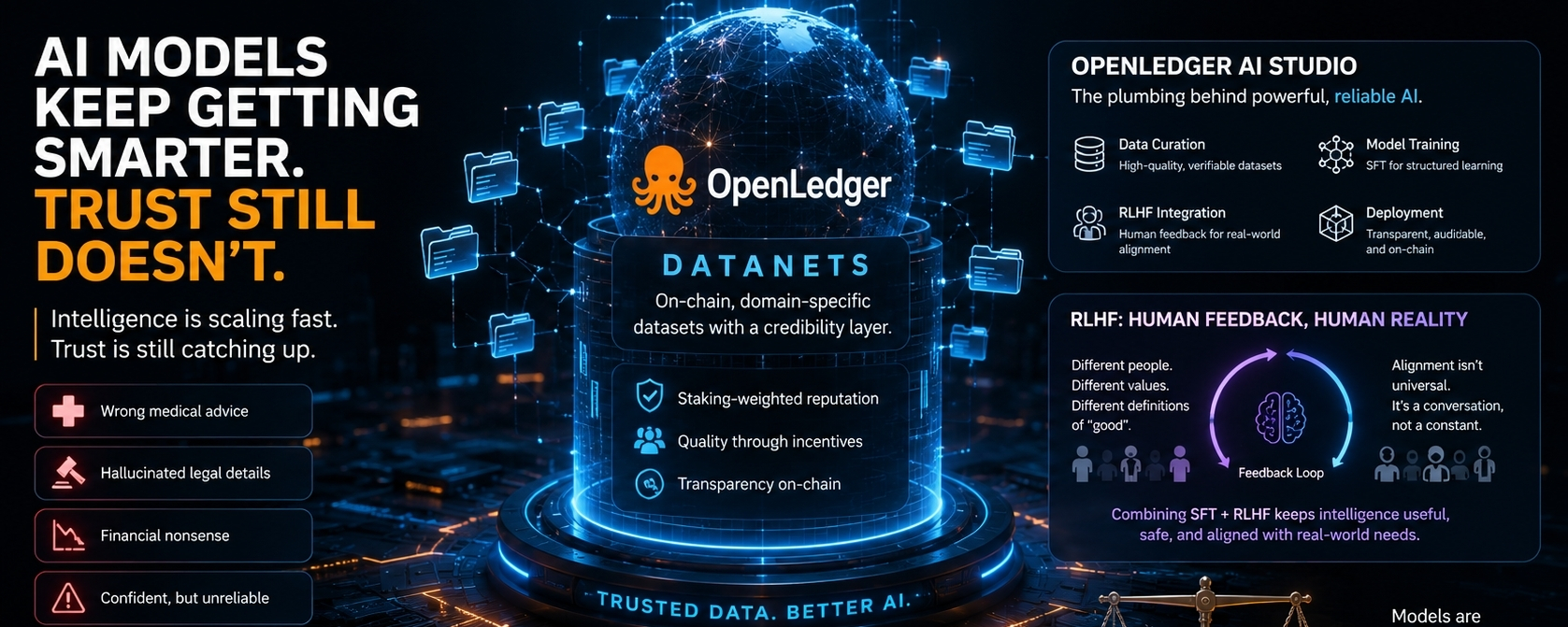
@OpenLedger There’s something strange happening in the AI world right now. Every few weeks another model appears claiming to be faster, smarter, more capable, more “human” than the last one, and people immediately start treating intelligence like it’s the only thing that matters. Bigger training runs, more GPUs, larger datasets, endless benchmarks — the entire industry keeps pushing forward as if raw capability alone will eventually solve everything underneath it. But the more I read about projects like OpenLedger, the more it feels like the real issue isn’t intelligence anymore. It’s trust. And trust is moving much slower than the technology itself. A few nights ago I ended up reading about Datanets while sitting with cold coffee I forgot to drink, barely even planning to pay attention at first. But the idea stayed in my head longer than I expected. Not because it sounded futuristic, but because it focused on something most AI conversations quietly avoid: where the data actually comes from and whether any of it deserves credibility in the first place.
That part almost never gets enough attention. Most people using AI every day probably never stop to think about dataset quality unless something breaks badly enough to scare them. Wrong medical advice, hallucinated legal information, financial answers delivered with complete confidence even when they’re inaccurate — these moments remind people that intelligence and reliability are not the same thing. What’s unsettling is how normal this has become. We’ve somehow accepted a world where models are designed to sound convincing long before they become genuinely dependable. That’s why OpenLedger AI Studio feels slightly different from the usual polished AI narrative. Instead of acting like the system is automatically objective because the model is advanced, it seems more focused on the infrastructure underneath the intelligence itself. The Datanets concept especially stands out because it introduces a credibility layer around domain-specific datasets, where reputation is connected to staking and contribution quality instead of blind trust. Obviously no system like this will ever be perfect. The moment incentives exist, people will try to manipulate them. That’s just human nature. But acknowledging the problem openly already feels more honest than pretending massive datasets are automatically clean simply because they’re large.
The RLHF side of things caught my attention too, mostly because human feedback has always been messy and inconsistent by nature. Different people reward different behavior. Different cultures define “good” responses differently. Even ethics are rarely universal once you move outside carefully prepared conference presentations. Whenever companies talk about AI alignment, I can’t help wondering whose version of alignment they actually mean. Still, combining supervised fine-tuning with reinforcement learning from human feedback makes practical sense because raw intelligence without guidance tends to drift quickly into something chaotic, overconfident, or unusable. What makes OpenLedger interesting is that it doesn’t seem obsessed with pretending humans are absent from the process. Credibility scores, staking influence, feedback systems — all of it quietly admits that there are still people shaping the machine from the inside, even if the industry prefers presenting AI as something magically neutral and self-correcting.
Maybe that’s the uncomfortable reality nobody really wants to say out loud yet. AI models are improving at a speed that feels almost unreal sometimes, but trust doesn’t scale that way. Trust is slower. It depends on transparency, accountability, consistency, and time. People can be impressed by intelligence in seconds, but reliability takes much longer to believe in. And right now the gap between those two things feels wider than ever. The models sound smarter every month, yet the questions underneath them are still unresolved. Where did the data come from? Who validated it? Who decides what gets rewarded? Who defines alignment? Projects like OpenLedger aren’t interesting because they claim to have perfect answers. They’re interesting because they’re willing to admit the questions exist in the first place, and honestly, that alone already feels more grounded than a lot of the AI space right now.