

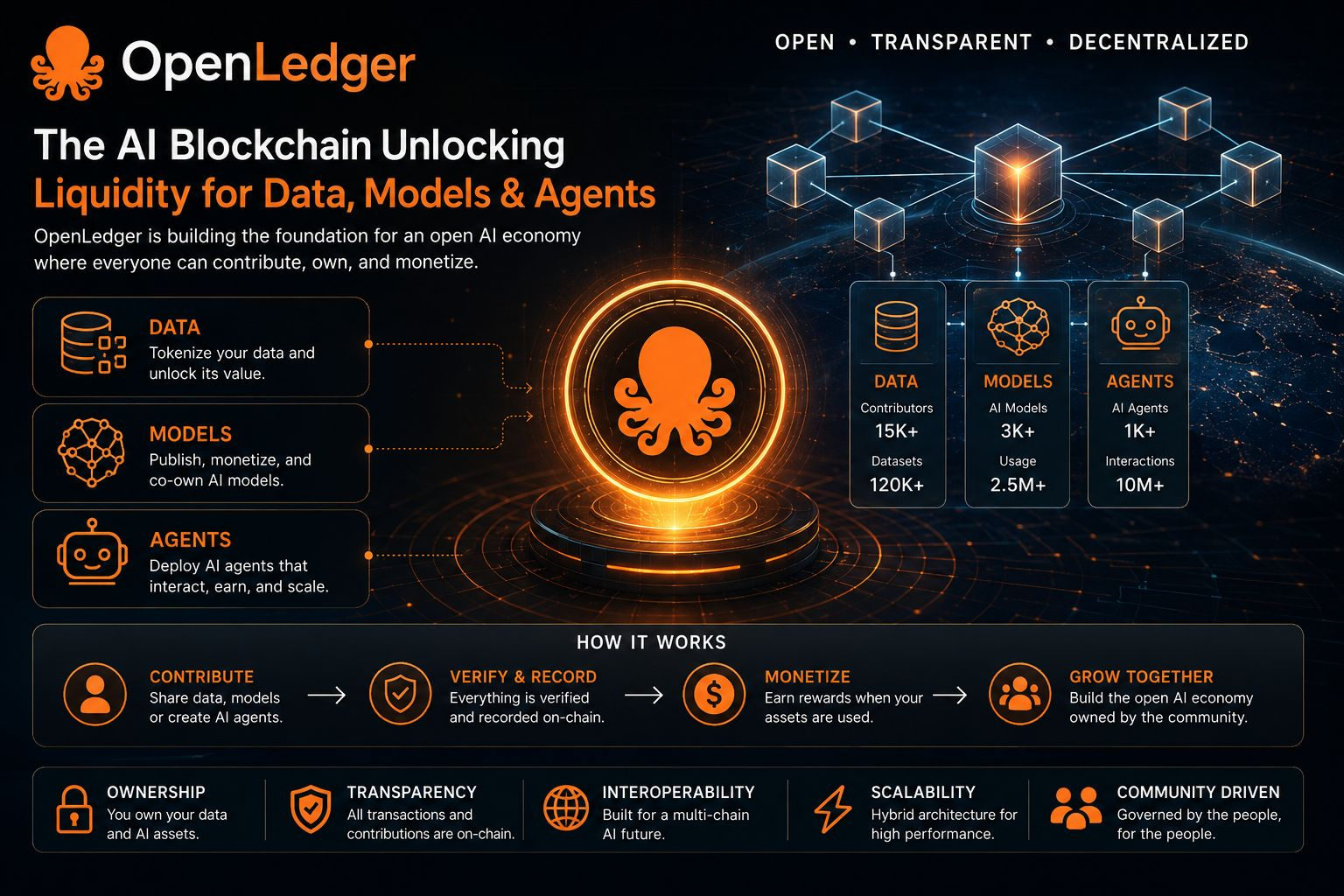
The crypto market has a habit of repeating itself. I’ve watched new sectors explode with excitement, attract huge liquidity, and then slowly fade once the hype disappears. AI projects are starting to face the same pressure now. Everyone suddenly wants exposure to artificial intelligence, but most platforms still feel incomplete. That’s why OpenLedger caught my attention in a different way. Instead of only promoting AI as a trend, OpenLedger seems focused on building the infrastructure behind data, models, and autonomous agents.
When I first looked into OpenLedger, I noticed the project was trying to approach AI ownership differently. Most users today generate valuable data constantly, yet they rarely benefit from it financially. Large AI systems collect information, improve models, and monetize outputs while contributors remain disconnected from the value being created. OpenLedger appears to challenge that structure by introducing an ecosystem where data and AI participation can become economically visible on-chain.
What makes OpenLedger interesting to me is the user experience side. Many blockchain applications feel exhausting after a few days because the interaction becomes repetitive and reward-focused. The experience starts feeling like unpaid work disguised as engagement. OpenLedger doesn’t fully give me that impression. The platform seems designed around contribution and coordination instead of endless farming mechanics. That difference matters because users usually stay longer when the product feels useful rather than purely speculative.
I also think OpenLedger benefits from entering the market at the right time. AI adoption is accelerating globally, but questions around ownership, transparency, and monetization are becoming bigger concerns. OpenLedger seems positioned around solving part of that issue by creating infrastructure where AI-related assets and interactions can be verified and rewarded more openly. It’s still early, but the direction feels more practical than many projects chasing short-term narratives.
From a technical perspective, OpenLedger appears focused on balancing scalability with transparency. That balance is important because AI ecosystems generate large amounts of activity. Running everything entirely on-chain would likely become inefficient and expensive. OpenLedger seems to combine on-chain verification with off-chain operational flexibility, which makes the system feel more realistic for long-term growth. I think that hybrid structure gives the project an advantage compared to platforms trying to force every process directly onto the blockchain.
Another thing I’ve noticed about OpenLedger is the community behavior around it. In many crypto ecosystems, conversations quickly become dominated by price speculation. Here, I’ve seen more discussion around participation, experimentation, and network development. That doesn’t guarantee success, but it usually creates stronger retention over time. Users who stay for utility often build healthier ecosystems than users who only arrive during hype phases.
At the same time, I don’t see OpenLedger as risk-free. Competition inside the AI-blockchain sector is growing fast, and larger ecosystems already have stronger liquidity and developer networks. OpenLedger will need consistent execution to stand out long term. Token economics are another area that deserves attention because balancing incentives without creating excessive inflation is difficult for any blockchain project.
What keeps me interested in OpenLedger is that the project feels more focused on execution than unrealistic promises. I’ve seen many AI narratives come and go, but OpenLedger currently looks like a platform trying to build actual infrastructure instead of simply benefiting from market excitement. That alone makes it worth watching closely.