
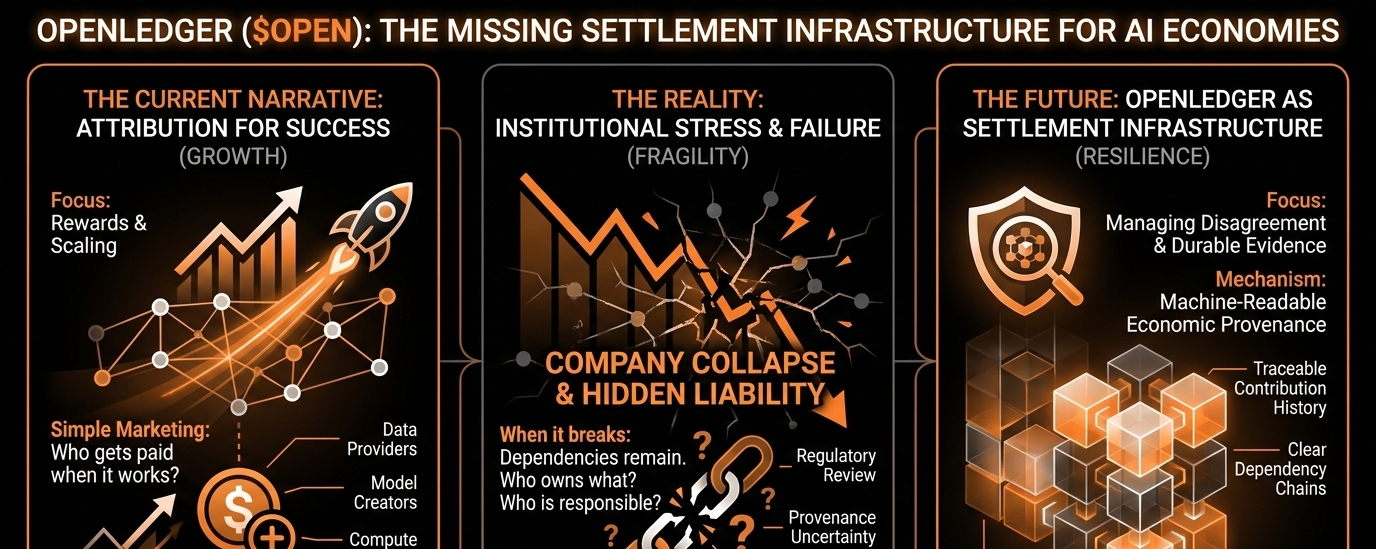
For a long time, I misunderstood what attribution infrastructure in AI was actually trying to solve. Like most people, I assumed the idea was mainly about fairness during success. A model becomes valuable, an AI company scales, revenue starts flowing, and infrastructure like OpenLedger helps identify who contributed data, models, annotations, compute, or intellectual inputs so the economics can be distributed more transparently. It sounded clean, logical, and easy to market.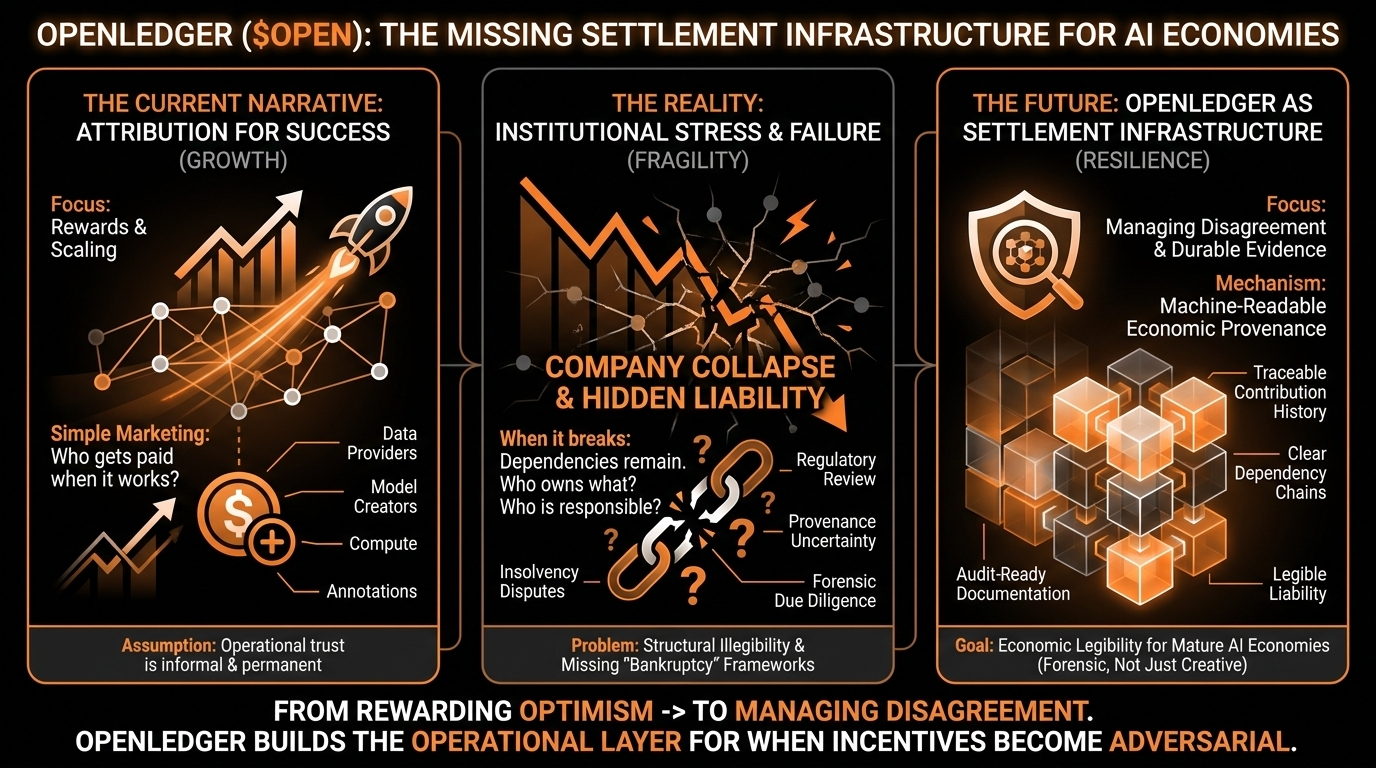
Honestly, that narrative fits perfectly into the phase AI is currently living through. Every conversation around artificial intelligence feels centered on acceleration. People talk about autonomous agents, trillion-dollar productivity gains, decentralized intelligence markets, and AI economies operating at internet scale. Everything sounds exponential. Everything sounds inevitable. But lately I’ve been thinking about something much less exciting. What happens when the AI company itself collapses?
Not theoretically. Not dramatically. Just ordinary business failure.
Because businesses fail constantly, especially in sectors where expectations grow faster than sustainable economics. A startup raises capital, licenses external datasets, integrates APIs from multiple providers, pays annotation teams, builds fine-tuned models on top of third-party architectures, ships a vertical AI product, gains users, and burns cash aggressively. Then six quarters later, the environment changes. Funding tightens. Regulatory pressure appears. Customer acquisition costs become unsustainable. Margins disappear. The company dies.
And that’s where I think the conversation around attribution infrastructure becomes far more important than people realize.
Because when the company disappears, the dependencies do not disappear with it.
That’s the part AI discussions still avoid.
One thing I’ve noticed while following AI infrastructure conversations is how strangely optimistic the entire sector sounds. Every discussion revolves around faster inference, more capable agents, larger models, and autonomous execution. Nobody really wants to discuss institutional stress. But mature industries are defined less by how they behave during growth and more by how they behave during failure.
Traditional finance understands this deeply. Banks have settlement layers. Corporations have bankruptcy frameworks. Supply chains rely on auditability. Licensing agreements exist because memory becomes unreliable once money gets involved. The AI industry, meanwhile, still behaves like operational trust can remain informal forever. That feels incredibly naive to me.
Especially because modern AI systems are no longer isolated products. They’re dependency networks.
A single AI application today may involve licensed proprietary datasets, open-source model architectures, third-party APIs, external annotation providers, retrieval systems, cloud inference providers, fine-tuning pipelines, synthetic data generators, and external agent tooling all stacked together. From the outside, the product looks singular. Underneath, it’s fragmented infrastructure stitched together economically and technically.
That structure works surprisingly well during expansion because revenue smooths over ambiguity. People cooperate while incentives align. But stress exposes hidden assumptions. And crypto should understand this better than almost anyone.
One reason this topic keeps pulling my attention is because I’ve already watched similar dynamics happen across crypto infrastructure. During bullish periods, coordination feels effortless. Validators cooperate. Governance seems aligned. Treasuries feel abundant. Protocols market decentralization like it automatically guarantees harmony. Then markets contract. Suddenly everyone interprets agreements differently. Treasury rights become contested. Governance expectations shift. Communities split over who deserves what. The invisible social assumptions underneath the system become visible all at once.
I remember watching certain DeFi ecosystems during downturns where contributors who once seemed completely aligned started disagreeing about ownership, incentives, obligations, and responsibility almost immediately after economic pressure arrived. The technology itself didn’t change. The incentives did.
And AI systems are building toward the same reality.
The only difference is that AI dependency chains may become even more complex than crypto coordination ever was, which makes attribution infrastructure potentially much more significant than current narratives suggest.
Most people describe OpenLedger as attribution infrastructure, which is technically accurate but still incomplete. The more I think about it, the more I suspect attribution matters most when cooperation breaks down, not when everything is working. That distinction completely changes how I view the project.
Because if contribution history becomes machine-readable, persistent, and economically visible, then attribution stops being a creator economy feature. It becomes forensic infrastructure.
And that is a much heavier role.
Imagine a healthcare AI company using licensed medical datasets, external annotation labor, third-party LLM architecture, proprietary fine-tuning, live retrieval systems, and multiple cloud providers. Now imagine the company collapses. Investors begin restructuring. Regulators start reviewing data provenance. Former providers dispute compensation. Acquirers perform due diligence. Ownership questions emerge around outputs and model dependencies.
At that moment, documentation quality suddenly matters enormously.
Not because anyone cares about philosophical decentralization, but because nobody trusts memory anymore.
This is where OpenLedger becomes interesting to me. Not as a hype infrastructure layer, but as a mechanism that preserves economic traceability when incentives become adversarial. That’s a very different use case, and honestly, probably a more durable one.
One phrase I keep coming back to is economic legibility. Modern AI systems are becoming structurally illegible. Data sources blur together. Model inheritance becomes recursive. Agents call external tools dynamically. Outputs emerge from layered dependencies nobody fully tracks manually anymore. That complexity creates hidden liability, and enterprises hate hidden liability.
Retail markets tend to underestimate this because retail narratives prioritize capability. Can the model perform? Can the agent automate? Can the product scale? Institutions ask different questions entirely. Who owns the underlying data? What are the compliance risks? What happens if attribution claims emerge later? Can provenance be audited? Are dependency chains visible? Is exposure measurable?
That operational layer is deeply boring compared to AI hype, which is exactly why it may become valuable. Infrastructure markets often reward boring necessities far more than exciting narratives, especially once industries mature.
One thing that increasingly stands out to me is how aggressively markets price AI upside while barely discussing institutional risk plumbing. Everyone wants exposure to acceleration. Very few people want exposure to governance architecture. But historically, durable value often accrues to systems that reduce uncertainty rather than systems that maximize excitement.
That’s true in finance, true in cloud infrastructure, true in payments, and possibly true in AI as well.
The EU AI Act is already pushing governance expectations higher. Enterprise procurement teams are becoming increasingly cautious around data lineage and compliance exposure. Regulators are asking harder questions about training transparency. Commercial contracts still require attribution clarity even if AI systems themselves become probabilistic and blurry.
The market talks about intelligence scaling.
Institutions worry about responsibility scaling.
That’s a completely different problem.
And that problem may create its own infrastructure category.
But attribution itself is still messy. It sounds elegant until you actually try to operationalize it. Then things become complicated very quickly. How much did a specific dataset actually contribute? How economically material was a particular annotation layer? Does every microscopic contribution deserve recurring claims forever?
That path becomes unsustainable almost immediately.
A functioning economy cannot support infinite micro-obligations attached to every output because coordination costs would explode. Any real attribution system would eventually need materiality thresholds, relevance weighting, governance standards, contribution filtering, and claim prioritization.
And the moment those mechanisms appear, politics enters the system.
Because someone has to decide what mattered.
That’s where many crypto systems become fragile. People love transparent systems until transparency affects incentives unevenly. Then governance becomes conflict.
OpenLedger does not magically solve that. No blockchain solves human disagreement. That’s an important distinction.
This is also where I think crypto still oversimplifies reality. People constantly assume that if something is on-chain, the problem is solved. But on-chain records create visibility, not enforceability. A blockchain cannot independently resolve cross-border insolvency disputes, regulatory conflicts, commercial litigation, off-chain contractual ambiguity, or jurisdictional enforcement.
What it can do is preserve durable evidence.
And durable evidence changes negotiation dynamics significantly, especially during moments of stress.
That matters more than people think because economic systems become dangerous when nobody agrees on what happened. Reliable provenance narrows the ambiguity surface. Not perfectly, but enough to matter institutionally.
I know the phrase “AI bankruptcy infrastructure” sounds dramatic, but I genuinely think the market may underestimate how important failure-management infrastructure becomes as AI economies mature. Every mature economic system eventually develops mechanisms for handling breakdown, not just growth. Bankruptcy courts, settlement systems, audit frameworks, clearing houses, compliance architecture, and risk disclosure systems all emerged because economic complexity eventually requires coordination during failure.
AI still feels early partly because the industry mostly talks about acceleration while ignoring failure coordination entirely.
That won’t last forever.
Eventually AI companies will fail. Attribution disputes will emerge. Ownership conflicts will intensify. Regulators will intervene. Acquisitions will require forensic transparency. Institutional capital will demand operational traceability.
And when that happens, provenance infrastructure may stop looking optional.
It may start looking foundational.
That doesn’t mean OpenLedger automatically wins. Far from it. Execution risk remains enormous. Governance design matters. Token utility matters. Adoption matters. Institutional integration matters. Most importantly, the network has to prove that attribution can become economically useful without creating unbearable coordination overhead.
That’s difficult.
Still, I cannot shake the intuition that the market may be viewing attribution infrastructure through the wrong lens entirely. People keep treating it like infrastructure for rewarding success. I increasingly think it may matter more as infrastructure for managing disagreement.
And mature systems are usually defined by how well they survive disagreement, not optimism.
That’s the less exciting story.
Possibly the more important one.
@OpenLedger #OpenLedger #openledger $OPEN
