
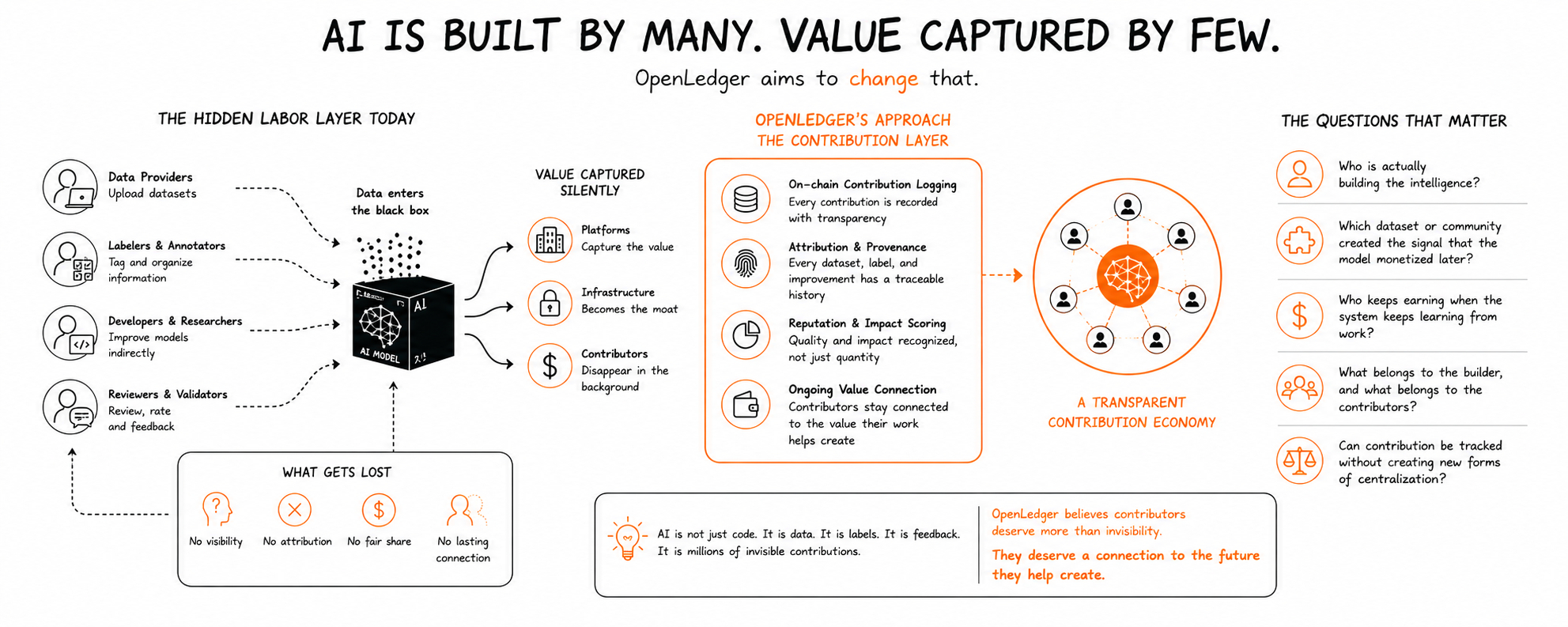
I started to notice something after spending more time around AI projects.
A lot of people in crypto still talk about ownership in an old way.
You own the protocol or you are just a user inside somebody else’s system.
There is rarely anything in between.
When I looked into OpenLedger I realized the more interesting area is actually the middle layer.
The place where people contribute work without fully controlling the final product.
That part gets ignored everywhere.
I have worked around online systems to know how this usually goes.
* You upload data.
* You label information.
* You improve models indirectly.
Then some platform absorbs the value quietly into a product.
Most contributors never really know where their work ended up or how much of the output depended on them.
What caught my attention with OpenLedger was not the side first.
It was the attempt to isolate contribution itself as a layer.
That sounds small until you compare it with how AI systems operate today.
Normally everything gets blended together.
The model becomes the brand.
The infrastructure becomes the moat.
The contributors disappear into the background.
Even researchers often lose visibility once their datasets enter pipelines.
OpenLedger seems to be trying to break that structure
When I tested parts of the ecosystem I kept thinking about one question.
What actually belongs to the builder. What belongs to the contributors who made the build possible?
I do not think most AI companies want that question asked loudly.
Because once contribution becomes traceable people start asking things.
* Who improved the outputs?
* Which dataset mattered most?
* Which community created the signal that the model monetized later?
* And who keeps earning when the system keeps learning from work?
Most centralized AI systems avoid these questions by design.
Data enters a box and ownership becomes abstract very fast.
OpenLedger is trying to keep the trail visible
That changes behavior.
Suddenly datasets are not raw material anymore.
They become assets with history attached to them.
That sounds useful on paper. It also creates new problems that people are not discussing enough.
For example what happens when contribution scoring becomes more important than contribution quality?
I already saw signs of this behavior in crypto ecosystems before.
Once rewards become attached to measurable activity people start optimizing for the metric of the actual usefulness.
Low quality farming starts creeping in quietly.
That risk feels very real here too.
Another thing I kept thinking about is whether permanent contribution tracking could eventually create a type of centralization.
Not through servers or governance.
Through reputation concentration.
If a few data providers become sources across the ecosystem then smaller contributors may slowly lose relevance anyway.
The system becomes open technically but socially closed over time.
I do not think enough people talk about this possibility.
Still I cannot ignore what feels genuinely different here.
For the time I saw an AI related system trying to financially separate infrastructure ownership from contribution ownership in a more visible way.
That distinction matters.
Because building a protocol and feeding intelligence into a protocol are not the thing.
Crypto already learned this lesson with mining pools staking systems and liquidity networks.
The people securing value and the people capturing value are usually groups even when marketing tries to merge them together.
AI may be entering the phase now.
One thing I personally liked was how OpenLedger made me think harder about my activity online.
I started asking myself whether I was building something for myself or just strengthening somebody ’s model quietly without realizing it.
That question stayed in my head longer than I expected.
Especially because most internet users still do not see their data work as labor.
They see it as participation.
Posting correcting tagging reviewing reacting training systems indirectly every day.
Maybe that assumption breaks over the few years.
Maybe these systems become too complicated for normal contributors to track properly and the same extraction cycle continues under new branding.
I honestly do not know yet.
What I do know is this.
After spending time studying OpenLedger I stopped looking at AI ecosystems as products.
Now I look at them like economies, with hidden labor layers underneath.
Once you notice that structure it becomes hard to unsee.
* Who is actually building the intelligence?
* Who is only packaging it?
*. When an AI system becomes valuable years later who should still be connected to that value chain?