
@OpenLedger The conversation around artificial intelligence is still dominated by speed, scale, and the assumption that progress only moves in one direction. Every week seems to bring a new wave of agentic systems, autonomous optimization, and promises that intelligence will soon be easier to access, cheaper to deploy, and more powerful than anything that came before. But that story leaves out the part that history always reminds us of: industries built on heavy capital, layered dependencies, and complicated incentives do not stay clean and frictionless forever. They break, they dispute, they restructure, and when they do, the real battle is rarely about whether the technology worked in theory. It is about who owns what, who is liable for what, and how value gets divided when the original optimism has already collapsed.
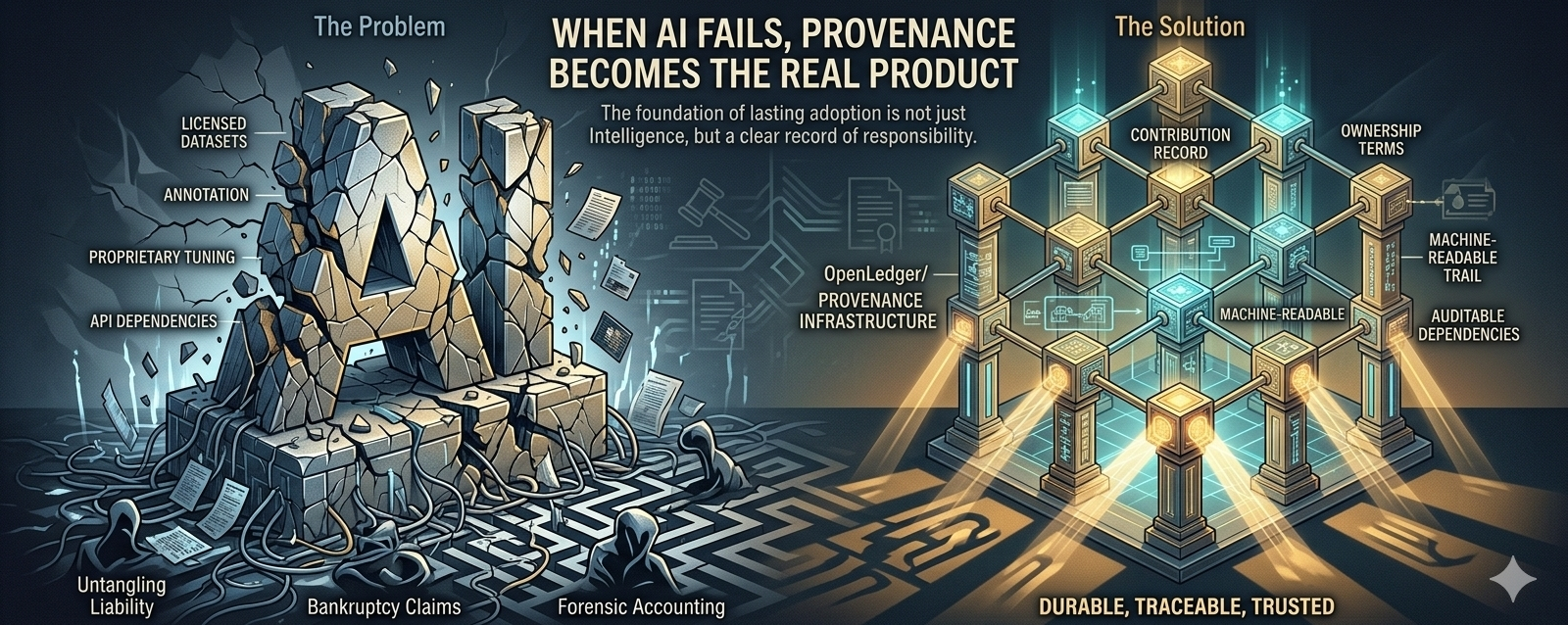
That is why a framework like OpenLedger deserves to be understood in a much more serious way than a simple rewards layer for contributors. In a world where modern AI products are assembled from licensed datasets, outside annotation work, proprietary tuning, and multiple API dependencies, the real challenge is not just building something impressive. It is proving, later, exactly how that thing was built. The black box problem is often described as a technical inconvenience, but in practice it becomes a legal and financial burden the moment a company runs into trouble. If a startup fails, gets acquired under pressure, or enters bankruptcy proceedings, its model and data stack can turn into a messy web of claims. Without a durable, machine-readable record of contribution and ownership terms, untangling that web becomes an exhausting exercise in forensic accounting. A system that preserves provenance from the start does not prevent failure, but it can make failure intelligible, traceable, and far less destructive.
This is also why the most compelling argument for this kind of infrastructure is not the romantic idea of a creator economy for data, but the far more practical demand for institutional trust. Enterprises do not hesitate because they are unconvinced that AI is powerful. They hesitate because they understand risk. They know that once an AI system is embedded into critical workflows, every hidden dependency becomes a potential source of exposure. Procurement teams, compliance officers, and legal departments are not trying to slow innovation for the sake of it; they are trying to protect the organization from inheriting liabilities that nobody can fully explain after the fact. If provenance can be captured in a form that survives audits, restructurings, and disputes, then it stops being a nice-to-have feature and starts looking like core infrastructure. In that sense, the true value is not in the hype around autonomous systems, but in the quiet reliability of records that can be trusted when the pressure is highest.
Of course, it would be a mistake to confuse transparency with enforcement. A ledger can show history, but it cannot magically resolve the legal complexity of insolvency, cross-border contract disputes, or the question of what counts as a meaningful contribution in the first place. That is the hard part. If every small input creates a permanent claim, the system becomes too expensive to operate and too cumbersome to govern. The architecture only works if it develops sensible thresholds, credible governance, and settlement rules that can bridge the gap between technical attribution and real-world legal outcomes. The most valuable version of this model would not simply record who participated; it would help establish how participation should matter when commercial agreements fail and the original deal no longer holds together.
In the end, every mature economic system is judged not only by how well it grows, but by how well it handles disappointment, collapse, and repair. AI is still being sold like a future that can only expand, yet the more realistic test is whether the ecosystem can survive the moments when enthusiasm fades and accountability begins. That is where provenance infrastructure becomes more than an abstract idea. It becomes a way to preserve order when the market turns, to make settlements less chaotic, and to prevent failure from becoming total amnesia. The dream of AI may be intelligence at scale, but the real foundation of lasting adoption may be something much less glamorous: a clear record of responsibility that still makes sense when the revenue slows down and the lawyers start asking questions.