
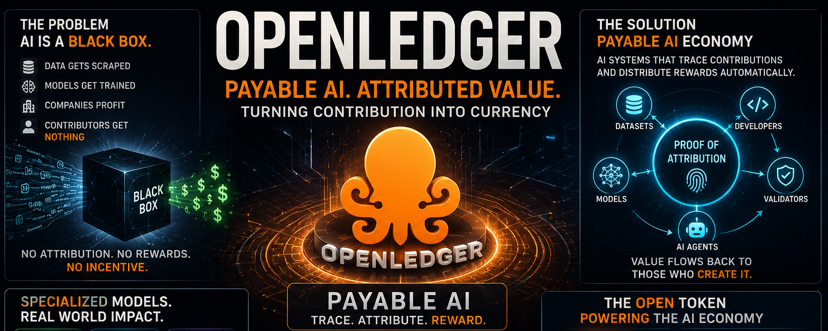
At first I honestly thought OpenLedger was another project trying to force a token into the AI conversation because that is what the market rewards right now. We have seen a lot of those already. Add AI, decentralised agents and suddenly there is a valuation attached to a whitepaper.
But the deeper I went into OpenLedger, the more I realized the project is not really obsessed with chatbots or flashy AI demos.
It is obsessed with attribution.
That sounds boring until you think about how the current AI economy actually works.
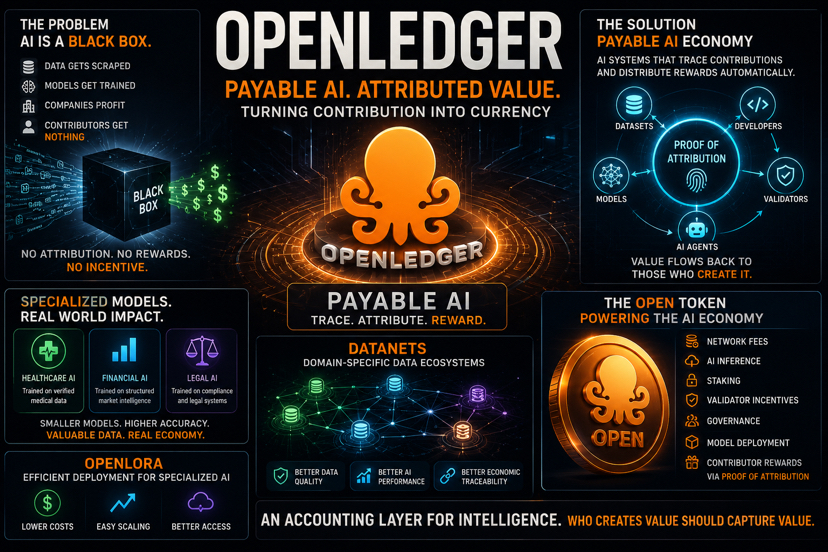
Right now, most AI systems are black boxes. Data gets scraped. Models get trained. Companies monetize the outputs. Meanwhile the people who created the data, improved the datasets, validated the information, or specialized the models usually disappear from the economic equation entirely.
OpenLedger’s entire thesis is basically:
if intelligence creates value, the contributors behind that intelligence should be economically visible.That is where their Payable AI idea started making sense to me.
Not AI that simply answers questions.
AI that can trace where value came from and distribute rewards accordingly.
Or more simply:
OpenLedger is turning contribution into currency.
What surprised me is that they are not positioning themselves as another L1 competing with ETH.
They are positioning themselves as infrastructure for an AI native economy.
And honestly, that distinction matters.The phrase Payable AI sounded abstract to me at first. I had to reread it a few times because my brain initially translated it into subscriptions or AI payments.
That is not really the point.
The core idea is that AI systems should be able to identify who contributed value to a model and compensate them automatically.
If someone contributes useful healthcare datasets
If another developer fine tunes a specialized model
If validators verify high quality information
If an AI agent uses those resources to generate revenue then the system should be able to distribute rewards across that chain of contribution.That is the economic layer OpenLedger is trying to build.
Not just decentralized AI.
Traceable AI.
Monetizable AI.
Attributable AI.
That feels like the real shift here because AI is rapidly becoming an economy, not just a technology.One thing that genuinely changed my perspective is their focus on specialized models instead of giant general purpose AI.
Most people assume the future belongs to one massive universal model that can do everything. OpenLedger seems to believe the opposite.Their architecture leans toward specialized language models trained for specific domains.A healthcare model trained on verified medical data.
A financial model trained on structured market intelligence.
A legal model trained on compliance systems.
That honestly feels more practical for real-world adoption.
And economically it makes sense too because specialized datasets suddenly become valuable digital assets instead of invisible raw material.The most important part of the architecture is probably Proof of Attribution.
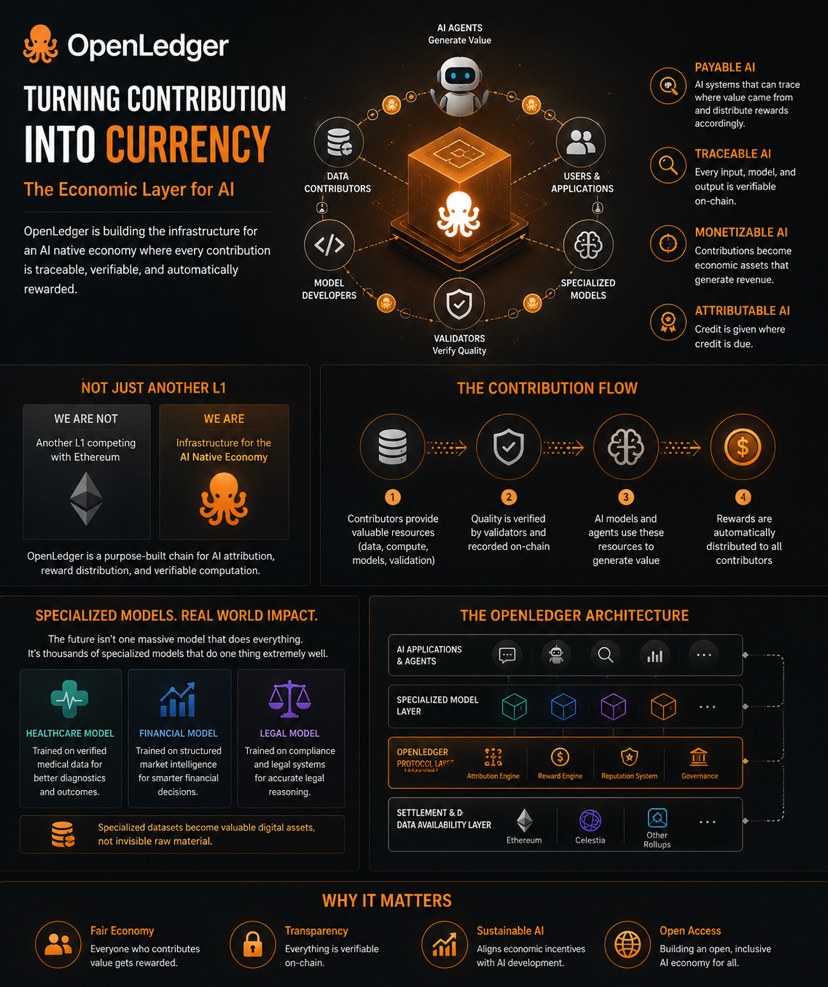
That is the mechanism designed to track how datasets and contributors influence AI outputs.
Instead of AI training becoming a giant invisible soup of internet data, the system attempts to measure contribution itself.
Who provided useful data?
Which dataset improved performance?
Which model refinement created value?
That attribution layer is what enables rewards.
Without attribution, Payable AI cannot really exist.
And I think this becomes more important as AI grows because lawsuits and debates around training data are already increasing everywhere.
OpenLedger is basically betting that transparent attribution eventually becomes infrastructure, not an optional feature.
Another interesting concept is Datanets.
Instead of relying on random internet scale information, OpenLedger organizes domain specific datasets into structured ecosystems.The goal is simple:
better AI performance and better economic traceability at the same time.
That combination is what makes the model interesting to me.They are also building around deployment efficiency through something called OpenLoRA, which focuses on making specialized AI models cheaper and easier to scale.
That matters because AI infrastructure is not only about intelligence anymore.
Cost efficiency is becoming just as important.The token itself is where the economic layer comes together.
Unlike many AI tokens that feel disconnected from the actual product, the utility here is fairly understandable.
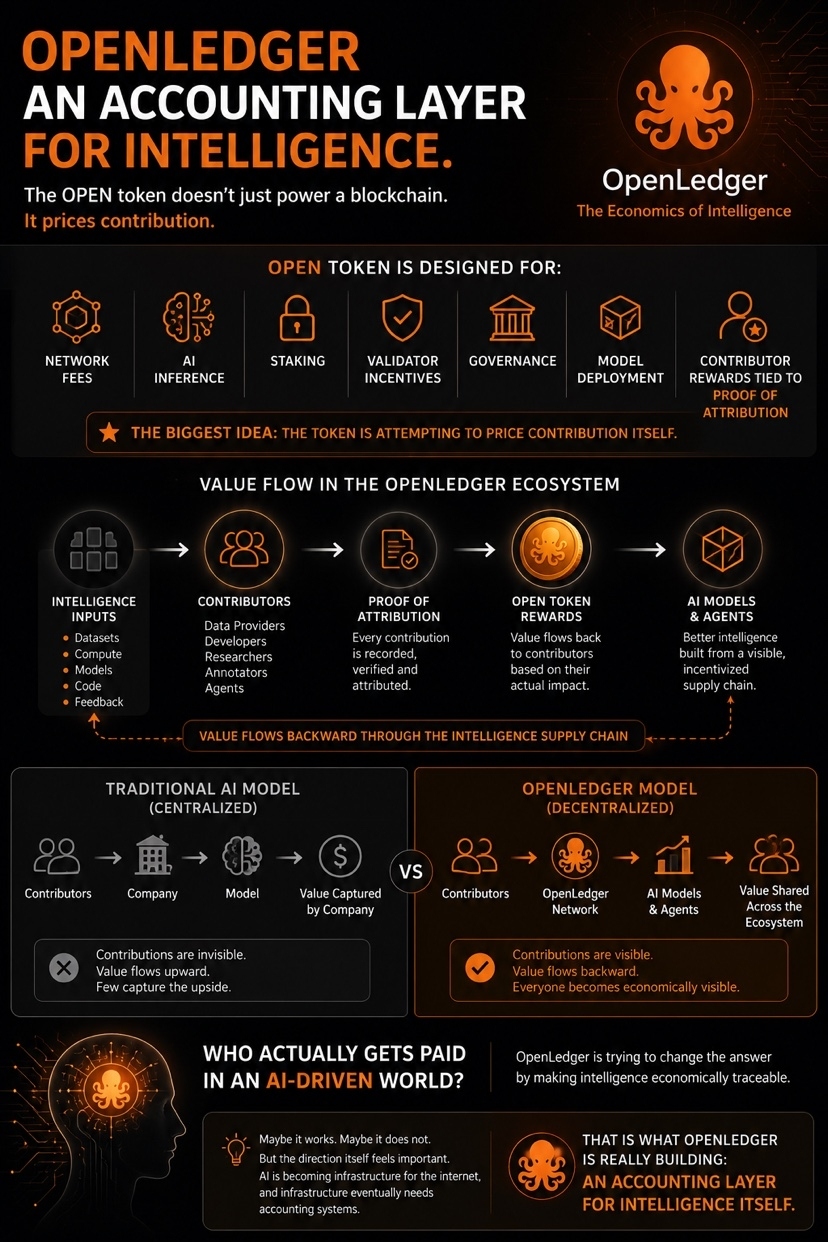
The OPEN token is designed for:network fees,AI inference, staking, validator incentives, governance, model deployment, and contributor rewards tied to Proof of Attribution.
That last part is probably the biggest idea behind the entire ecosystem.
The token is not just securing a blockchain.
It is attempting to price contribution itself.
And that creates a very different economic structure from traditional AI companies where almost all value flows toward centralized model owners.
OpenLedger wants value to flow backward through the intelligence supply chain.
Datasets.
Validators.
Developers.
Contributors.
Agents.
Everyone becomes economically visible.
The more I think about OpenLedger, the less I see it as a typical crypto project and the more I see it as an attempt to answer a difficult question:
Who actually gets paid in an AI driven world?
Right now the answer is mostly the companies controlling the models.
OpenLedger is trying to change that by making intelligence economically traceable.
Maybe it works.
Maybe it does not.
But the direction itself feels important because AI is slowly becoming infrastructure for the internet, and infrastructure eventually needs accounting systems.
That seems to be what OpenLedger is really building.
An accounting layer for intelligence itself.
