
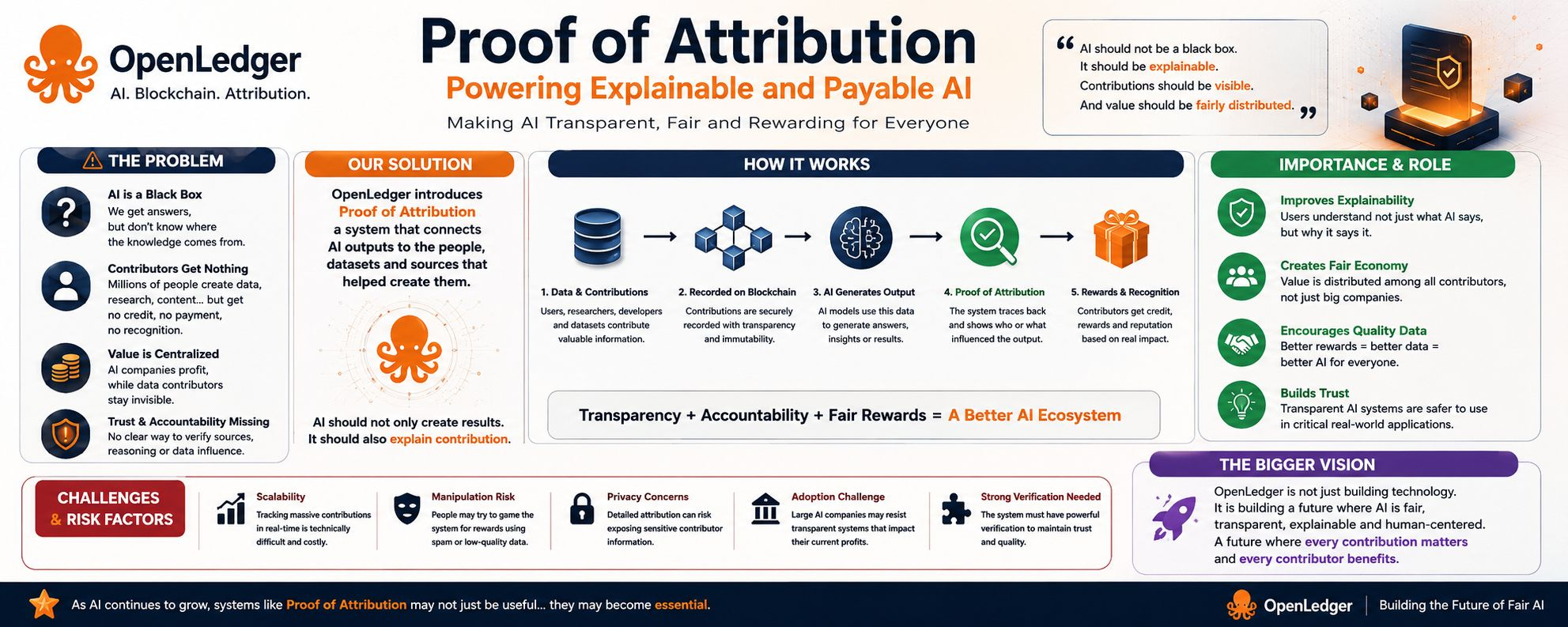

Recently I spent time reading the research paper from OpenLedger called “Proof of Attribution: Powering Explainable and Payable AI.”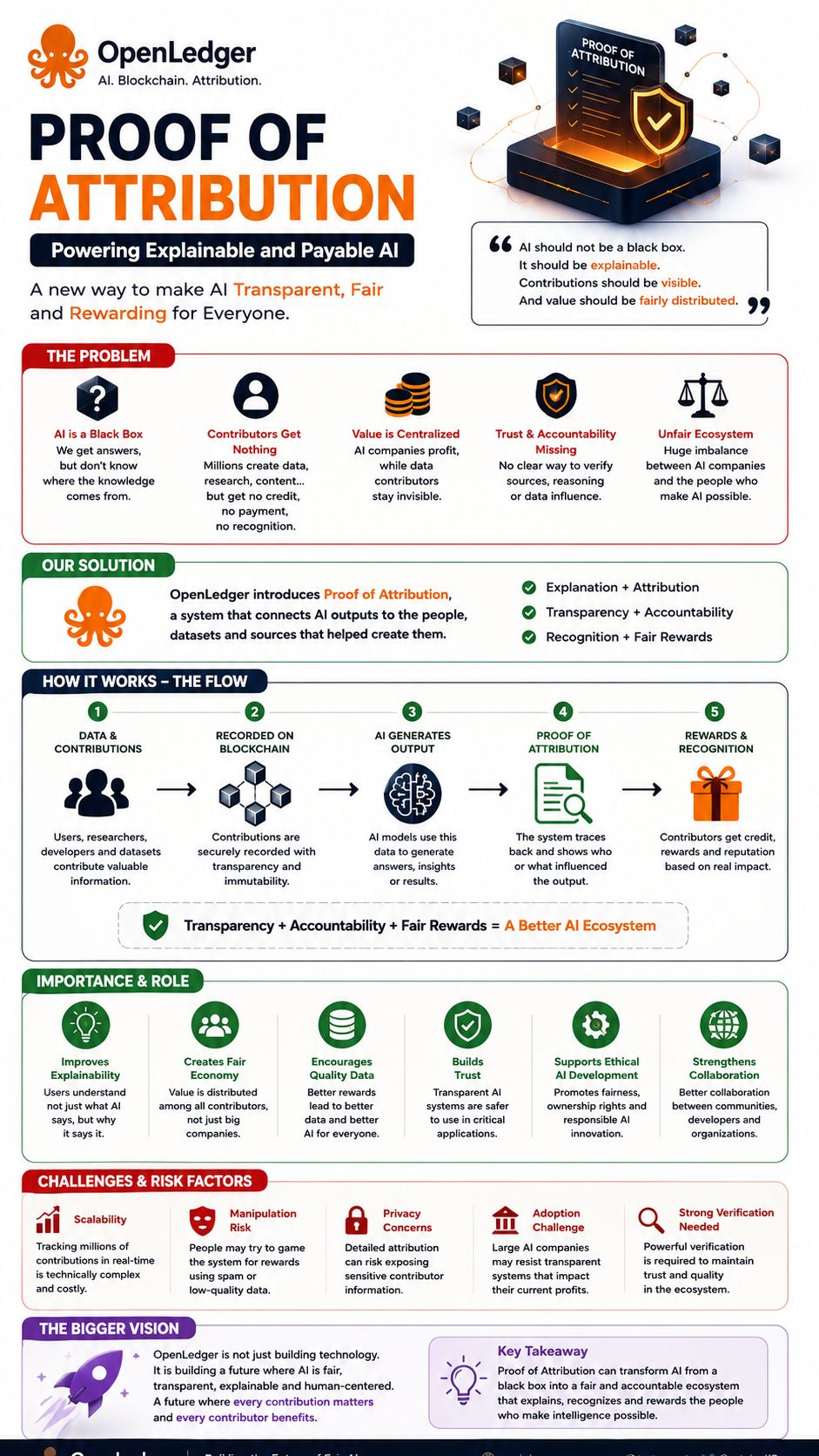
At first I expected it to be another complicated AI document filled with technical blockchain language.
But after reading it carefully, the main idea actually felt very practical and important.
The whole concept focuses on one simple question.
When AI generates something useful… who should get credit for it?
Right now most AI systems work like a black box.
We ask something.
The AI gives an answer.
But we never really know where the knowledge came from.
Millions of articles, datasets, conversations, research papers, and public information are used while training AI models.
Still, the original contributors usually get nothing back.
No visibility.
No payment.
No attribution.
That is exactly the problem @OpenLedger is trying to solve.
The idea behind “Proof of Attribution” is creating a system where AI outputs can be connected back to the people or data sources that helped generate them.
Basically… AI should not only create results.
It should also explain contribution.
And honestly, this idea makes a lot of sense.
Because today AI companies are becoming more powerful every single year.
But the people whose data helped build those systems are mostly invisible.
OpenLedger wants to change that structure.
While reading the paper, one thing that stood out to me was how they combine AI with blockchain technology in a different way.
Usually people only connect blockchain with crypto trading or tokens.
But here blockchain is being used for verification and transparency.
The system tries to record contributions in a traceable way.
So instead of guessing who helped improve an AI model… there is supposed to be proof attached to it.
That proof can potentially create accountability.
And also fair rewards.
For example, if someone contributes high-quality data that improves AI responses, the system could recognize that contribution.
That contributor may receive incentives, rewards, or reputation based on impact.
This creates a much more balanced ecosystem compared to traditional AI systems today.
Another thing I found interesting was the explainability factor.
Most AI tools today generate outputs without showing reasoning clearly.
People trust answers without understanding how the answer was formed.
That becomes risky in areas like healthcare, finance, research, or education.
Because if AI gives incorrect information, tracing the source becomes difficult.
OpenLedger’s approach tries to reduce that problem by improving transparency.
The paper also talks about creating a “payable AI” ecosystem.
Meaning value inside AI systems should not remain centralized only around large companies.
Instead, contributors across the network should also benefit economically.
Personally, I think this is one of the strongest parts of the idea.
Because AI today depends heavily on collective human knowledge.
Without human-generated data, AI models would not become intelligent in the first place.
So creating systems that reward contribution feels fair.
At the same time, I also noticed some challenges and risk factors while understanding the project.
The first challenge is scalability.
Modern AI systems process enormous amounts of data every second.
Tracking every contribution accurately could become technically difficult.
And maybe expensive too.
Another possible issue is manipulation.
If rewards become connected with attribution, some people might try to exploit the system using spam or low-quality contributions.
That means verification systems will need to be extremely strong.
Privacy is another important concern.
If attribution becomes too detailed, sensitive contributor information could accidentally become exposed.
So balancing transparency and privacy will be very important for projects like this.
There is also the question of adoption.
Even if the technology works properly, large centralized AI companies may not fully support transparent attribution systems.
Because the current model already benefits them financially.
So OpenLedger is not only facing a technical challenge.
It is also facing an ecosystem challenge.
Still… I think the bigger vision behind this project is genuinely important.
The AI industry is moving extremely fast right now.
But conversations about fairness, ownership, accountability, and contributor rights are still very limited.
Most discussions only focus on making AI smarter.
Very few projects are trying to make AI more fair.
That is why OpenLedger’s “Proof of Attribution” concept feels different.
It pushes the conversation beyond performance.
It asks deeper questions about trust and value distribution.
After reading the paper completely, I personally feel this idea has strong long-term potential if executed correctly.
Maybe it will take years before systems like this become mainstream.
Maybe the model will evolve in different ways.
But the core problem it highlights is real.
As AI keeps growing, people will eventually demand more transparency about where intelligence comes from and who deserves credit for it.
And in many ways… OpenLedger is already trying to build that future now.
