
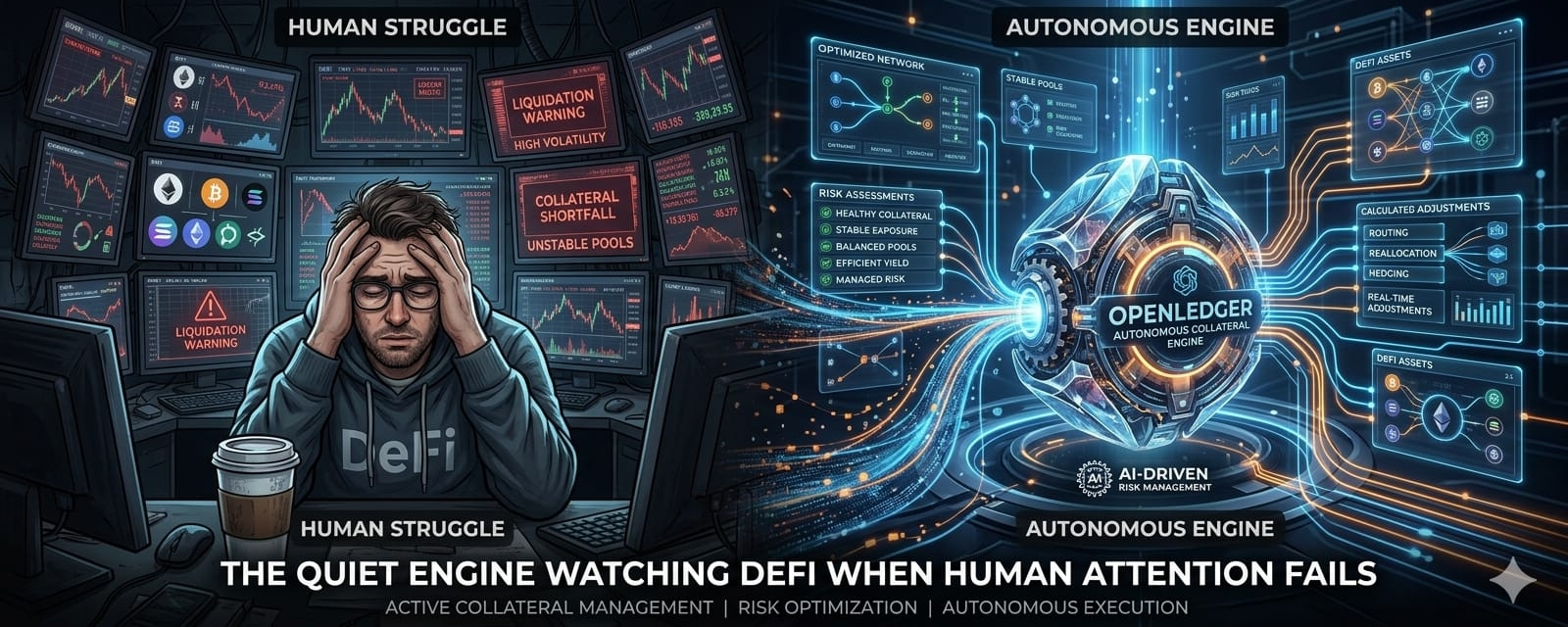
I was sitting with a half-cold cup of coffee, switching between DeFi dashboards, when the whole thing started to feel less like strategy and more like survival. Every protocol had its own rhythm. Every pool was moving differently. Collateral levels changed, borrow utilization shifted, funding rates moved, liquidity depth expanded and dried up without warning. It felt like watching several machines run at once, each one demanding attention, each one capable of causing damage if ignored for too long. I kept thinking that in DeFi, even a small delay can turn into a costly mistake. One missed signal, one liquidation threshold ignored, one pool losing depth faster than expected, and suddenly the position you thought was stable starts looking fragile.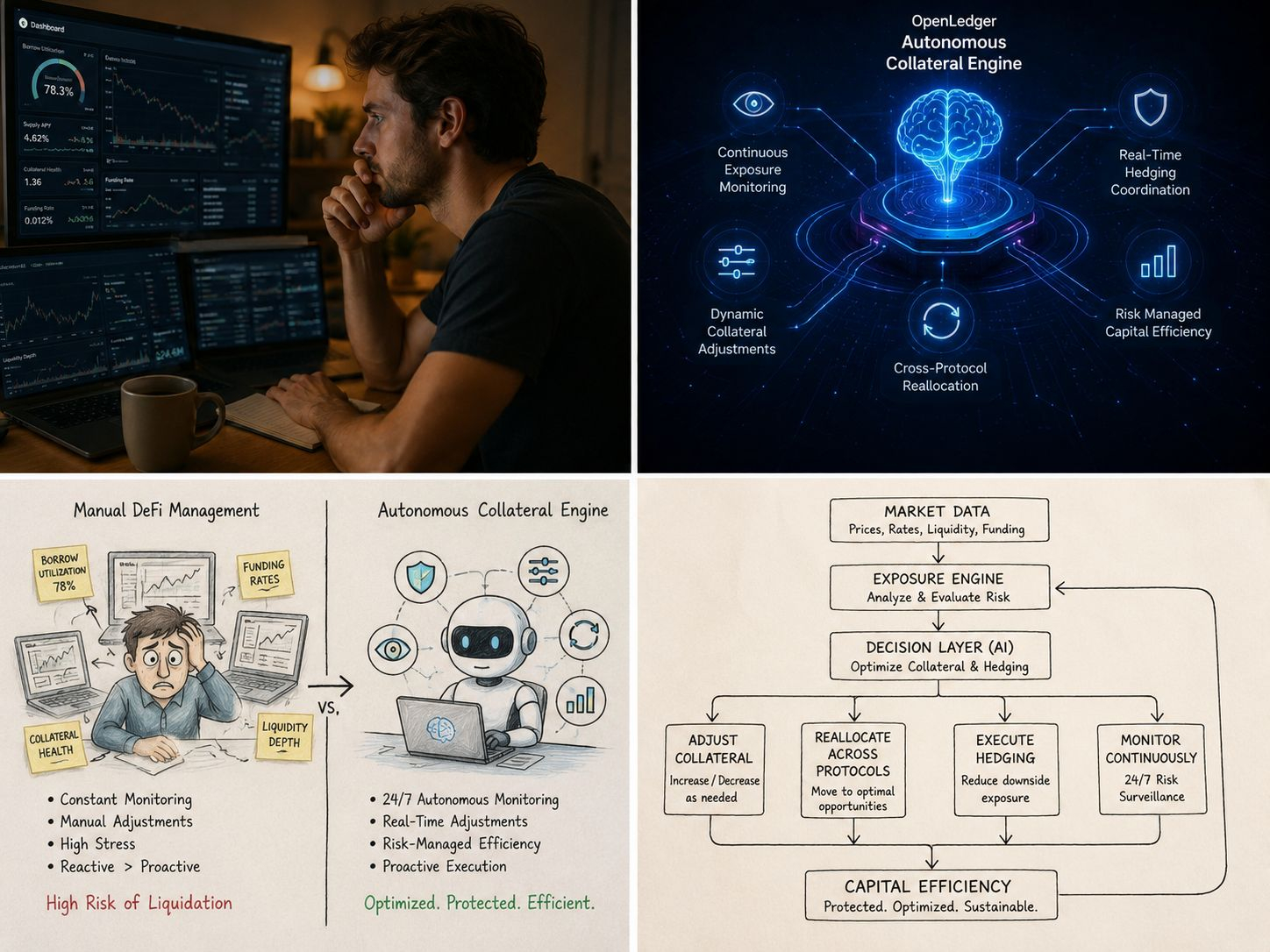
That is where OpenLedger’s Autonomous Collateral Engine becomes interesting to me. Not because it sounds futuristic, but because it deals with the most exhausting part of DeFi: constant monitoring. It does not depend on human patience or mood. It does not wait until I remember to check a dashboard. It keeps watching exposure, borrowing pressure, liquidation levels, funding movements, liquidity depth, and yield differences in the background. The idea is simple, but powerful: instead of leaving capital exposed while a user tries to manually follow every moving part, the system keeps adjusting, reallocating, and managing risk as conditions change. There is something strangely comforting about that, even if it also feels a little uncomfortable.
I still remember the stress of manually rebalancing a lending position. At the time, I thought I had everything under control. But some of my capital was sitting underused, while other positions were moving too close to dangerous liquidation zones. I was checking numbers again and again, trying to decide whether to move collateral, reduce exposure, or wait. That kind of decision-making sounds easy from the outside, but when markets are moving and every protocol has different conditions, it becomes mentally heavy. With an autonomous collateral system, that pressure changes. The engine reads the data, calculates risk, and acts without needing emotional confirmation from me. It does not panic, hesitate, or chase the highest yield just because it looks attractive for a moment.
What makes this more serious is the execution layer behind it. DeFi is fragmented by nature. Liquidity is spread across different protocols, chains, pools, and collateral types. A human can understand the broad picture, but following every route in real time is another matter. OpenLedger’s system feels like a kind of silent traffic controller for capital, watching where risk is forming and where movement is needed. If one pool starts weakening, if exposure becomes unhealthy, if liquidity depth changes, the engine can respond through routing, collateral reallocation, hedging coordination, and exposure adjustment. It is not glamorous work, but it is exactly the kind of work that matters when conditions turn messy.
The more I think about it, the more I realize this changes the way yield should be viewed. For a long time, DeFi conversations were obsessed with APY. The biggest number always grabbed attention. But high APY means very little if the position is exposed, inefficient, or one market swing away from trouble. What matters more is whether capital is working intelligently without becoming reckless. That is where this type of engine becomes valuable. It is not only searching for return. It is trying to keep exposure balanced, collateral productive, and risk within acceptable boundaries. That approach feels less exciting than chasing aggressive yields, but it is probably far more sustainable.
There is also a strange emotional side to handing responsibility to an AI-driven system. On one hand, it is freeing. I do not have to sit there constantly refreshing dashboards or second-guessing every movement. On the other hand, it creates distance between me and the decisions being made. I want to know why every move happened. I want to feel in control. But the truth is that DeFi has already become too fast and too fragmented for full manual control to feel realistic. At some point, trusting a system does not mean becoming careless. It means accepting that some forms of precision are better handled by infrastructure than by human attention.
Still, I would not call this blind trust. No autonomous engine is perfect. Markets can behave in ways models do not fully expect. Liquidity can disappear suddenly. Cross-chain conditions can become unstable. There will always be edge cases where human judgment, timing, or even instinct matters. But for the daily pressure of managing positions across DeFi, a system that constantly watches, adjusts, and manages risk can remove a huge amount of operational stress. It does not replace responsibility completely, but it changes where that responsibility sits. Instead of manually reacting to every small signal, the user can focus on understanding the broader picture.
What I respect most is the discipline such a system can create. Capital does not sit idle without reason. Risk is not ignored just because the market feels calm. Liquidation thresholds are treated seriously. Yield opportunities are considered, but not worshipped. There is a quiet honesty in that kind of design. It does not need to make loud promises or sell a fantasy of effortless profit. It simply keeps working in the background, making small adjustments that may prevent much bigger problems later. In DeFi, the most important systems are often the ones nobody notices until they fail.
That is why OpenLedger’s Autonomous Collateral Engine feels less like a flashy product and more like a necessary layer for a market that has become too complex for human attention alone. I still watch it with some caution. I still want to understand what is happening under the surface. But I also know that manually managing every position across multiple DeFi environments is not realistic for me anymore. The space moves too quickly, the risks overlap too easily, and the cost of missing something can be too high. So I watch, I learn, and I let the engine handle the parts I cannot reliably manage myself.
Maybe that is the real shift. The future of DeFi may not be about who finds the highest yield first. It may be about who can keep capital alive, efficient, and protected long enough to survive the noise. A quiet engine that monitors risk, reallocates collateral, and keeps exposure under control may not sound dramatic, but in a market full of chaos, that kind of steady intelligence matters. It makes me feel slightly powerless, but also strangely relieved. And in DeFi, relief is not a small thing.