
I’ve been spending more time lately watching how AI and crypto are starting to overlap in ways that feel less theoretical and more operational. Not in the usual cycle-driven way where every new narrative suddenly becomes “the future” for three months before liquidity disappears. Something else is happening underneath the noise now. Slower. More structural.
And honestly, that changes everything.
A few years ago, most AI discussions inside crypto felt cosmetic. Chatbots attached to tokens. “AI-powered” dashboards with no real infrastructure behind them. Markets rewarded branding more than execution. But eventually every speculative cycle runs into the same wall: systems either produce real coordination value, or they fade once attention moves elsewhere.
That’s why projects like OpenLedger started catching my attention. Not because the branding sounds futuristic. Crypto has never lacked futuristic branding. What matters is whether the architecture actually aligns with where digital systems are heading.
And the deeper I looked into the Octoclaw launch, the more it felt less like another product release and more like a glimpse into what AI infrastructure may actually become over the next decade.
Not overnight. Not cleanly. Probably not without failures.
But the direction itself feels increasingly difficult to ignore.
For a long time, AI systems were mostly passive. You asked questions. They responded. The relationship was linear. Human prompts in, machine outputs out. Useful, impressive even, but still fundamentally reactive.
Now that model is starting to evolve into something far more autonomous.
Agents are beginning to move beyond assistance into execution.
That distinction matters more than most people realize.
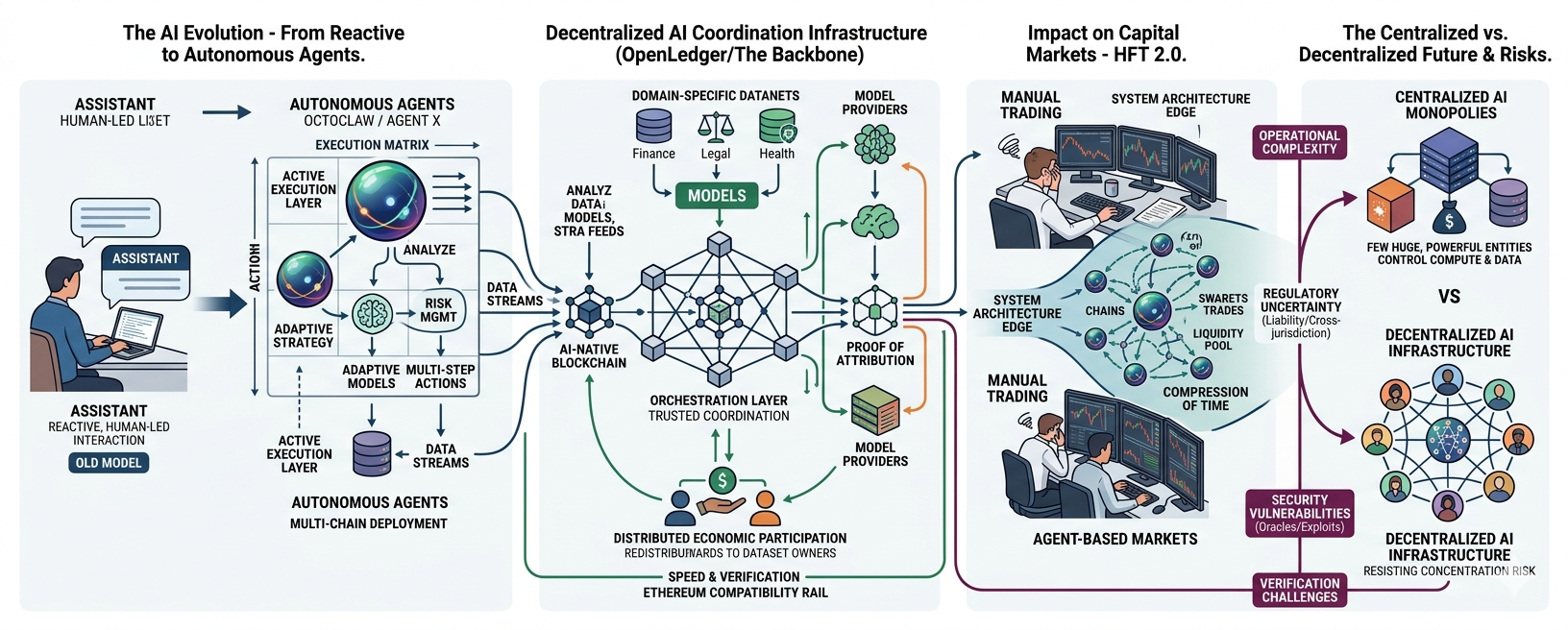
An assistant helps you analyze a trade. An autonomous agent executes one across multiple chains while monitoring liquidity conditions, adjusting strategy parameters, managing risk exposure, and reallocating capital dynamically based on incoming data streams.
Those are completely different worlds.
And that’s where things get interesting.
Because once AI agents begin interacting with markets, protocols, APIs, smart contracts, datasets, and each other autonomously, the bottleneck shifts away from intelligence alone. The real challenge becomes coordination infrastructure.
Speed. Execution. Verification. Attribution. Trust.
The infrastructure layer is the part most people ignore.
Everyone talks about the models because models are visible. Infrastructure is quieter. Less exciting on the surface. But infrastructure is usually where durable value accumulates over time because every higher-level system eventually depends on it.
That seems to be the broader thesis behind OpenLedger’s positioning as an AI blockchain rather than simply another AI token trying to capture narrative momentum.
The Octoclaw launch feels important in that context because it pushes the conversation toward orchestration instead of isolated intelligence. The market is gradually realizing that future AI systems probably won’t exist as single monolithic entities. They’ll exist as networks of agents coordinating tasks, accessing datasets, triggering transactions, negotiating execution pathways, and interacting across fragmented digital environments.
Especially in crypto.
Crypto markets already operate twenty-four hours a day across dozens of chains, protocols, bridges, liquidity layers, and data sources. Humans can monitor pieces of it, but not all of it simultaneously with precision. Autonomous systems can.
That creates a strange new dynamic where the edge slowly shifts away from raw human reaction speed toward system architecture itself.
Manual trading starts looking increasingly inefficient compared to adaptive execution frameworks.
Not immediately. But gradually.
You can already feel the transition beginning.
The trader sitting in front of six monitors manually rotating between narratives may eventually be competing against AI systems coordinating across chains in milliseconds while continuously retraining on fresh data environments.
That sounds dramatic until you realize most modern markets already reward infrastructure over intuition.
High-frequency firms understood this years ago. The fastest systems usually win. Not because they predict the future perfectly, but because execution efficiency compounds over time.
Now apply that logic to AI-native coordination systems.
That’s where OpenLedger’s infrastructure thesis becomes harder to dismiss.
Still, this is where the real question starts.
Because building autonomous systems is one thing. Building trustworthy autonomous systems is another entirely.
Crypto already struggles with smart contract exploits, bridge failures, governance attacks, oracle manipulation, and fragmented liquidity risks. Adding autonomous AI execution layers on top of that introduces entirely new categories of uncertainty.
What happens when an AI agent executes flawed logic at scale?
Who becomes accountable?
What happens if training data itself becomes corrupted or manipulated?
How do you verify attribution across decentralized AI systems where multiple contributors provide datasets, models, optimizations, or computational resources?
These questions are not theoretical anymore.
They’re infrastructure questions.
And infrastructure questions determine survivability.
That’s partly why concepts like Proof of Attribution become increasingly important inside decentralized AI ecosystems. If AI eventually becomes an economic layer generating value autonomously, then ownership structures around data contributions, model development, and execution outcomes become critical.
Right now, most AI economies are deeply centralized.
A handful of companies control the models. Control the compute. Control the datasets. Control the monetization layers.
Users contribute value constantly through interactions and behavioral data, yet ownership remains concentrated.
Decentralized AI infrastructure attempts to challenge that structure by redistributing participation itself. The idea that datasets, models, and contributors can receive attribution-based economic participation changes the architecture of incentives completely.
At least in theory.
Whether that theory survives real-world scaling pressure is another story.
Because decentralized systems often sound elegant before colliding with operational complexity.
And operational complexity destroys many projects.
I’ve watched enough crypto cycles to know that vision alone means very little. Most projects fail somewhere between whitepaper ambition and real-world execution. Coordination is difficult. Incentives drift. Liquidity disappears. Teams overpromise. Infrastructure breaks under pressure.
AI infrastructure may become even harder because it combines two already difficult industries into one system.
Blockchain scaling is hard. AI scaling is hard. Combining both creates exponential complexity.
That’s why I remain cautious even while finding the broader direction compelling.
Still, OpenLedger seems to understand something many projects miss: the future AI economy probably depends less on isolated consumer apps and more on invisible coordination layers operating underneath everything else.
Datanets are a good example of this shift.
Specialized domain-specific AI models are likely far more valuable than generic intelligence in many enterprise environments. Healthcare data behaves differently from financial data. Legal systems require different contextual frameworks than gaming economies or logistics networks.
General intelligence sounds impressive, but specialized execution usually creates actual business value.
So the idea of decentralized datanets feeding domain-specific models starts making strategic sense. Not because decentralization itself magically solves problems, but because fragmented expertise and proprietary datasets already exist everywhere.
The challenge is coordination and incentive alignment.
Again, infrastructure.
And Ethereum compatibility matters more here than people may initially think. AI systems won’t operate in isolation. Interoperability with existing ecosystems determines whether new infrastructure becomes composable or irrelevant. Crypto history repeatedly shows that ecosystems survive through integration, not isolation.
If autonomous agents eventually become economic actors interacting with DeFi protocols, enterprise systems, payment layers, marketplaces, and governance structures, they need compatibility with existing financial rails.
Otherwise adoption friction becomes fatal.
Enterprise adoption itself remains another massive uncertainty.
People inside crypto often underestimate how slowly institutions move when operational risk enters the equation. Enterprises care about compliance, liability exposure, auditability, security guarantees, and predictable execution environments far more than narrative momentum.
That creates tension.
AI wants speed. Institutions want control. Crypto wants openness.
Balancing those forces will not be simple.
Especially once regulators become more aggressive around autonomous financial systems.
Because regulation around AI alone remains unclear. Regulation around crypto remains fragmented globally. Combining both creates an entirely new category policymakers barely understand yet.
What happens when autonomous agents begin executing financial activity independently across jurisdictions?
What qualifies as liability? Who owns responsibility? Who gets regulated?
The protocol? The developer? The user? The model itself?
Nobody really has clean answers yet.
And honestly, markets are probably underestimating how messy this phase could become.
But despite all the uncertainty, I still keep returning to the same thought.
Decentralized AI infrastructure may become inevitable precisely because centralized AI systems become too powerful.
That’s the paradox.
As AI capabilities increase, concentration risk increases with them. The more valuable intelligence systems become, the more dangerous centralized ownership structures start looking economically and politically.
History tends to resist permanent concentration eventually.
Not always immediately. Not cleanly. But structurally.
That creates a long-term opening for decentralized coordination systems even if the path there becomes chaotic.
And this is where OpenLedger becomes more interesting to me than many surface-level AI narratives floating through crypto right now.
It doesn’t seem entirely focused on selling AI as spectacle.
The deeper thesis appears to revolve around coordination infrastructure itself. Attribution systems. Agent execution layers. Data monetization frameworks. Economic participation around intelligence production.
That’s a very different category from simply attaching a token to a chatbot interface and hoping speculation carries it forward.
Whether OpenLedger actually succeeds is impossible to know right now.
Execution risk remains enormous.
Security failures alone could destroy confidence instantly. Autonomous systems interacting with financial infrastructure create attack surfaces the industry probably hasn’t fully modeled yet. Even technically successful systems may struggle with adoption, governance complexity, or regulatory pressure.
And markets are ruthless toward unfinished infrastructure.
But the broader direction still feels real.
AI agents are becoming more autonomous. Execution speed is becoming the edge. Data is becoming economic infrastructure. Attribution is becoming politically important. Coordination layers are becoming more valuable than interfaces.
That trend seems increasingly visible no matter which way markets move short term.
Maybe that’s ultimately why the Octoclaw launch stands out to me.
Not because it guarantees success.
But because it reflects where the industry may quietly be heading underneath all the speculation.
Toward systems where autonomous agents interact economically. Toward infrastructure that coordinates intelligence instead of simply displaying it. Toward markets where strategy design matters more than manual execution. Toward decentralized participation models attempting to compete against centralized AI monopolies.
A lot of these experiments will fail.
Some probably deserve to.
But every major technological transition starts with infrastructure that initially looks premature before eventually becoming necessary.
And right now, decentralized AI infrastructure still feels premature.
Which is exactly why it might matter later.