Most people looking at decentralized AI are staring at the wrong problem.
They go straight for the flashy stuff. AI agents, chatbots, trading bots, dashboards that look like mission control. Tokens with “AI” slapped on them like that alone proves something is happening. And yeah, I get it — it looks like a new era.
But I’ve been thinking honestly… that’s not where the real pressure sits.
Not even close.
The hard part isn’t intelligence anymore.
It’s coordination.
And yeah, I know that sounds almost disappointing. No hype. No sci-fi glow. Just coordination. But that’s exactly where systems fall apart. Quietly. Expensively. Without warning.
That’s why OpenLedger actually got my attention.
Not the AI branding. Let’s be real, everyone’s got that now.
It’s what sits underneath that matters. The messy plumbing layer nobody tweets about because it doesn’t fit into a neat narrative.
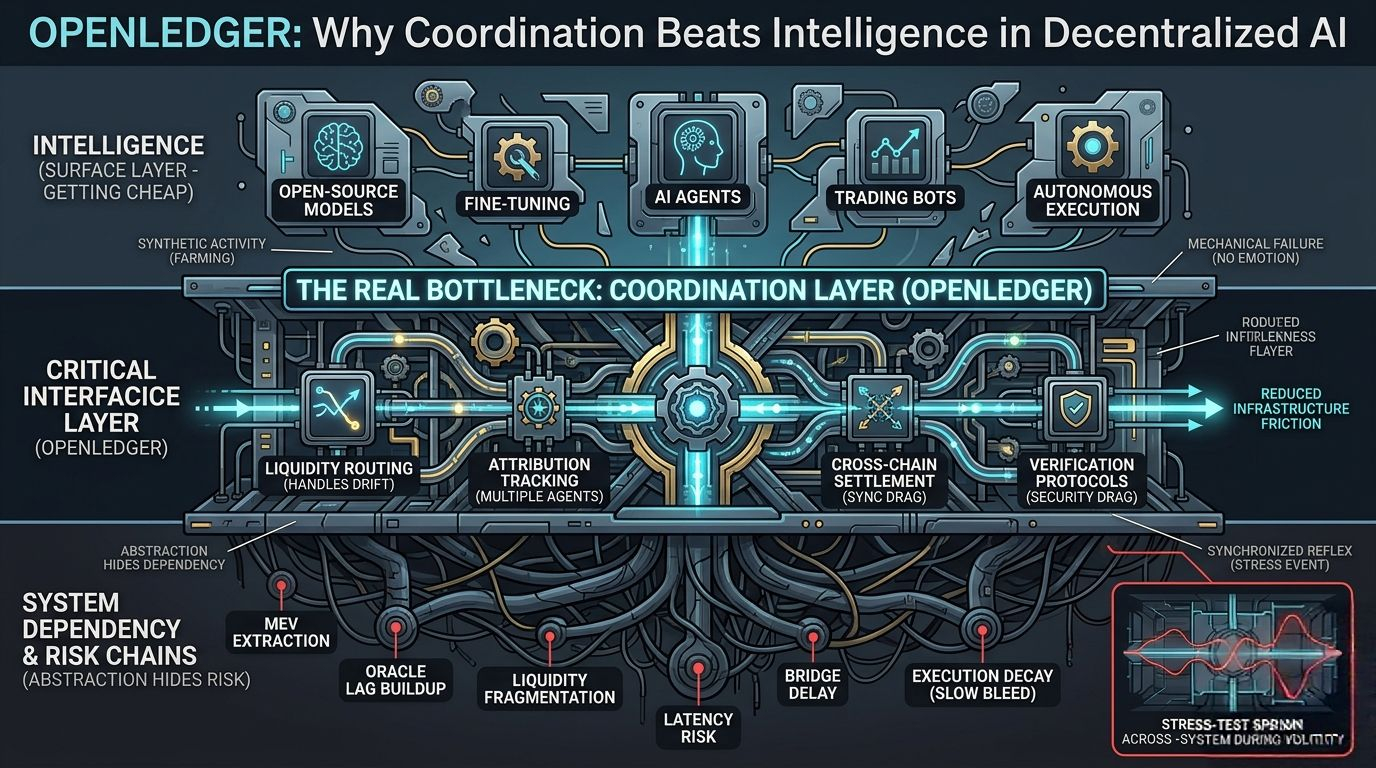
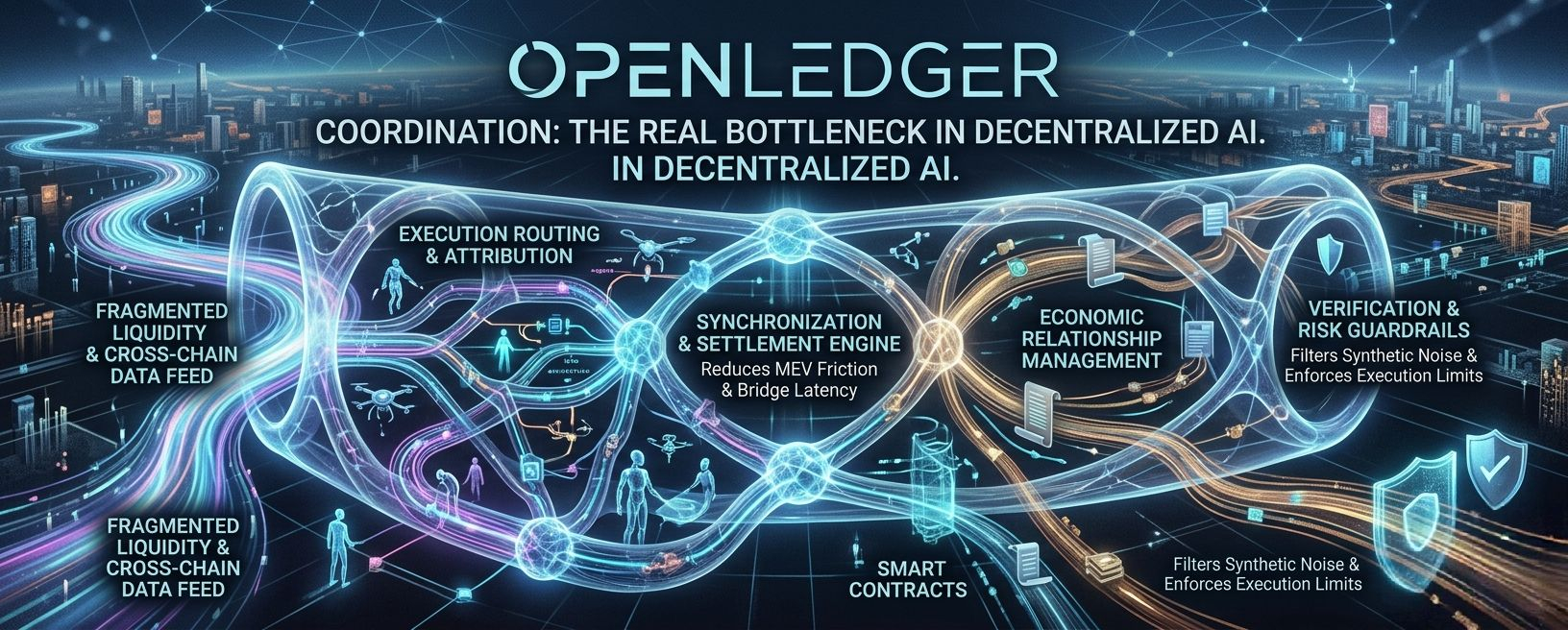
Who routes liquidity when everything starts slipping? Who handles attribution when five agents touch the same trade path? Who eats the loss when execution drifts mid-route? Who fixes settlement when chains don’t agree on timing?
That’s the real system.
And here’s the thing — people still underestimate how brutal infrastructure friction gets in crypto.
Everyone talks about volatility like it’s the main risk. Price swings. Charts. Candles.
Fine.
But I’ve seen traders lose more money from execution decay than from bad calls.
No joke.
Bridges lag. MEV eats your edge. Liquidity fragments across pools. Oracles lag behind reality. Settlement drifts just enough to matter.
It doesn’t look dramatic. That’s the problem.
You still see a filled trade and think you’re fine. Then later you realize the fill slipped, timing got worse, arbitrage closed early, and your capital just sat there while the market moved without you.
It’s slow bleeding. You don’t feel it happening.
And nobody talks about it enough because you can’t screenshot it.
Now here’s where things get tricky.
Once autonomous agents start executing instead of humans clicking buttons, all those “small inefficiencies” stop being small.
They become constant.
Humans hesitate. We slow down. We second-guess.
Agents don’t.
An AI agent just runs the logic. That’s it. No nerves. No doubt. No “this feels weird right now.”
Sounds great… until the system underneath starts breaking while execution keeps going full speed.
That’s where it gets ugly.
Because decentralized systems already struggle with synchronization under stress. Now stack autonomous execution on top of fragmented liquidity across multiple chains… and suddenly latency turns into real money risk.
And I think OpenLedger sits right in that tension.
Not just “AI agents.” That’s surface-level.
The real question is sharper:
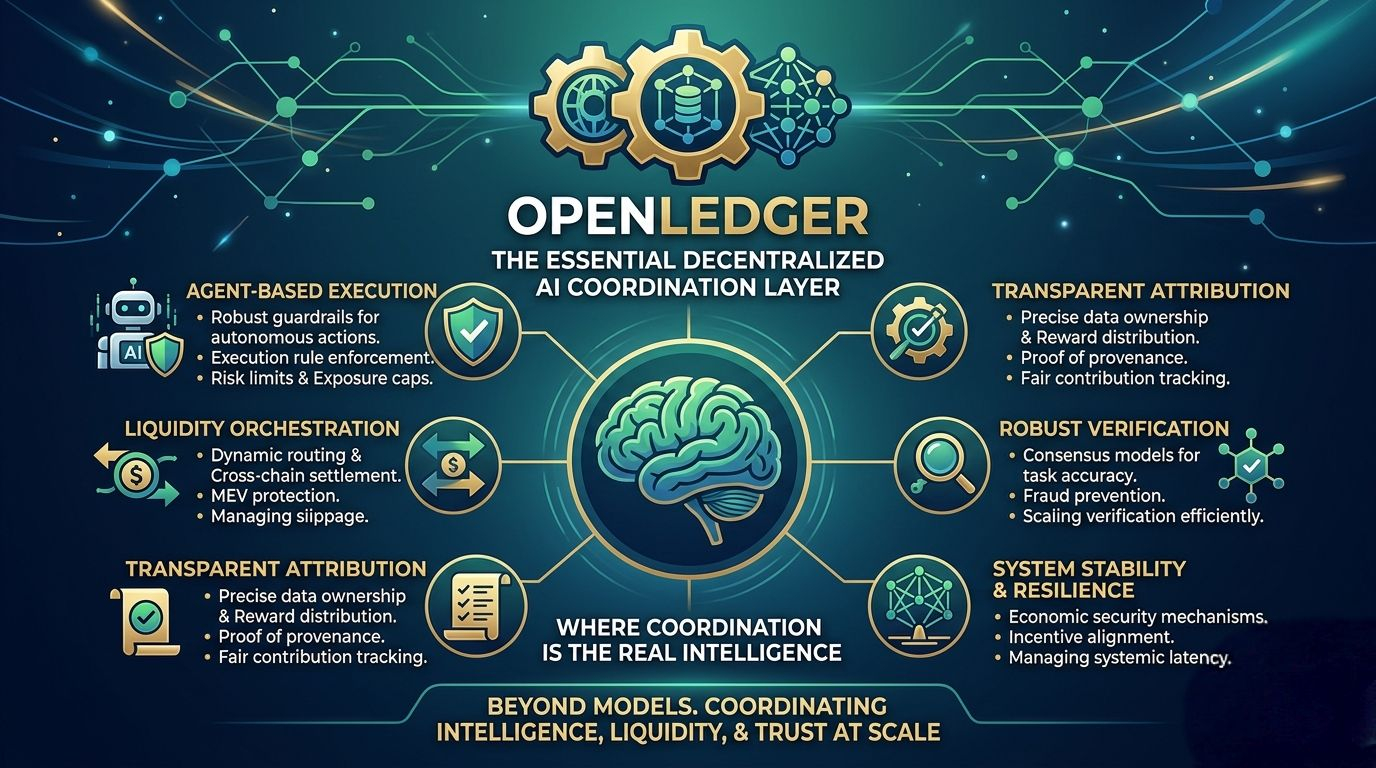
Can decentralized systems actually coordinate intelligence, liquidity, attribution, execution, and verification without falling apart under complexity?
That’s not a marketing question. That’s an engineering stress test.
And look, here’s a shift most people still haven’t fully internalized.
AI itself is getting cheap.
Open-source models keep improving. Fine-tuning doesn’t feel special anymore. Compute spreads out. Inference stacks modularize.
So intelligence? Honestly, I don’t think it stays scarce for long.
Coordination probably does.
That’s where the real scarcity moves.
And OpenLedger, at least from where I stand, leans closer to that coordination layer than most projects admit. It’s not about “who owns the smartest model.”
That framing already feels outdated.
It’s about who manages the economic relationships around intelligence.
Different game entirely.
And I’ve seen this pattern before.
First, information becomes the bottleneck. Then infrastructure. Then coordination quietly becomes the real power layer.
Same cycle. New tech.
Look, the winners usually don’t scream the loudest. They just remove friction while everyone else argues online.
Markets eventually reward that.
Now here’s the uncomfortable part.
The smoother a system gets, the less people see underneath it.
And that’s not always good.
People assume abstraction equals safety or progress. Sometimes it just hides risk better.
If OpenLedger actually works at scale, most users won’t see:
where liquidity sits
which chain carries settlement risk
which oracle feeds pricing
where latency starts
which bridge caused delay
who extracted MEV during execution
which verifier failed when things broke
Everything feels clean… until volatility hits and the system gets stress-tested.
Then everyone suddenly cares about the invisible layers they ignored.
I’ve seen this before in traditional markets too. Systems get abstracted for usability. Fine. But abstraction hides dependency chains. Those chains turn into hidden leverage. Hidden leverage turns into fragility.
Then liquidity vanishes and everyone acts surprised.
Crypto keeps repeating that cycle.
And yeah, autonomous agents could make it worse.
Picture a stress event.
Oracle lag builds. Gas spikes. One bridge slows down. Liquidity shifts unevenly. MEV bots get aggressive. Settlement queues stack across chains.
Humans slow down there. Naturally.
Agents might not.
And that’s the uncomfortable part.
Because an autonomous system can keep executing exactly as designed while reality underneath already shifts. And if thousands of agents do the same thing… you don’t get independence anymore.
You get synchronized reflex.
That can spiral fast.
And I’ll be honest, most AI x DeFi projects don’t really solve that. Not even close.
Then there’s something else people barely talk about: synthetic activity.
Every incentive system gets gamed. Always.
If OpenLedger rewards data, attribution, coordination — people will farm it. Of course they will. It’s crypto. We’ve all watched this movie before.
You’ll get synthetic datasets. AI-generated noise loops. Attribution farming. Engagement spam tuned perfectly for rewards. Low-quality outputs designed only to extract value.
Filtering that at scale? That’s not hard. That’s brutal.
Especially when AI agents start generating data for other AI agents. Then the system starts looping in on itself.
And suddenly you’ve got a network that looks active… but the signal quietly collapses underneath.
High throughput doesn’t mean intelligence.
Sometimes it just means the incentive loop got too good at rewarding noise.
And here’s another thing people don’t like admitting: verification costs.
Everyone loves decentralization until they actually pay for it.
Every layer adds drag.
Consensus drag. Settlement drag. Sync drag. Attribution drag. Execution drag. Security drag.
At small scale, nobody notices. At scale, it compounds hard.
That’s why I don’t think OpenLedger’s real challenge sits in narrative. Narratives are easy in crypto.
The real challenge is whether coordination stays economically stable once incentives normalize.
Because eventually someone pays for all of it.
Who eats failed execution? Who subsidizes verification? Who handles cross-chain stress? Who absorbs latency risk when things break?
Those aren’t side questions. That is the system.
And traders are already shifting too.
Old DeFi edge was simple: move faster.
Now it’s changing.
The real edge looks like designing constraints instead of chasing speed.
You set boundaries.
Risk limits. Execution rules. Guardrails. Fallback logic. Exposure caps.
Then agents operate inside that box.
Clean idea. Almost elegant.
But here’s the catch.
Failure stops being emotional. It becomes mechanical.
A human panics and stops.
An agent just keeps going until something external shuts it down.
That difference matters more than people think.
Look, I’m not dismissing OpenLedger.
If anything, it gets more interesting when you stop treating it like another AI token and start treating it like an experiment in coordination economics.
That’s the real thesis.
Can decentralized systems coordinate intelligence, liquidity, attribution, execution, and verification without collapsing under their own weight?
Nobody really knows yet.
Centralized systems still win on coordination speed. They route faster. Recover faster. Verify faster.
Decentralized systems win on trust distribution.
But they spread friction everywhere.
So the real question stays simple:
Can OpenLedger reduce enough friction to matter… without breaking the reason decentralization exists in the first place?
I don’t think we’ve got that answer yet.
So yeah.
Still watching.
Still skeptical.
Still paying attention.