
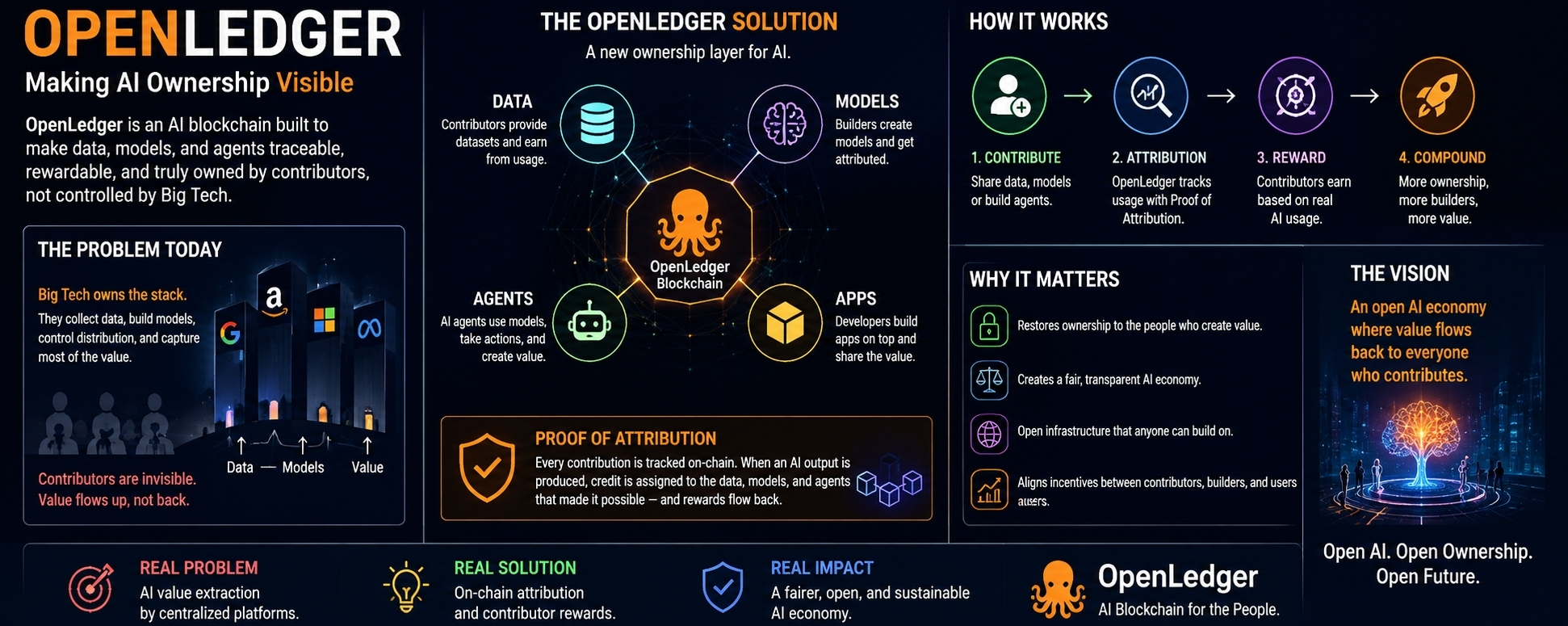
I keep looking at OpenLedger with curiosity, but not the easy kind. The project sits in that uncomfortable space where the idea makes sense before the market has proven it deserves trust. It talks about AI agents, data ownership, attribution, and open infrastructure at a time when everyone can feel how much of the AI world is being pulled into the hands of a few large companies. That makes OpenLedger interesting. It also makes it dangerous to judge too quickly, because crypto has a habit of turning real problems into clean narratives before the execution catches up.
What OpenLedger is trying to address is not small. AI is being built on data, models, user behavior, and invisible contributions from people who often never see the value they helped create. Big platforms collect the inputs, improve the systems, control the interfaces, and keep most of the economics. OpenLedger seems to be pushing against that pattern by trying to make contribution trackable and rewardable. The idea is simple on the surface: if data, models, apps, and agents create value, the people and systems behind them should not disappear.
But simple ideas become complicated once markets touch them.
The part I keep coming back to is attribution. It sounds clean when written as a concept. Someone contributes data. A model uses it. An agent acts on top of it. Value is created. Rewards flow back. That is the story. The reality is messier. AI outputs do not come from one clean source. They come from layers of training, prompts, retrieval, fine-tuning, context, model behavior, and decisions that are difficult to separate. OpenLedger has to turn that mess into something usable without making it easy to exploit.
That is where the project becomes interesting, and also where the risk begins.
Crypto systems do not just attract users. They attract optimizers. If OpenLedger creates rewards for data contribution, people will try to game the quality of data. If it rewards model usage, builders will try to shape activity around the reward structure. If agents become part of the system, some will be useful and others will simply create noise. The market does not wait politely for a protocol to mature. It pushes on weak points immediately.
Good theory does not survive bad incentives.
This is why I do not want to look at OpenLedger only as another AI crypto narrative. The narrative is the easy part. AI agents are easy to sell right now because users are tired. Crypto has become too fragmented, too fast, too demanding. People are expected to understand chains, wallets, bridges, permissions, dashboards, tokenomics, rewards, and risks all at once. An agent that can simplify decisions sounds useful. But useful in theory is not the same as safe in practice.
If an OpenLedger-based agent helps a user act, choose, trade, route, or access information, then the project is not just dealing with automation. It is dealing with responsibility. Who is accountable when the agent is wrong? Who checks the data behind the answer? Who verifies the model? Who benefits when the action succeeds? Who absorbs the cost when it fails?
Automation does not remove responsibility. It only moves it.
The strongest version of OpenLedger would not need to scream about AI. It would become useful quietly. Builders would use it because they need a better way to connect data, models, and agents. Contributors would care because their work has a clearer path to value. Users would benefit because the system reduces friction instead of adding another layer of things to understand. In that version, OpenLedger becomes infrastructure that people depend on without constantly talking about it.
The weaker version is easier to imagine because crypto has shown it many times. A strong idea becomes a token story. A token story becomes community language. Community language becomes belief before usage is real. Dashboards show activity, but the activity does not always mean demand. Agents move, but movement does not always mean intelligence. Rewards flow, but rewards do not always mean value was created.
Most systems sound clean before users arrive.
OpenLedger has to prove that its design can handle real behavior. Not pitch-deck behavior. Not demo behavior. Real market behavior. Builders chasing incentives. Users choosing convenience. Traders reducing everything into price. Contributors trying to maximize rewards. Agents acting quickly without always acting wisely. If the system cannot handle those pressures, then the project becomes another well-packaged idea inside a noisy cycle.
What makes OpenLedger worth watching is that it is aimed at a real problem. AI does have an ownership problem. Data does have an attribution problem. Agents will create accountability problems. Big Tech does have a distribution advantage that open systems struggle to match. None of that is imaginary. The question is whether OpenLedger can turn those problems into working infrastructure instead of just borrowing their importance.
That distinction matters.
A project can be early and still serious. It can also be early and already over-narrated. OpenLedger seems to live somewhere between those two states right now. The concept has weight, but the market will try to flatten it into a trade. The technology may take time, but attention will demand constant proof. The project may need patience, but crypto rarely rewards patience unless price gives people a reason to pretend they have it.
Execution is where narratives go to die.
The thing I want to see from OpenLedger is not louder messaging. I want to see whether the system can create useful behavior after the initial excitement fades. Do developers keep building when incentives are lower? Do contributors send quality data when rewards become harder to farm? Do agents solve real problems or just create more on-chain motion? Does attribution become practical, or does it stay as a concept people repeat because it sounds right?
These are not small questions. They are the project.
OpenLedger is trying to sit between AI and crypto at a time when both markets are full of noise. That gives it opportunity, but also exposes it to every weakness in both worlds. AI brings opacity, centralization, and automation risk. Crypto brings speculation, short attention spans, and incentive games. Combining them does not automatically solve either side. Sometimes it just makes the failure modes faster.
Still, I do not think OpenLedger should be dismissed. There is something real in the desire to stop AI value from flowing only upward into closed platforms. There is something worth studying in the attempt to make data, models, and agents part of an open economic layer. But I would not treat the project as proven just because the direction feels right.
A good direction is not the same as a working system.
For now, OpenLedger feels like one of those projects where the important thing is not the story it tells, but the pressure it can survive. The project has to show that attribution can work under incentives, that agents can be useful without becoming reckless, and that openness can reduce friction instead of asking users to carry even more complexity.
I am still watching it with caution.
OpenLedger may be building toward something meaningful, or it may become another example of crypto seeing the right problem and rushing too quickly toward a marketable answer. The difference will not be decided by language. It will be decided by behavior, usage, and the small failures that reveal whether the system was designed for reality or only for belief.