
A Sudden Shock Hits the Crypto Market
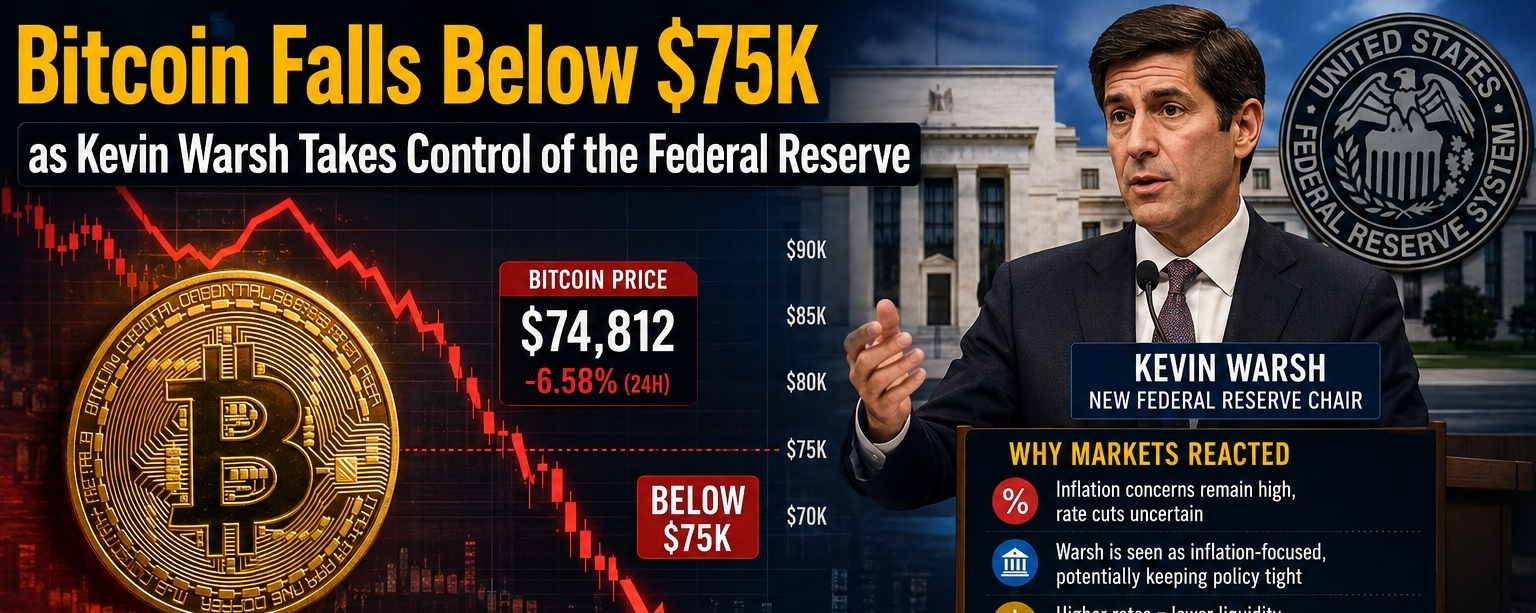
Bitcoin has dropped below the major $75,000 level, creating fresh fear across the cryptocurrency market and forcing investors to rethink where the market could move next. After weeks of strong optimism and expectations of another massive rally, the sudden correction arrived at a time when financial markets were already watching major developments coming from the Federal Reserve. The timing of the decline became even more important because Kevin Warsh officially stepped into leadership at the Fed, instantly turning attention toward how his policies could shape the future of crypto and global markets.
The move below $75K was not just another normal dip. It became a psychological turning point that triggered panic among short-term traders and increased uncertainty across the digital asset space. Many investors had expected Bitcoin to continue climbing higher after months of institutional buying, ETF demand, and growing confidence around long-term adoption. Instead, the market experienced a sharp reversal that wiped billions from crypto valuations within a very short period of time.
Why the Market Reacted So Aggressively
Financial markets are extremely sensitive to changes in Federal Reserve leadership because investors know that monetary policy affects almost every asset class, including cryptocurrencies. Kevin Warsh is viewed as someone who takes inflation risks seriously, and that alone was enough to make investors nervous about the possibility of tighter financial conditions continuing for longer than expected.
For months, traders were betting that the Federal Reserve would eventually begin cutting interest rates, which would likely increase liquidity across markets and support higher prices for risk assets like Bitcoin. However, the arrival of Warsh created fresh uncertainty because many investors now fear the central bank may remain cautious instead of quickly shifting toward easier policies.
Bitcoin has increasingly become tied to macroeconomic conditions. Even though the cryptocurrency was originally created as an alternative financial system outside traditional banking, its price movements today are heavily influenced by interest rates, inflation data, bond yields, and investor confidence. When markets expect easy money and lower borrowing costs, Bitcoin often performs strongly because investors become more comfortable taking risks. But when inflation remains high and monetary policy stays tight, risk assets usually come under pressure.
Inflation Concerns Are Still Dominating Markets
One of the biggest reasons behind the recent market weakness is the growing concern that inflation may remain stubborn for longer than expected. Rising energy costs, global economic uncertainty, and geopolitical tensions continue to create pressure on central banks around the world. Investors are worried that if inflation refuses to cool down, the Federal Reserve could delay rate cuts or even maintain restrictive policies deeper into the year.
That situation creates a difficult environment for cryptocurrencies because Bitcoin thrives most during periods of strong liquidity and easy financial conditions. The crypto market has historically benefited when central banks inject money into the economy, but it struggles when borrowing becomes expensive and investors move toward safer assets.
Many traders now believe the market may have become too optimistic too quickly. Expectations for aggressive rate cuts had fueled strong buying momentum across crypto, tech stocks, and other speculative assets. Once doubts started appearing around future monetary policy, sentiment shifted rapidly and triggered widespread selling.
The Role of Leverage in Bitcoin’s Sharp Decline
Another major factor behind the sudden drop was excessive leverage across the crypto market. During bullish periods, many traders borrow money to increase the size of their positions because they expect prices to continue rising. While leverage can create massive profits during rallies, it also becomes extremely dangerous when markets reverse unexpectedly.
As Bitcoin started losing important support levels, liquidation cascades began spreading across exchanges. Traders who were heavily leveraged suddenly faced forced sell-offs as their positions were automatically closed. This created additional selling pressure and accelerated the decline even further.
The crypto market often reacts much faster than traditional finance because leverage is deeply embedded into trading activity. A relatively small drop can quickly turn into a much larger correction once liquidations start hitting the market. That chain reaction played a huge role in Bitcoin falling below the critical $75K support zone.
Kevin Warsh’s Relationship With Bitcoin
Interestingly, Kevin Warsh is not considered openly hostile toward cryptocurrency. In previous discussions, he acknowledged Bitcoin’s growing importance and even suggested that digital assets can reflect public concerns about fiat currency and monetary policy. Some investors initially viewed his appointment as potentially positive for crypto because he appeared more open-minded than several traditional policymakers.
However, markets are now realizing that personal opinions about Bitcoin matter far less than actual economic policy decisions. Even if a Federal Reserve chair understands or appreciates cryptocurrency, controlling inflation and maintaining economic stability remain the top priorities of the central bank.
That is why the market reaction has been so intense. Investors are not focused on whether Warsh personally supports Bitcoin. Instead, they are trying to predict whether his leadership will keep financial conditions tighter for longer, which could continue putting pressure on speculative assets.
Fear and Psychology Are Driving Volatility
The emotional side of financial markets cannot be ignored, especially in crypto where sentiment changes extremely fast. The break below $75,000 damaged confidence because major price levels often act as psychological support zones for traders. Once those levels collapse, fear spreads rapidly across social media, trading platforms, and investor communities.
Retail investors begin questioning whether the bull market is still intact, while short-term traders rush to protect profits or reduce exposure. This emotional reaction often amplifies volatility because panic selling creates even more downward momentum.
At the same time, experienced investors understand that sharp corrections have always been part of Bitcoin’s history. The cryptocurrency has survived multiple crashes throughout its existence, including several declines much larger than the current pullback. Long-term holders argue that volatility is normal during every major market cycle and believe corrections are often necessary before stronger rallies can eventually return.
Could Bitcoin Recover From Here?
The future direction of Bitcoin now depends heavily on broader economic conditions and Federal Reserve policy decisions. If inflation starts cooling and markets regain confidence that interest rates could eventually move lower, crypto may recover momentum quickly. However, if inflation remains elevated and financial conditions stay restrictive, Bitcoin could continue facing pressure in the short term.
Some analysts believe this correction may simply represent a healthy reset after months of aggressive buying and overheated sentiment. Others warn that the market could experience additional downside if investors become more defensive globally.
Despite the uncertainty, institutional interest in Bitcoin remains significant. Large investment firms, ETFs, and corporate investors continue viewing Bitcoin as a long-term asset with growing importance inside the financial system. That institutional presence is one reason many long-term investors remain optimistic even during periods of extreme volatility.
A New Era for Crypto and Global Markets
Bitcoin’s drop below $75K represents more than just another correction in the crypto market. It highlights how deeply connected digital assets have become to the global financial system. Interest rates, inflation, central bank policy, and economic uncertainty now play a massive role in shaping crypto market direction.
As Kevin Warsh begins leading the Federal Reserve, investors around the world are closely watching every signal coming from policymakers because future decisions could determine whether markets regain confidence or continue moving through a period of uncertainty and volatility.
The coming months may define the next major chapter for Bitcoin. Whether this decline becomes a temporary shakeout or the beginning of a deeper correction will depend on how inflation evolves, how central banks respond, and whether investor confidence can recover after one of the market’s most important psychological support levels was broken.