
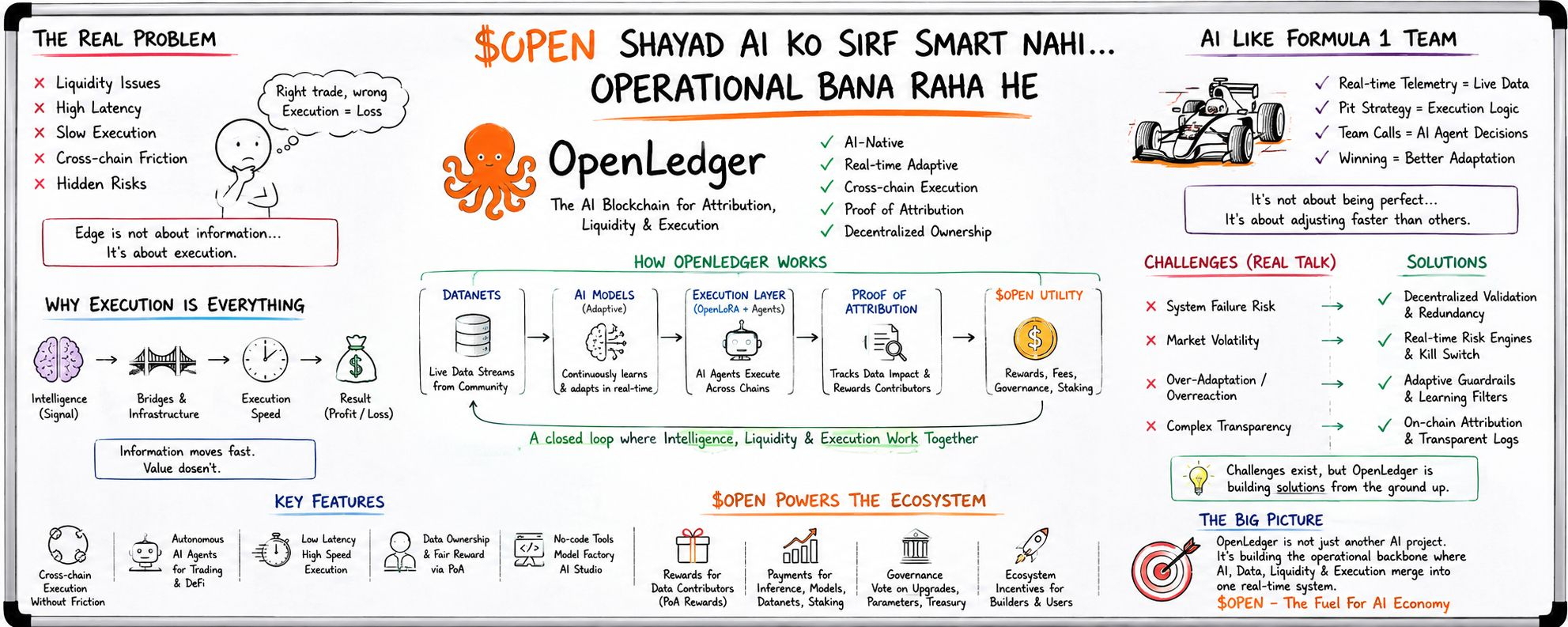
Kal raat mai sirf 10 minute ke liye OpenLedger ecosystem dekhne gaya tha.
Honestly bas curiosity thi.
AI + blockchain narrative market mai itna overused ho chuka he ke usually 2 minute baad interest khatam ho jata he. Har project same cheez bolta he: agents, automation, smarter execution, DeFAI.
Lekin phir bhi kuch tha jo mujhe baar baar wapas kheench raha tha.
Shayad is liye kyun ke yahan focus sirf “AI intelligence” par nahi lag raha tha.
Execution infrastructure par lag raha tha.
Aur mujhe lagta he market abhi bhi dono cheezon ka difference properly samajh nahi raha.
Trading ka hardest part prediction nahi hota.
Coordination hota he.
Hum log charts, sentiment aur narratives dekhte rehte hain… lekin real loss aksar wahan hota he jahan execution break karta he. Cross-chain bridge slow ho gaya. Liquidity shift ho gayi. Route inefficient nikla. Market move kar gaya aur transaction abhi pending he.
Mere sath khud hua he.
Trade idea sahi tha… infrastructure slow nikli.
Isi liye OctoClaw direction mujhe interesting lagne lagi. Yahan AI ka role sirf “signal dena” nahi lagta. Lagta he system continuously market states observe karke execution maintain karne ki taraf move kar raha he instead of waiting for manual triggers every few minutes.
Aur honestly… yahi part underrated lagta he.
Most current AI systems session-based behave karte hain.
Prompt do. Output lo. Session khatam.
Lekin markets session-based nahi hote.
Liquidity continuously move karti he. Volatility continuously shift hoti he. Conditions continuously mutate hoti rehti hain.
Agar har baar system ko human ke wapas aane ka wait karna pade… tou autonomy kitni real reh jati he?
Yahan mujhe OpenLedger ka infrastructure angle deeper laga.
Datanets sirf datasets nahi lagte. Continuous sensory layer lagte hain.
Proof of Attribution bhi sirf reward mechanism nahi lagta. Execution trust layer lagta he.
Kyuki autonomous systems ka biggest risk intelligence nahi hota.
Wrong data hota he.
Fast execution + manipulated signal = accelerated disaster.
Aur mujhe lagta he OpenLedger isi uncomfortable zone ko seriously treat kar raha he. Attribution, provenance tracking, inference visibility aur verifiable contribution ka focus isi wajah se important lagta he.
“AI systems sirf smart nahi… legible bhi hone chahiye.”
Market abhi bhi mostly outputs ko price kar raha he.
Mujhe lagta he future mai infrastructure quality zyada important hogi.
Specially jab AI agents actual liquidity, treasury ya cross-chain execution handle karna start karenge.
Isi process mai ek aur cheez mujhe unexpected lagi.
Vibecoding.
Normally mai technical systems se quickly bore ho jata hun. Setup friction, dependencies, deployment issues… aur motivation khatam. Isi wajah se bahut ideas notes app mai mar jate hain before execution.
Lekin OpenLedger ecosystem dekhte waqt strange cheez hui.
Ek small tweak pura execution flow change kar rahi thi.
Phir dusri adjustment timing shift kar rahi thi.
Phir suddenly dimagh mai multiple strategy variations generate hone lage.
Yahan mujhe realize hua ke shayad AI ka next shift coding automation nahi…
Experimentation friction reduction ho sakta he.
Agar builders ko infra complexity kam feel hone lage, tou unfinished ideas bhi testable ban jate hain before motivation disappear ho.
Aur honestly… ye behavior-level change he.
Sirf software change nahi.
Isi point par ERC-4626 angle bhi suddenly interesting lagne laga mujhe.
DeFi historically fragmented execution systems par chalta raha he. Different vault logic, inconsistent yield structures, manual coordination overhead. Agar AI agents continuously liquidity route karenge aur yield optimize karenge, tou standardized vault architecture almost necessary ban jati he.
Warna autonomous systems har protocol ke liye alag execution logic rebuild karte rahenge.
Yani future edge sirf “smart agents” nahi ho sakta.
Composable execution standards bhi honge.
Aur mujhe lagta he OpenLedger indirectly isi direction ki groundwork build kar raha he… jahan AI, liquidity, attribution aur execution isolated tools nahi rehte. Ek coordinated economic loop ban jate hain.
Contributors data dete hain.
Models fine-tune hote hain.
Inference usage generate hoti he.
OPEN settlement aur attribution routing handle karta he.
Validators quality maintain karte hain.
Better infrastructure more developers attract karti he.
Phir ecosystem aur strong hota he.
Ye sirf AI product thesis nahi lagta.
Operational economy thesis lagta he.
Haan risks bhi obvious hain.
Real-time adaptive systems overreact bhi kar sakte hain. Cross-chain latency abhi bhi problem he. Sequencer dependence aur execution failures future pressure create kar sakte hain.
Lekin positive part ye he ke OpenLedger kam az kam in problems ko ignore nahi kar raha.
Most projects sirf “AI will change everything” marketing push karte hain.
Yahan architecture discussions zyada visible lagte hain: attribution, execution consistency, deployment friction, live data coordination, on-chain provenance, inference economics.
Aur honestly… infrastructure projects usually shuru mai boring lagte hain.
Baad mai essential ban jate hain.
Shayad isi liye $OPEN mujhe ab sirf AI narrative token nahi lagta.
Thora zyada operational lagta he.
Jaise system quietly prepare kar raha ho us world ke liye jahan intelligence valuable zaroor hogi…
Lekin reliable execution us se bhi zyada valuable hogi.