The more I explored OpenLedger, the more I realized this project is not trying to become just another AI-powered blockchain. It is attempting to solve a deeper issue that most of the technology industry still avoids discussing openly — who actually owns the value created by artificial intelligence. Right now, AI systems are growing rapidly, but the economic structure behind them feels extremely centralized. Massive companies collect data from millions of users, train advanced models, and generate enormous profits, while the people contributing to that ecosystem remain mostly invisible. OpenLedger seems to recognize this imbalance early, and in my opinion, that is what makes the project genuinely interesting.
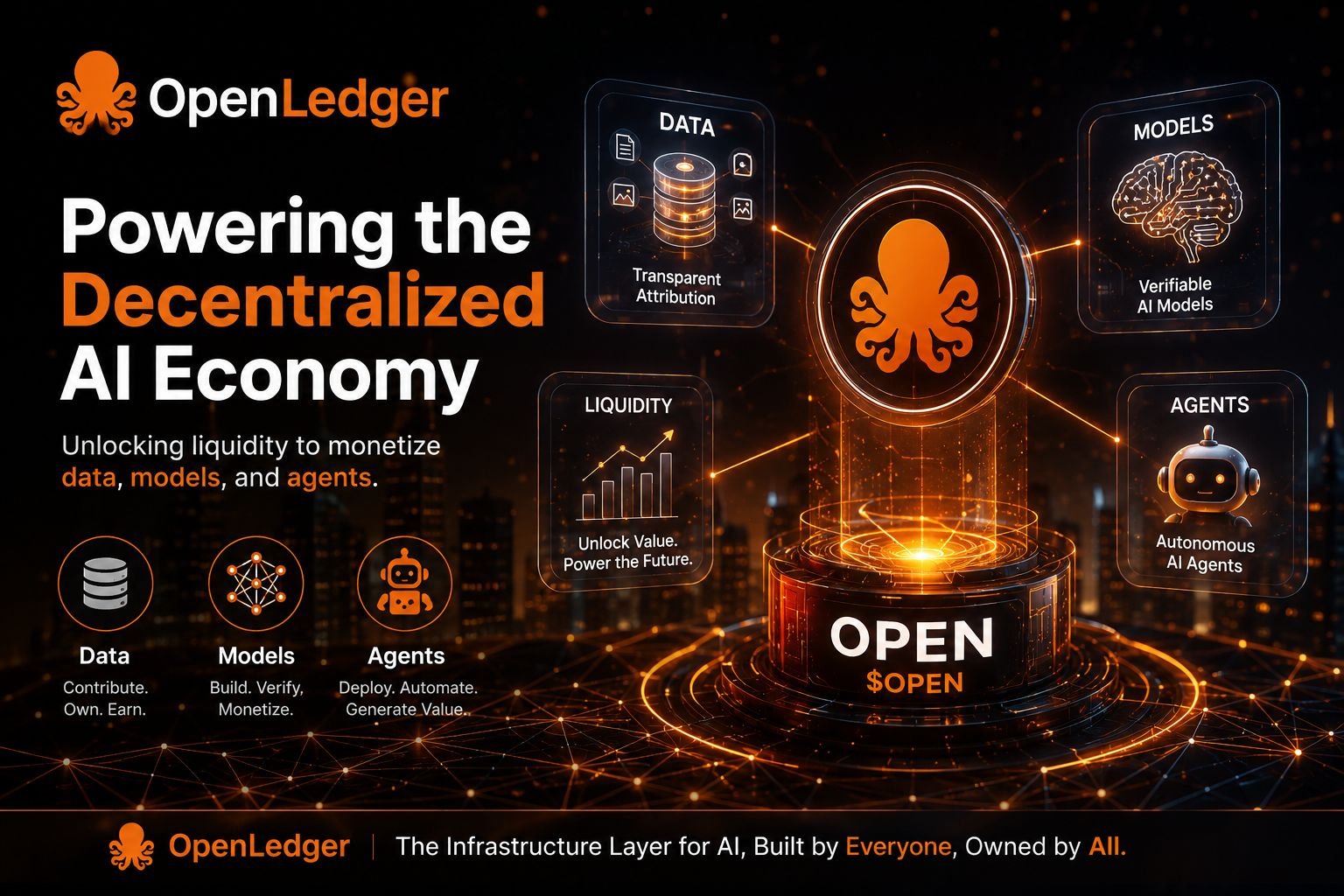
At its core, OpenLedger is building around a very important idea: intelligence itself can become a liquid digital asset. Instead of treating AI models, datasets, and autonomous agents as isolated tools controlled by corporations, the network wants to create an ecosystem where these components can interact economically in a transparent and decentralized environment. That may sound highly technical at first, but the implications are actually very practical. If data contributors, developers, researchers, and AI systems themselves can participate financially inside one open infrastructure, the entire economics of AI could eventually change.
One thing that immediately stood out to me is how OpenLedger focuses heavily on attribution and monetization instead of simply promoting “AI plus blockchain” narratives like many other projects. The crypto industry has become crowded with platforms using artificial intelligence as a marketing keyword, but very few are addressing the real structural inefficiencies inside the AI economy. OpenLedger appears to understand that future competition in AI may not revolve only around bigger models or faster outputs. It may revolve around who creates the fairest and most scalable economic coordination layer for intelligence.
The project’s emphasis on community-powered datasets is especially important in this context. Today, data is one of the most valuable resources in the world, yet contributors rarely receive direct rewards for it. AI systems consume enormous amounts of human-generated information every day, from online discussions to research materials and creative content. OpenLedger’s framework suggests a future where contributors can receive transparent attribution and incentives for helping train or improve AI systems. In my observation, this idea aligns perfectly with the growing global conversation around data ownership and digital rights.
Another reason OpenLedger feels strategically relevant is because the market is slowly becoming uncomfortable with centralized AI dependence. Developers increasingly rely on a handful of corporations for APIs, cloud infrastructure, and model access. Startups worry about pricing changes and ecosystem restrictions controlled by companies far larger than themselves. Even users are beginning to question how their data is being used inside AI systems. OpenLedger seems positioned directly within this tension, offering an alternative framework where AI resources can operate inside open blockchain-based economies instead of closed corporate environments.
What makes the project even more compelling is its timing. The AI industry is entering a transition period. A few years ago, people were mainly fascinated by AI capabilities. Now the discussion is evolving toward accountability, transparency, ownership, and trust. Businesses want to understand how models are trained. Governments are preparing regulations around AI governance. Users want more visibility into where their information goes. OpenLedger’s architecture appears naturally aligned with these concerns because it treats transparency and attribution as core infrastructure rather than optional features.
When comparing OpenLedger with projects like Fetch.ai, SingularityNET, and Bittensor, I noticed an important difference in strategic direction. Fetch.ai focused strongly on autonomous machine economies. SingularityNET concentrated on decentralized AI marketplaces. Bittensor created a competitive network around distributed machine intelligence. OpenLedger appears to combine elements of these ideas while placing stronger attention on liquidity and ownership around AI-related assets themselves.
That distinction matters more than most people realize. Liquidity is what transforms isolated technology into functioning economies. Data locked inside organizations has limited long-term value. AI models disconnected from open participation remain controlled assets rather than shared infrastructure. OpenLedger’s vision suggests a future where datasets, applications, models, and intelligent agents can interact financially inside one ecosystem. If successful, this would move blockchain utility beyond speculation and into productive AI coordination.
Personally, I think one of the project’s most underrated ideas involves autonomous AI agents. Most people still view AI as a chatbot or assistant responding to prompts, but the technology is evolving toward semi-autonomous systems capable of making decisions, performing tasks, and interacting with digital economies independently. Imagine AI agents negotiating services, purchasing data access, collaborating with other agents, or managing decentralized operations without direct human input. OpenLedger appears to be building infrastructure with this future in mind, which could become extremely important over the next decade.
At the same time, I do not think the project’s journey will be easy. Building decentralized AI infrastructure is one of the hardest challenges in modern technology. It requires scalable systems, high-quality datasets, strong developer communities, sustainable incentives, and real-world adoption. Many blockchain projects have failed because their narratives expanded faster than their actual utility. OpenLedger will eventually need to prove that its ecosystem can support meaningful participation beyond speculation.
There is also intense competition from centralized technology giants. Companies like OpenAI, Google, and Microsoft already dominate AI infrastructure and cloud distribution. OpenLedger is unlikely to compete directly against them in terms of raw computational scale. Instead, its opportunity probably lies in creating open economic systems where ownership, transparency, and decentralized participation become advantages rather than limitations.
What I personally find most compelling is the economic philosophy behind the project. OpenLedger seems to believe that intelligence should function as a shared network rather than a privately controlled monopoly. That is a bold idea because it challenges the current structure of the AI industry itself. Instead of concentrating value in centralized institutions, the project is attempting to distribute participation across contributors, developers, and users collectively.
Whether OpenLedger ultimately becomes a dominant infrastructure layer or simply influences the broader AI-blockchain ecosystem, its direction reflects where the industry already appears to be heading. Artificial intelligence is no longer just about capability expansion. It is increasingly about ownership, coordination, and economic fairness. The projects that solve these structural issues may become far more valuable than those focused only on model performance.
From my perspective, OpenLedger is not simply another speculative crypto narrative attached to AI hype. It represents an early attempt to redesign how value flows inside the intelligence economy. The project is betting that the future of AI will depend not only on powerful systems, but also on transparent networks where contributors are rewarded fairly and participation remains open. That vision is ambitious, difficult, and risky, but it is also one of the most intellectually relevant ideas emerging from the intersection of blockchain and artificial intelligence today.