

One thing I’ve noticed over the last few years is how easy it became for crypto and AI projects to sound impressive without really explaining how anything would function once real demand showed up. A lot of teams talked about autonomous agents, intelligent systems, automation, and machine-driven execution, but most of the conversation stayed at the surface level. The ideas were ambitious, but the infrastructure behind those ideas often felt unfinished or unrealistic.
That’s why the recent direction around Octoclaw and OpenLedger caught my attention in a different way.
Not because cloud configuration is some flashy narrative that instantly drives hype, but because it points toward something the space usually ignores until problems start appearing: deployment and scalability. In most technology cycles, the infrastructure layer ends up becoming more important than the original marketing. Features attract people at first, but stability is what determines whether users stay.
At a basic level, cloud configuration simply means running systems across distributed infrastructure instead of relying on one local setup or a limited server environment. That sounds technical and maybe even boring to some people, but in practice it changes how systems behave under pressure. Resources can scale depending on demand, workloads can be distributed, updates become easier to manage, and the overall environment becomes more reliable.
For AI agents, this matters far more than most people realize.
An AI system is not just sitting idle waiting for commands. These agents constantly process information, monitor conditions, make decisions, interact with APIs, analyze markets, and sometimes execute actions in real time. The smarter these systems become, the more infrastructure they require behind the scenes. If the backend cannot keep up, the intelligence itself becomes less valuable.
That’s one of the reasons so many early automation tools eventually struggled once usage increased. People often remember the excitement around the first generation of crypto trading bots, but fewer remember the operational issues that came later. Strategies became more complex, user demand increased, latency started affecting execution, and maintaining stable infrastructure became difficult. A lot of tools looked powerful in small environments but became unreliable once they tried operating at larger scale.
This is where OpenLedger’s approach with Octoclaw feels more practical than theoretical.
The focus no longer seems to be only about creating AI agents. It appears to be about figuring out how those agents can actually operate continuously, scale across environments, and remain manageable over time. That shift is important because the AI sector is slowly moving past the stage where ideas alone are enough. Users now care about whether systems work consistently in real conditions.
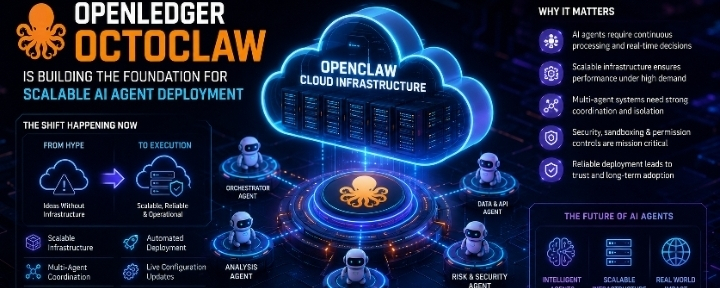
From what’s publicly available around OpenClaw infrastructure and deployment documentation, there seems to be a strong emphasis on things like centralized configuration management, multi-agent routing, sandbox isolation, cloud-based deployment workflows, automated task scheduling, live configuration updates, and distributed execution environments. Those are not the kinds of features that generate instant hype on social media, but they are often the exact features that determine whether platforms survive long term.
The interesting part is that this trend is becoming visible across the broader AI ecosystem as well. Earlier conversations mostly focused on intelligence itself. Which model is smarter? Which agent can reason better? Which system sounds more advanced? Now the conversation is slowly becoming more operational. People are starting to ask different questions.
Can these agents run continuously without breaking?
Can multiple agents coordinate together efficiently?
Can developers deploy updates safely?
Can systems recover automatically from failures?
Can infrastructure handle large amounts of simultaneous activity?
Those are much harder problems than simply building a demo.
And honestly, this is usually the stage where technologies start becoming real. The early phase of any innovation is driven by imagination. The later phase is driven by execution. Infrastructure becomes the dividing line between ideas that stay experimental and systems that become part of everyday usage.
What also stands out here is the growing importance of multi-agent coordination. Early AI systems often tried to make one model do everything at once, but that approach becomes inefficient quickly. More advanced architectures increasingly separate responsibilities between different agents. One handles orchestration, another handles analysis, another manages execution, and another monitors security or risk conditions.
That kind of environment requires strong coordination infrastructure underneath it. Without scalable deployment systems, multi-agent frameworks become extremely difficult to manage. This is another reason why cloud-focused architecture matters so much. It creates the operational flexibility needed for these systems to work together without constantly running into bottlenecks.
There’s also a deeper shift happening around security. As AI agents begin interacting more directly with financial systems, protocols, APIs, and on-chain environments, security stops being a secondary issue. Suddenly things like sandboxing, permission layers, policy controls, and isolation frameworks become essential. If an autonomous system has the ability to trigger actions or manage assets, infrastructure security becomes just as important as the intelligence itself.
A lot of community discussions around OpenClaw deployments already seem focused on these operational concerns rather than just performance claims. That alone says something about where the sector is heading. The conversation is maturing. People are no longer only asking what AI can do. They are asking how these systems can be trusted to operate reliably.
Another important factor here is usability.
One of the biggest reasons advanced tools struggle with adoption is because deployment becomes too complicated for most users. Even highly capable systems lose momentum if developers constantly need to manage difficult server environments, networking issues, API synchronization, or manual scaling problems. Simplifying deployment may sound less exciting than launching new features, but historically it plays a massive role in whether technologies become widely adopted.
The internet itself did not grow because protocols suddenly became more intelligent. It grew because infrastructure and usability improved enough for ordinary people to interact with it easily. AI agents may follow a very similar path.
That’s why developments like this feel more significant than they initially appear. They suggest that projects are beginning to think beyond demonstrations and toward sustainable operation. Instead of only building intelligent systems, they are trying to build environments where those systems can function reliably over time.
Of course, none of this guarantees success. Cloud infrastructure introduces its own challenges. Costs can increase rapidly, security risks become more serious, and dependency on distributed systems creates new operational complexity. Scaling infrastructure poorly can create as many problems as it solves. Execution still matters more than the narrative itself.
But from a broader perspective, this feels like one of those quiet stages where the industry is gradually leveling up beneath the surface. The improvements are not always dramatic enough to trend immediately, but they slowly change how people interact with technology. Systems become smoother, more stable, easier to deploy, and more dependable under pressure.
Those kinds of changes rarely create instant excitement, but they often end up shaping the next phase of an industry far more than the loudest announcements do.
And that’s probably the most interesting thing about Octoclaw’s cloud configuration direction. It does not just signal another AI feature release. It signals a growing recognition that scalable deployment, operational reliability, and infrastructure management may ultimately matter just as much as the intelligence layer itself.
In a market that spent years focusing mostly on ideas, that shift toward execution feels genuinely important.
