
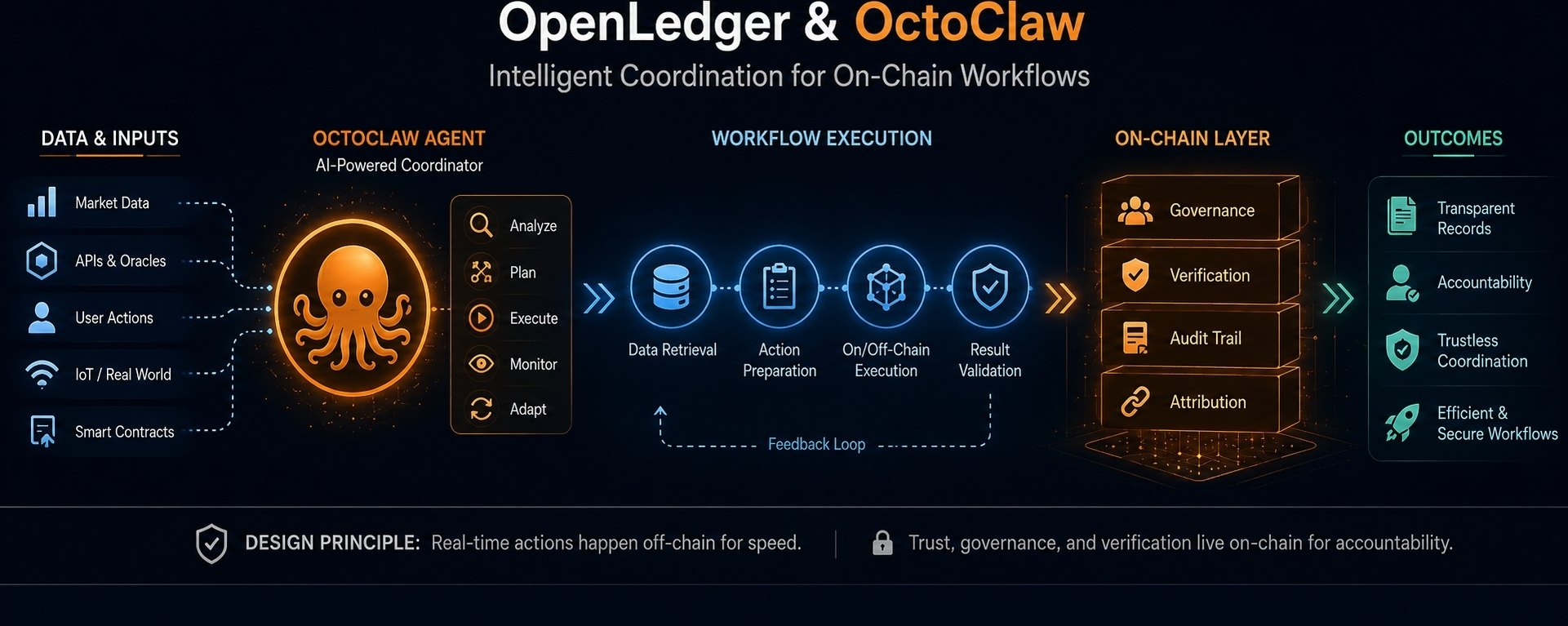
I’m waiting to see whether OpenLedger can make on-chain work feel less scattered without asking users to trust another hidden layer. I’m watching OctoClaw because it is dealing with a problem active crypto users already feel every day. I’m looking for cleaner coordination, fewer blind steps, and better records after actions happen. I’ve seen enough infrastructure promises to know that good wording does not mean good execution. I focus on whether the system can make crypto workflows easier to use without making them harder to verify. OpenLedger becomes interesting because it is not trying to sell one simple story. It is dealing with data, AI models, agents, attribution, and on-chain records together. That can sound heavy at first, but the basic idea is not hard to understand. If a system uses data, builds a model, suggests an action, or helps complete a workflow, people should be able to see where the information came from and why the action made sense. That is a real issue in crypto. Most users do not experience on-chain activity as one clean process. They jump between wallets, bridges, apps, dashboards, approvals, bots, and tabs. One step depends on another step, and if something fails in the middle, the user is often left guessing what went wrong. The chain may be open, but the workflow around it still feels messy. OctoClaw is trying to sit in that gap. It can be understood as a coordinator for on-chain and data-driven actions. Instead of making the user manually connect every step, it tries to help organize the process. It can read information, prepare actions, connect tools, and make a workflow move in a cleaner order. In simple words, it is not only about giving answers. It is about helping different parts of a process work together. That idea sounds useful, but it also needs caution. Any tool that only reads information has limited damage when it is wrong. A tool that helps execute actions is different. Once money, contracts, permissions, or cross-chain movement are involved, a small mistake can become expensive very quickly. Crypto does not forgive bad assumptions just because the interface looks smooth. The most honest way to look at OpenLedger is through the split between action and accountability. Real-time action often has to happen off-chain because prices move, APIs update, wallets respond, gas fees change, and market conditions shift quickly. But governance, verification, audits, attribution, and permission records can live on-chain. That distinction matters because it keeps speed close to execution while keeping trust close to the record. A blockchain does not magically know what happened in a warehouse, inside an API, or inside a pricing engine. But it can help record which data was used, who approved what, what rules were followed, and what changed after the action. That is where OpenLedger’s direction makes more sense. It is not about pretending everything belongs on-chain. It is about making the parts that require trust easier to check. Take a basic logistics example. A company receives goods, checks delivery notes, confirms an invoice, and releases payment. The truck, the warehouse worker, and the delivery condition all exist in the real world. Those things do not naturally live on-chain. But the payment rule, approval trail, invoice match, and final settlement record can be verified. If a system can coordinate that process and leave a clear record behind, it saves time without turning trust into guesswork. Energy data is another simple example. A solar operator may collect production numbers from meters and sensors. The live readings come from physical devices, not from the blockchain itself. But if those readings are used for credits, payments, or rewards, the system needs a record of which data was used and how the result was calculated. That is a practical use case for OpenLedger’s data and attribution layer. DeFi also makes the need obvious. A user may want to rebalance a portfolio, claim rewards, move assets, check risk, compare routes, and avoid high fees. Today this often means using several apps and hoping every step works. A coordinator like OctoClaw could make this flow easier by preparing the steps in order and showing the logic before the user signs. But this is exactly where things can break. The first failure scenario is stale data. If an agent reads an old price feed, a delayed bridge quote, or a wrong liquidity pool condition, the action may look safe but execute badly. In a calm market, that may only waste gas. In a fast market, it can cause a poor swap, failed hedge, or liquidation. The second failure scenario is permission creep. A user may first allow small actions, like claiming rewards or checking balances. Later, the workflow expands. The agent asks for broader permissions, and the user gets used to approving without reading closely. If one connected contract, tool, or route is compromised, the damage can spread faster because the system already has too much access. The third failure scenario is governance weakness. Open governance sounds good, but real governance is often quiet. Many users do not vote. Some votes are controlled by large holders. Some proposals pass because people follow a popular voice without reading the details. Some votes are symbolic, where the community appears involved but the main direction is already decided elsewhere. That matters because governance is not only about counting votes. It is about the quality of participation. A thousand careless votes do not protect a system better than a few informed people asking the right questions. If OpenLedger wants governance to mean something, proposals need to be understandable, risks need to be visible, and voters need enough context to know what they are approving. Whale capture is also a real concern. If a small group holds enough influence, the system can still look decentralized from the outside while decisions stay concentrated in practice. That does not always mean bad intent, but it does create trust pressure. Users need to know whether governance can actually stop risky changes, or whether it only confirms decisions after they are already socially locked in. Regulation is another area that will become harder as agents move closer to execution. If an AI tool only explains information, responsibility is easier to discuss. If it helps prepare or trigger financial actions, the question changes. If something goes wrong, who is responsible? The user who signed, the developer who built the agent, the data source, the interface, or the governance body that approved the system? OpenLedger’s Proof of Attribution can help with part of this problem. It creates a way to connect data contributions and model outputs more clearly. In plain language, it asks a fair question: if a model becomes useful because of certain data, how do people know where that value came from? That is important because data should not disappear into a black box once it has helped create something useful. Datanets also fit into this idea. They can be seen as organized data environments built around specific needs. Instead of using random data from everywhere and hoping the model understands the job, a Datanet can focus on a particular type of information or use case. That makes the system easier to inspect and easier to improve, at least in theory. ModelFactory adds another useful piece. It supports the creation of specialized models, which makes more sense than relying on one general model for every problem. A model built for DeFi risk, logistics records, or market monitoring should not be treated the same as a model built for casual answers. Different workflows need different data, different limits, and different checks. Still, specialized models are not automatically safe. If the data is weak, outdated, biased, or too narrow, the model can still produce bad guidance. A confident answer is not the same as a reliable one. OpenLedger’s challenge is to make the model layer visible enough that users and developers can question it instead of blindly accepting it. OctoClaw’s strongest use case may be in workflows where timing and coordination both matter. Cross-chain actions are a good example. Moving assets across chains is not only about choosing a bridge. It involves liquidity, fees, confirmation times, route safety, and market movement. A good coordinator can reduce mistakes. A poor coordinator can create several mistakes at once. Automated portfolio management is another area where it could matter. A user may want to reduce risk when conditions change, move funds when fees are reasonable, or claim rewards only when the reward is worth more than the gas cost. OctoClaw could help by watching the conditions and preparing the action. But the user still needs to understand why the action is being suggested before signing it. Complex DeFi strategies may be the hardest test. Lending, borrowing, swapping, hedging, staking, and claiming rewards can all depend on each other. If one step fails, the full strategy may become risky. OctoClaw would need to handle these dependencies carefully. It should not simply push a workflow forward because the plan looked good at the start. The better version of OpenLedger is not a system that removes thinking from crypto. That would be unsafe. The better version is a system that removes repetitive manual work while keeping the decision trail clear. A user should be able to see what data was used, what action was prepared, what permission is needed, and what record will exist after execution. This is where many automation products fail. They reduce friction but also reduce awareness. Some friction is unnecessary. Some friction protects the user from a bad decision. The hard part is knowing which friction to remove and which friction to keep. OctoClaw needs to make actions smoother without making users passive. The market will not prove this through announcements. Developers will prove it by using the tools when there is real pressure. Users will prove it by trusting the flow with actual funds. Governance will prove it by handling difficult proposals honestly. The system will prove it when conditions are messy, not when everything is calm. OpenLedger is worth watching because it is working near a problem that is easy to ignore until it breaks. Crypto does not only need more apps. It needs better coordination between apps, data, agents, and records. It needs systems that can act quickly without hiding the reason behind the action. Caution still makes sense. A system that connects data, AI, and transactions can become powerful in a risky way if the controls are weak. The more connected the workflow becomes, the more important it is to know where authority sits. If users cannot see that clearly, the system only moves the trust problem to a new place. OctoClaw may change how on-chain workflows feel if it can make execution cleaner and records stronger at the same time. That is the real test. Not whether it can do more steps, but whether people can understand, verify, and limit those steps before damage happens. Trust cannot sit behind a corporate black box with a better interface. If OpenLedger wants to matter, trust has to live in the architecture.

مقالة
OpenLedger OctoClaw Is Quietly Building the Coordination Layer Crypto Workflows Have Been Missing
إخلاء المسؤولية: تتضمن آراء أطراف خارجية. ليست نصيحةً مالية. يُمكن أن تحتوي على مُحتوى مُمول. اطلع على الشروط والأحكام.