
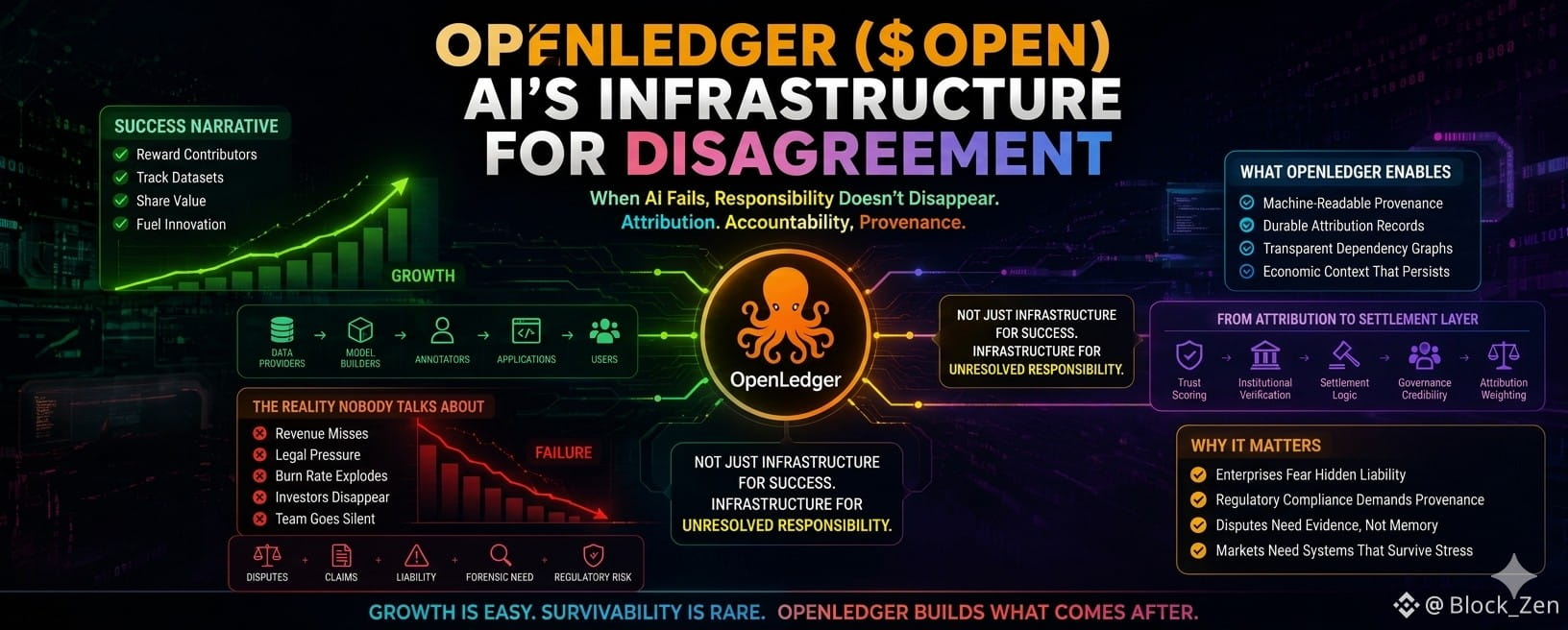

I’ll be honest… a few months ago I thought AI attribution was mostly just a fairness narrative
You know the usual pitch:
reward contributors,
track datasets,
share value with developers,
make AI less of a black box.
Cool idea. Made sense.
But lately I keep thinking the real reason attribution infrastructure might matter has nothing to do with success.
I think it matters when things start breaking.
And honestly… almost nobody in AI talks about that part.
Right now the whole market feels addicted to acceleration.
AI agents.
Autonomous workflows.
Infinite scaling.
“Replace human labor.”
“10x productivity.”
Same conversation everywhere.
It reminds me of early DeFi honestly. Everybody talks about expansion during bull markets. Very few people think about what happens once incentives get ugly.
And incentives ALWAYS get ugly eventually lol.
A startup raises money.
Integrates multiple datasets.
Uses third-party models.
Pays annotators.
Builds some vertical AI product.
Gets attention on CT.
People start calling it “the future.”
Then a year later the numbers stop working.
Revenue misses.
Burn rate gets nasty.
Legal pressure shows up.
Investors disappear.
Team slowly goes silent.
We have all seen versions of this before.
But here’s the thing I keep thinking about:
The company might die… but the economic responsibility around the AI doesn’t magically disappear.
That’s the part bothering me lately while looking into OpenLedger ($OPEN).
At first I saw it as simple attribution infra.
Now I’m starting to think it could become something way more important:
infrastructure for unresolved responsibility.
Yeah that sounds dramatic 😂 but I mean structurally, not emotionally.
Traditional finance already understands this problem really well.
Banks have settlement systems.
Corporations have bankruptcy procedures.
Supply chains have audit trails.
Because once real money gets involved, nobody trusts memory anymore.
Meanwhile AI still acts like we can skip that entire layer lol.
Which feels kinda naive tbh.
Modern AI systems are messy as hell underneath.
One AI product today can involve:
licensed datasets,
open-source fine-tunes,
external APIs,
synthetic data,
annotation teams,
retrieval systems,
older models stacked underneath newer models…
It’s basically dependency spaghetti.
But nobody cares while money is flowing.
That’s always how it works.
During growth, everybody acts cooperative.
Contributions feel collaborative.
Ownership feels “obvious.”
Then stress hits and suddenly people remember contracts differently 😅
Crypto should understand this better than anyone honestly.
We’ve already watched treasury fights, validator drama, governance wars, partnership collapses… all triggered once liquidity disappeared.
AI won’t magically avoid that just because the branding sounds smarter.
And this is where OpenLedger starts getting interesting to me.
Not because “putting things on-chain” magically solves legal disputes. It doesn’t.
Crypto people oversimplify that stuff constantly.
But durable attribution DOES change the shape of disagreement.
That matters.
Because most AI systems today rely on selective memory.
Teams disappear.
Docs vanish.
Contributors become invisible.
People rewrite history once outcomes change.
Machine-readable provenance doesn’t create truth…
but it creates evidence.
Big difference.
And honestly I think enterprises care way more about that than retail realizes.
People online keep acting like companies are scared of AI capability gaps.
I don’t think that’s the real fear anymore.
The real fear is hidden liability.
Unknown training exposure.
Data contamination.
Ownership ambiguity.
Compliance problems showing up 6 months later.
That’s the boring infrastructure side of AI nobody wants to tweet about because hype gets more engagement lol.
But boring infrastructure usually ends up becoming insanely valuable long term.
That pattern repeats constantly in markets.
And if OpenLedger eventually evolves into something tied to trust scoring, institutional verification, settlement logic, governance credibility, or attribution weighting…
then this becomes a much bigger market than people think.
Because now you’re not only monetizing intelligence.
You’re monetizing coordination during uncertainty.
Completely different category.
Of course there are still massive problems.
Attribution itself gets messy FAST.
How much did one dataset really matter?
Should every tiny contributor get permanent economic claims?
Who decides what counts as “material”?
That gets political real quick.
And enforcement is still the uncomfortable part nobody fully solves.
A blockchain can Preserve records beautifully.
It cannot force off-chain compliance across courts and jurisdictions.
Visibility ≠ enforceability.
Crypto still mixes those up all the time.
Still…
I can not shake the feeling the market is misunderstanding where attribution infrastructure becomes truly necessary.
Not during hype.
During conflict.
During acquisitions.
During lawsuits.
During restructurings.
During due diligence.
During moments where nobody trusts verbal memory anymore.
That’s when systems reveal whether they were real infrastructure… or just narrative packaging.
And honestly I think AI still feels early partly because almost every conversation is about acceleration while very few are about survivability.
But mature systems aren’t defined only by how fast they grow.
They’re defined by how well they handle stress once growth slows down.
That’s usually where the real infrastructure gets discovered.