
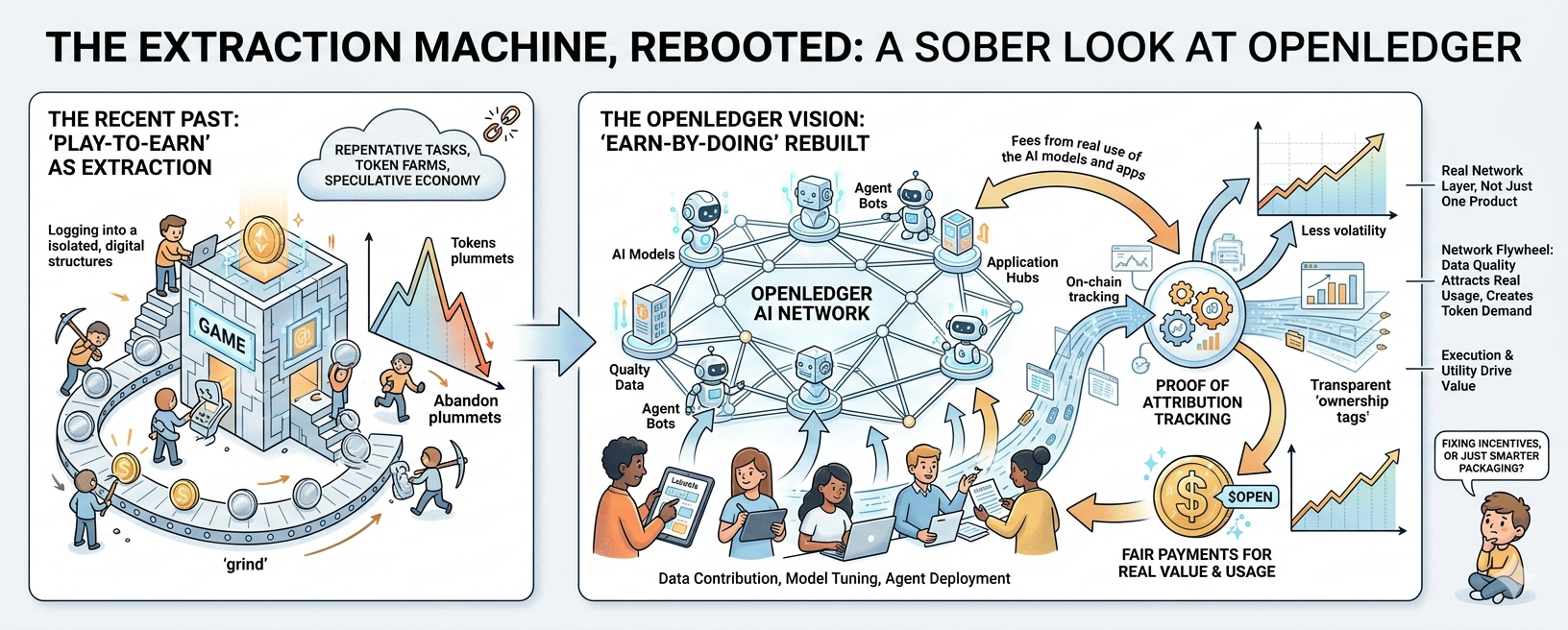

Play-to-earn kind of died the way most shiny crypto ideas do – it turned into straight-up extraction.
You know how it went. Everyone got excited about “own your stuff, earn while you play,” but most projects just became fancy token farms. Log in, grind some repetitive task, watch your wallet tick up for a few weeks, then sell before it all crashed. The actual game? Barely mattered. It was the token chase that kept it alive, until it wasn’t. Once the rewards slowed, the players vanished. Classic boom and ghost town.
That whole mess is why OpenLedger caught my eye, but also made me pause. It’s this AI-focused blockchain with the $OPEN token, promising to let regular people actually monetize their data, train models, run agents, and get paid fairly through on-chain tracking. Sounds pretty next-level on the surface. But the more I sit with it, the more I wonder: is this finally fixing the broken incentive stuff that killed most play-to-earn games, or is it just the same old extraction model wrapped up in smarter AI packaging?
To be completely honest, I’m still chewing on that.
### The usual problems that tanked these things
Most crypto gaming (and similar “earn by doing”) setups failed for pretty straightforward reasons. The fun part was usually an afterthought – just enough polish to get people in the door. Players quickly turned into farmers, optimizing spreadsheets instead of enjoying themselves. Tokens got printed like confetti to keep the hype going, everyone cashed out, and suddenly the economy was underwater. No real long-term reason for the token to hold value beyond “number go up” hope.
I thought about Pixels as a contrast because it tried doing things differently – put the actual farming sim gameplay first, build a little world and community, then worry about the economy. It had better staying power than most, but even there, you saw the same patterns when rewards got tighter: some dedicated players stuck around, but a lot bounced when the easy money dried up.
OpenLedger isn’t pretending to be another game. They’re going bigger, positioning it as an actual network for AI stuff. You contribute data, help fine-tune models, deploy agents – all tracked with this “Proof of Attribution” thing so you supposedly get paid when your work gets used. It’s like trying to fix how Big Tech hoovers up everyone’s data for free and turns it into go
Where they’re trying to break the pattern
Building it as a real network, not just one product.
Instead of one isolated game that lives or dies on daily logins, they want OpenLedger to be the underlying layer where lots of AI apps and agents run. The idea is a flywheel: more good data and models attract real usage, which creates actual demand for the token through fees, staking, inference payments, that kind of thing.
I like that ambition. If it clicks, the token might have some real staying power instead of just riding launch hype. It feels less fragile than a single game.
But here’s the rub – infrastructure projects are tough as hell to pull off. We’ve watched a bunch of “decentralized AI” or compute networks talk a huge game and then… kind of fade. Without some killer apps that actually need this chain specifically, it could easily become another speculative token with thin real activity. Execution feels like the make-or-break here.
**Tying rewards to actual value (Proof of Attribution).**
This is their standout claim – transparently track contributions and reward people based on real usage instead of blind farming.
Strength-wise, it’s addressing something genuinely annoying: creators and data owners getting zero cut while a handful of companies get rich. If they get the tech right, it might attract more serious folks instead of just reward chasers.
The risk though? Measuring “real value” in AI is messy. Who or what decides quality? It seems easy to imagine people spamming low-effort data, forming little groups to game the system, or just doing the minimum to farm points. Incentives still rule behavior, and if early rewards are juicy to bootstrap the network, you might just get the same mercenary crowd showing up.
**The token side and whether it can actually last.**
From what I’ve seen, the tokenomics look somewhat thoughtful – pretty big chunk going to the community, capped supply, utilities like gas fees and staking. But I keep coming back to the pressure question. People will sell what they earn. Unlocks will happen. If actual AI usage and fees don’t grow fast enough to balance it out, it risks sliding into the usual sell-heavy spiral.
The real issue is human nature. No matter how nice the design looks on paper, if the easiest path is low-effort contribution followed by dumping, that’s what most people will do.
### So where do I land?
I don’t know, man. Conceptually, OpenLedger feels more solid than a lot of the play-to-earn stuff because it’s hitting a real pain point in how AI gets built today. Turning scattered data and models into something liquid and rewardable is genuinely clever, and the network vision has potential.
At the same time, it’s still leaning on that same incentive engine that’s failed before. Getting contributors to keep showing up with quality stuff long-term, fighting off gaming the system, and building enough real usage before the token pressure hits – that’s a tall order. Execution risk feels pretty high.
It’s an interesting one. Thoughtful in spots, ambitious, and carrying all the usual crypto baggage. Whether it actually solves the extraction problem or just repackages it with better marketing… I guess we’ll see. I’m watching out of curiosity, but I’m not fully sold yet. Time will tell if this one breaks the cycle or joins the list of cautionary tales.
What about you – you buying the vision, or still skeptical too?
