
I’ve noticed something changing in the way people talk about AI lately. A year ago, most conversations were still obsessed with outputs...... faster content, smarter assistants, cleaner interfaces, better automation. Now the deeper conversation is slowly starting to emerge underneath all of that noise.
Who owns the intelligence economy once it becomes permanent infrastructure?
That question keeps pulling me back toward OpenLedger.
Not because the market suddenly Needs another AI narrative. If anything, I think people are exhausted by AI branding at this point. Every week there’s another project promising autonomous systems, decentralized intelligence, or some new version of machine-driven coordination. Most of it feels temporary. You can usually tell within minutes whether a project is built around real economic thinking or simply around whatever attracts attention during the current cycle.
What makes OpenLedger interesting to me is that it doesn’t feel entirely focused on the surface layer of AI. It feels more focused on the invisible layer underneath it — the part most people ignore while they chase headlines and token momentum.
I’ve been in crypto long enough to notice that the systems which survive usually solve uncomfortable structural problems before the market fully understands why those problems matter. The early internet rewarded platforms. Early crypto rewarded liquidity. I think the next phase may reward whoever builds sustainable ownership rails around intelligence itself.
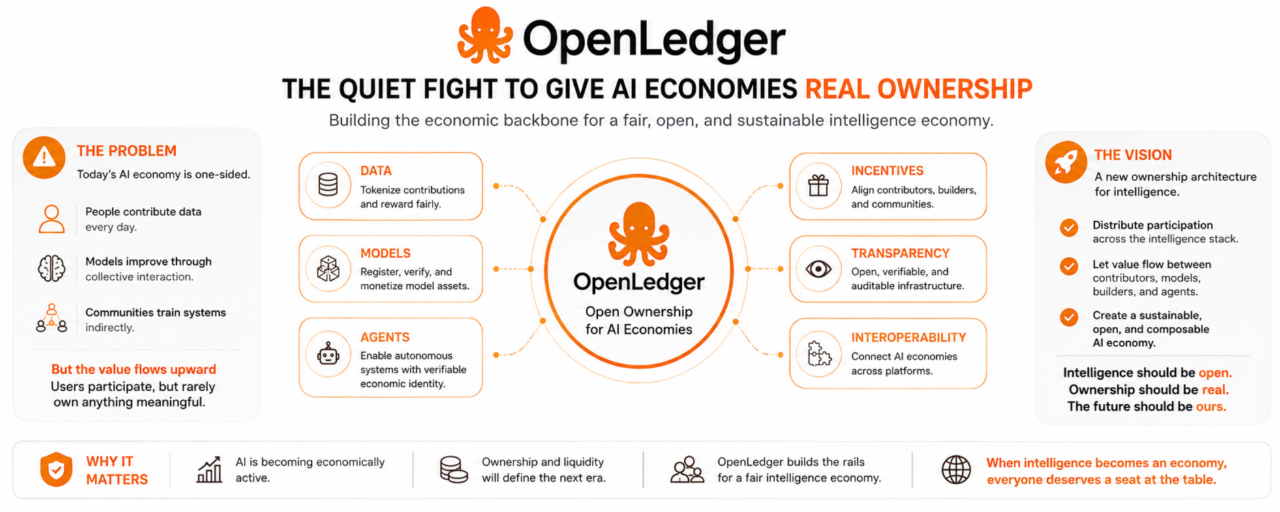
Because right now, most AI economies are incredibly one-sided.
People contribute data constantly. Models improve from collective interaction. Communities train systems indirectly every single day.
Yet the economic value generated from those loops still flows upward into closed ecosystems. Users participate, but they rarely own anything meaningful inside the infrastructure they help strengthen.
That imbalance feels increasingly unsustainable to me.
And honestly, I think crypto is one of the few environments capable of even attempting to redesign those incentives. Not perfectly. Not cleanly. But at least structurally.
That’s why OpenLedger keeps sitting in the back of my mind whenever I think about long-term AI infrastructure. The project appears less interested in building a flashy AI destination and more interested in building economic coordination around data, models, and agents themselves.
There’s a subtle difference there, but it matters.
One approach chases attention.
The other tries to create persistence.
I’ve noticed that durable projects usually become more useful as ecosystems become more complex. Fragile projects do the opposite. They depend heavily on emotional momentum because their actual utility doesn’t deepen enough over time. Once attention leaves, the entire system starts feeling hollow.
That’s the part of the market I’ve become more sensitive to after watching multiple cycles play out.
The projects I trust most now are usually the ones trying to solve infrastructure friction nobody fully appreciates yet. They rarely look exciting early. In fact, they often look slower, quieter, and less aggressive than the market expects. But when larger adoption waves arrive, those same systems suddenly become foundational.
I think AI is approaching one of those moments.
Not because the technology is new anymore, but because intelligence itself is becoming economically active. Agents are starting to interact with systems. Models are becoming productive assets. Data is becoming monetizable infrastructure instead of passive exhaust. Once that shift accelerates, liquidity and ownership become impossible to separate from AI itself.
And most ecosystems still aren’t prepared for that transition.
What I find compelling about OpenLedger is the idea that AI economies may eventually require open financial coordination layers the same way crypto economies required decentralized liquidity layers. Without economic interoperability, intelligence remains trapped inside isolated environments controlled by a small number of platforms.
That future feels fragile to me.
I think the next generation of durable infrastructure will come from projects trying to distribute participation more fairly across the intelligence stack — not just monetizing AI demand, but restructuring how value circulates between contributors, builders, models, and autonomous systems.
That’s a much harder problem than launching another application.
It also means progress probably looks slower from the outside.
But I’ve learned that the market often mistakes quiet development for irrelevance. Meanwhile, some of the most important infrastructure gets built far away from the loudest narratives on the timeline.
I’m still cautious with every AI-related project because the sector moves faster than almost anything I’ve seen in crypto. Entire assumptions can collapse within months. But I also think we’re entering a period where ownership architecture around intelligence may matter more than the intelligence products themselves.
And when I look at OpenLedger through that lens, it feels less like a temporary AI trend and more like an attempt to answer a bigger question the industry still hasn’t fully solved:
When intelligence becomes an economy of its own, who actually gets to participate in the value it creates?
@OpenLedger $OPEN #OpenLedger