
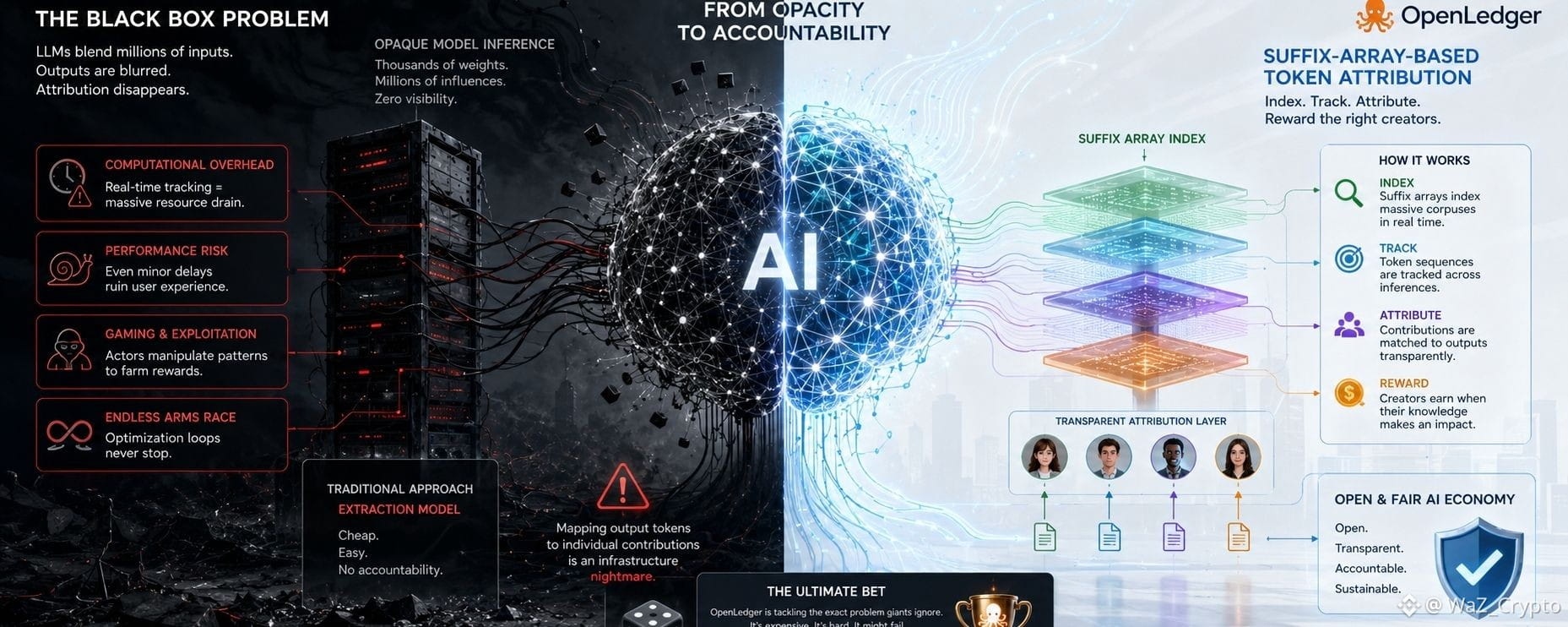
CONTRIBUTIONS IS AN ABSOLUTE INFRASTRUCTURE NIGHTMARE
It is incredibly easy to talk about data ownership on social media. Crypto projects love to put clean diagrams in their marketing materials showing a straight, perfect line from a user’s data submission to an AI model’s final payout loop.
But in reality, when you deal with Large Language Models, that line completely vanishes.
LLMs do not work like standard relational databases.
When a model generates an answer, it doesn't just pull a clean file from a specific folder. It processes thousands of weights across an opaque mathematical network, blending millions of different inputs into a single, collective response. The output tokens are fundamentally blurred and anonymous. And honestly, trying to accurately map an individual text string back to its original source influence is an incredibly messy engineering challenge. This is exactly why the technical direction @OpenLedger is taking with its Suffix-Array-Based Token Attribution system caught my attention.
They aren't just relying on simple database lookups.
They are building an architecture to index and track token sequences across massive training corpuses in real time.
The goal is to provide a transparent attribution layer for complex language outputs, ensuring that creators get paid when their written knowledge directly shapes a model's response. It is a highly ambitious attempt to bring raw accountability to a black-box industry. But let's look at the absolute reality of this technical approach. No mathematical formula for LLM data tracking will ever be completely pure or perfect.
The computational overhead required to check suffix arrays against live model inferences is massive.
If the verification layer introduces even a minor delay during a chat session, the user experience will feel incredibly sluggish.
Furthermore, clever actors will constantly try to reverse-engineer the token scoring metrics. They will structure their data submissions using specific phrase patterns designed to artificially trigger the suffix trackers, gaming the distribution contracts to siphon $OPEN rewards from the platform treasury. Dealing with these optimization loops is a constant game of cat and mouse. OpenLedger is taking a massive gamble by trying to solve the exact attribution problems that traditional tech giants completely ignore.
Most platforms prefer the extraction model because it is cheap and easy.
Accountability, on the other hand, is expensive and structurally exhausting.
Whether OpenLedger can scale this deep token tracking without breaking the underlying network transaction speed is something we will only find out under heavy commercial load. If it works, they have built a completely new standard for open, fair machine intelligence. If it fails, it will serve as a warning about the sheer complexity of trying to decentralized black-box technology anyway - let's see.....
#OpenLedger @OpenLedger #openledger $OPEN
