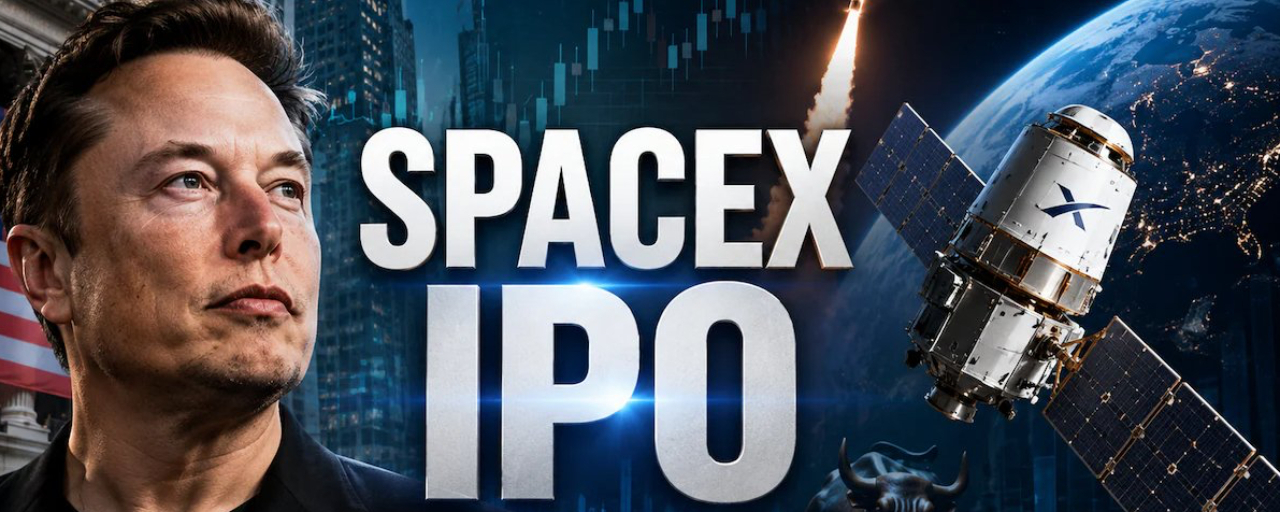

On June 12, 2026, the largest IPO in Wall Street history is set to begin.
SpaceX is preparing to list on Nasdaq under the ticker $SPCX , at a valuation approaching $1.75 trillion.
No IPO in history has ever come close to that number.
When Saudi Aramco went public in 2019, it raised $29.4 billion a world record at the time.
SpaceX is targeting up to $75 billion in a single offering.
More than double the previous record. In one move.
And perhaps even more important?
Elon Musk is on the verge of becoming the first CEO in history to lead two publicly traded trillion-dollar companies: Tesla alongside SpaceX.
What are investors actually buying when they purchase SPCX?
Many assume they are buying a rocket company.
In reality, the company going public on June 12 is a giant composed of three very different businesses each with its own economics, risks, and growth profile.
The First Segment: Space Launch Business
This is the company’s original core: Falcon 9, Falcon Heavy, Dragon capsules, and NASA contracts.
It generated $4.09 billion in revenue in 2025.
But it also posted an operating loss of $657 million.
Why?
Because Starship has already consumed more than $15 billion in development costs and has yet to produce meaningful commercial revenue.
The Second Segment: Starlink
This is the real engine of the company.
Starlink generated $11.39 billion in revenue in 2025, growing nearly 50% year over year.
Operating profit reached $4.42 billion up 120% from the previous year.
In Q1 2026 alone, Starlink produced $3.26 billion in revenue, accounting for 69% of total company revenue.
Subscriber count?
10.3 million users worldwide.
Satellites currently in orbit?
9,600.
This segment alone could justify a massive valuation.
This is the business funding the dream.
The Third Segment: xAI and X
This is where the story becomes more complicated.
In February 2026, SpaceX merged with Elon Musk’s xAI in a $250 billion transaction.
xAI had already absorbed X the social platform Musk purchased for $44 billion in 2022.
What did this merger add to SpaceX?
Massive spending and even larger ambitions.
The company spent $12.7 billion on AI projects in 2025 alone.
In Q1 2026, capital expenditures reached $10.1 billion, including $7.72 billion dedicated to AI infrastructure.
That level of spending exceeds what many pure AI companies spend in an entire year.
The Bull Case
Supporters of the valuation argue that SpaceX is targeting a combined addressable market worth $28.5 trillion.
That includes AI infrastructure, satellite internet, mobile communications, and enterprise software.
The company is positioned across three massive industries simultaneously:
Space,
Internet,
Artificial Intelligence.
And it holds a potentially decisive advantage: vertical integration.
It builds its own rockets.
Deploys its own satellites.
Operates its own internet network.
Constructs its own data centers.
Any competitor attempting to catch up may require decades of investment.
And the long-term wildcard?
Orbital data centers.
SpaceX reportedly aims to deploy solar-powered data centers in orbit by 2028 to reduce the cost of AI computation.
It sounds insane.
But few companies on Earth could even attempt something like that except the one launching rockets every week.
The Bear Case
Now the other side of the argument.
The company reported a net loss of $4.9 billion in 2025.
A $1.75 trillion valuation means investors today are paying for success that has not happened yet.
And there is another concern:
Starlink’s average revenue per user (ARPU) has started declining.
It was $99 per month in 2023.
By Q1 2026, it had fallen to $66.
More subscribers, yes.
But each subscriber is paying less.
Competitive pressure is beginning to emerge, even while Starlink still effectively dominates the market.
Then comes the corporate governance issue.
Musk’s compensation package is tied to highly unconventional milestones, including specific market-cap targets and even the establishment of a permanent colony on Mars.
This is not satire.
It is reportedly written into the S-1 filing.
How should investors value a stock when executive compensation is linked to the success of a Mars mission?
The Hidden Bomb: Nasdaq’s Fast-Track Inclusion Rule
Very few people are discussing this point.
Nasdaq has an accelerated inclusion rule.
Just 15 days after trading begins, SPCX could automatically qualify for inclusion in the Nasdaq-100 index.
What does that mean?
It means ETFs tracking the Nasdaq-100 would be forced to buy the stock.
Forced buying worth billions of dollars regardless of whether fund managers believe the valuation is justified.
The famous QQQ ETF alone manages more than $300 billion in assets.
Anyone holding QQQ may indirectly own $SPCX within weeks whether they want to or not.
This dynamic could create highly abnormal demand during the first weeks of trading.
And early sellers may benefit from that forced institutional inflow.
What Does This IPO Mean for the Entire Space Sector?
The moment $SPCX begins trading, the entire sector may be repriced.
Companies such as Rocket Lab ($RKLB),
AST SpaceMobile ($ASTS),
and Planet Labs ($PL)
could suddenly be evaluated against an entirely new benchmark.
Satellogic is already up 407% year-to-date.
Planet Labs has risen 110%.
EchoStar climbed 499% over the past year.
The market is moving in advance.
Investors are already trying to price the sector before the giant enters the arena.
Anyone holding a space stock today may be sitting on either an opportunity or a landmine.
The difference may be determined by SpaceX’s valuation on June 12.
The Most Important Question
SpaceX is an extraordinary company. That is not debatable.
But the question every investor should ask is not:
“Is this a great company?”
The real question is:
Is the IPO price the right entry point?
Or is the new investor simply being asked to provide liquidity for those who entered years earlier and already captured the easy gains?
If Starlink reaches 100 million subscribers,
and if Starship achieves launch economics below $100 per kilogram,
today’s valuation could look absurdly cheap in ten years.
But if the AI bets fail,
or orbital data centers never convert massive capital spending into real profit margins,
then the downside may fall on everyone holding SPCX.
And one critical detail remains:
SPCX shareholders will have little ability to influence management decisions.
Musk is expected to retain full control.
SpaceX may become the defining company of the 21st century.
But being a great company and being a great investment at the current moment are two very different things.
On June 12, the market will test that difference in front of the entire world.