
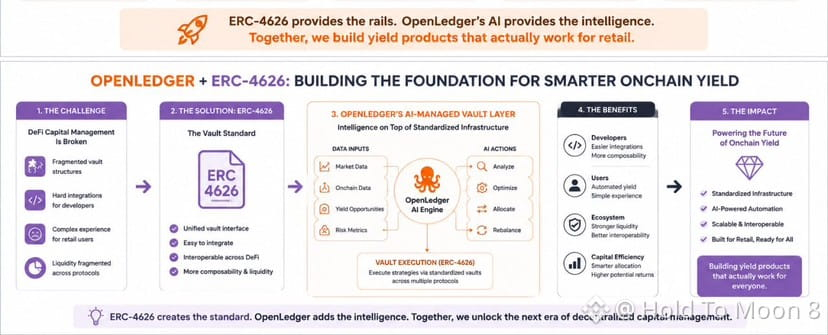
One of the most important upgrades happening in DeFi today isn’t a new token, a new chain, or another yield farming strategy. It’s the gradual standardization of how capital is managed onchain. That’s exactly why OpenLedger’s adoption of ERC-4626 is such a meaningful step forward.
At its core, ERC-4626 is a vault standard designed for yield-bearing assets. While that may sound technical, the impact is actually very practical. Before ERC-4626, every protocol often implemented vaults differently. Developers had to create custom integrations, users faced inconsistent experiences, and liquidity became fragmented across ecosystems.
ERC-4626 changes that by introducing a unified framework for tokenized vaults. Assets deposited into a vault can be represented and managed through a standard interface, making them easier to integrate with wallets, aggregators, lending protocols, and other DeFi applications. In simple terms, it creates a common language for yield-generating capital.
This standardization becomes increasingly important as DeFi evolves beyond passive yield farming. The industry is entering an era where capital allocation is becoming more dynamic, automated, and strategy-driven. Users no longer want to manually move assets between protocols every week searching for better returns. They want systems that can intelligently manage those decisions for them.
That is where OpenLedger’s vision becomes particularly interesting.
Rather than treating vaults as static containers for deposits, OpenLedger is building an AI-managed vault layer that can potentially transform vaults into active capital management systems. By leveraging AI to analyze opportunities, optimize allocations, and adapt strategies in real time, OpenLedger aims to reduce the complexity that typically prevents retail users from accessing sophisticated yield strategies.
The combination of ERC-4626 and AI creates a powerful foundation. ERC-4626 provides the standardized infrastructure, while OpenLedger’s intelligence layer adds decision-making capabilities on top of that infrastructure. Together, they create a framework where yield products can become more scalable, interoperable, and user-friendly.
From a developer perspective, this means easier integrations and greater composability across the broader DeFi ecosystem. Protocols built around a shared standard can interact more efficiently, accelerating innovation while reducing unnecessary complexity.
From a user perspective, the benefits are even clearer. Most retail participants are not interested in constantly monitoring markets, evaluating vault strategies, or rebalancing positions. They simply want reliable tools that can help their capital work more efficiently. Standardized vaults combined with intelligent automation move DeFi closer to delivering that experience.
More importantly, this reflects a broader trend within decentralized finance. The future of DeFi is likely to be defined not just by financial products, but by financial infrastructure that can make complex decisions easier to execute. Automated capital management, intelligent allocation systems, and interoperable vault architectures are becoming critical building blocks for the next generation of onchain finance.
OpenLedger’s adoption of ERC-4626 signals alignment with that future. It is not merely implementing another technical standard. It is laying the groundwork for a smarter yield ecosystem where AI and standardized vault infrastructure work together to make decentralized finance more efficient, accessible, and scalable.
As automated finance continues to evolve, the protocols that combine strong infrastructure with intelligent execution will likely shape the next phase of DeFi growth. OpenLedger is positioning itself at the intersection of both trends.