
I’ve been thinking about something lately that feels oddly easy to overlook.
Somewhere along the way, we all accepted the idea that AI should feel invisible.
You type something.
A response appears.
The system works.
And as long as the output feels useful, most people never stop to question what happened between the input and the answer.
Where the intelligence came from.
What data shaped it.
Who contributed to its evolution.
That invisibility has become normal.
Maybe even expected.
And honestly, that’s what made OpenLedger stand out to me.
Not because it’s louder than other projects.
If anything, it feels quieter.
But there’s something unusual about the way it approaches AI infrastructure.
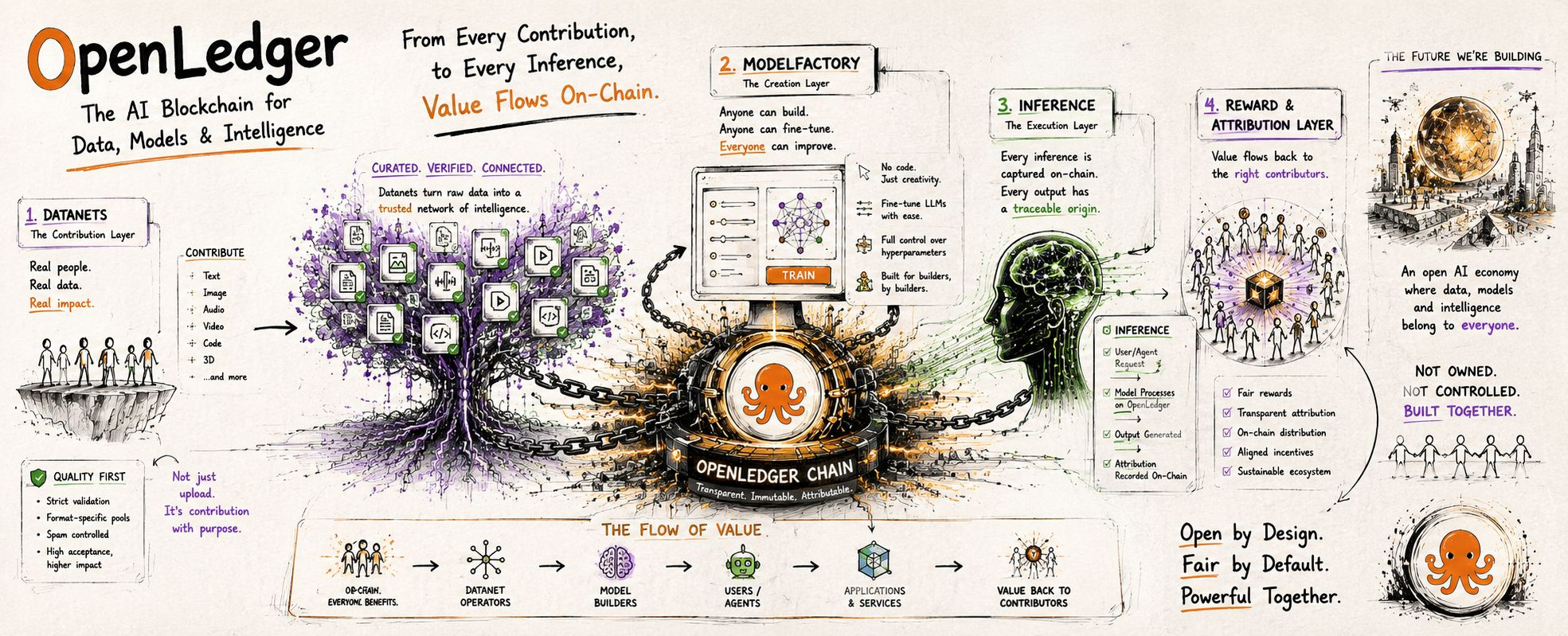
It seems built around the idea that intelligence shouldn’t simply appear as a finished product detached from its origins.
That thought kept sitting with me.
Because if AI continues scaling the way many people expect, we’re eventually going to reach a point where invisible systems start creating visible economic consequences.
At that stage, opacity stops being harmless.
It becomes a structural decision.
Who receives attribution won’t be a philosophical question anymore.
It will affect incentives.
Who gets rewarded.
Who keeps contributing.
Who controls the direction of improvement.
And that’s where OpenLedger starts feeling less like another AI narrative and more like an experiment in making those invisible layers harder to ignore.
The interesting part is that this doesn’t necessarily make things cleaner.
Actually, it probably makes them messier.
Once contribution becomes traceable, complexity rises.
Questions appear that closed systems rarely need to answer directly.
How do you measure meaningful input?
How do reward systems avoid becoming predictable enough to exploit?
How do open contribution layers protect quality without becoming exclusionary?
I don’t think there are easy answers to any of that.
And maybe that uncertainty is exactly why I find the whole thing worth paying attention to.
There’s something refreshing about infrastructure that doesn’t pretend difficult coordination problems disappear through abstraction.
Most AI products optimize for smoothness.
Everything is designed to feel seamless.
OpenLedger feels different.
It seems more willing to expose the machinery underneath, even if that means accepting a little friction.
I’m still not fully convinced whether that tradeoff becomes an advantage.
Sometimes visibility creates trust.
Other times it simply exposes how complicated everything actually is.
But I keep coming back to the same thought:
If AI is eventually going to become part of larger digital economies, then the systems organizing accountability around it will matter far more than people currently realize.
That’s probably why OpenLedger keeps holding my attention.
Not because it feels obvious.
Mostly because it feels like it’s questioning an assumption the rest of the space has quietly accepted for too long.
And usually, that’s where the most interesting experiments begin.
@OpenLedger #OpenLedger #openledger
