
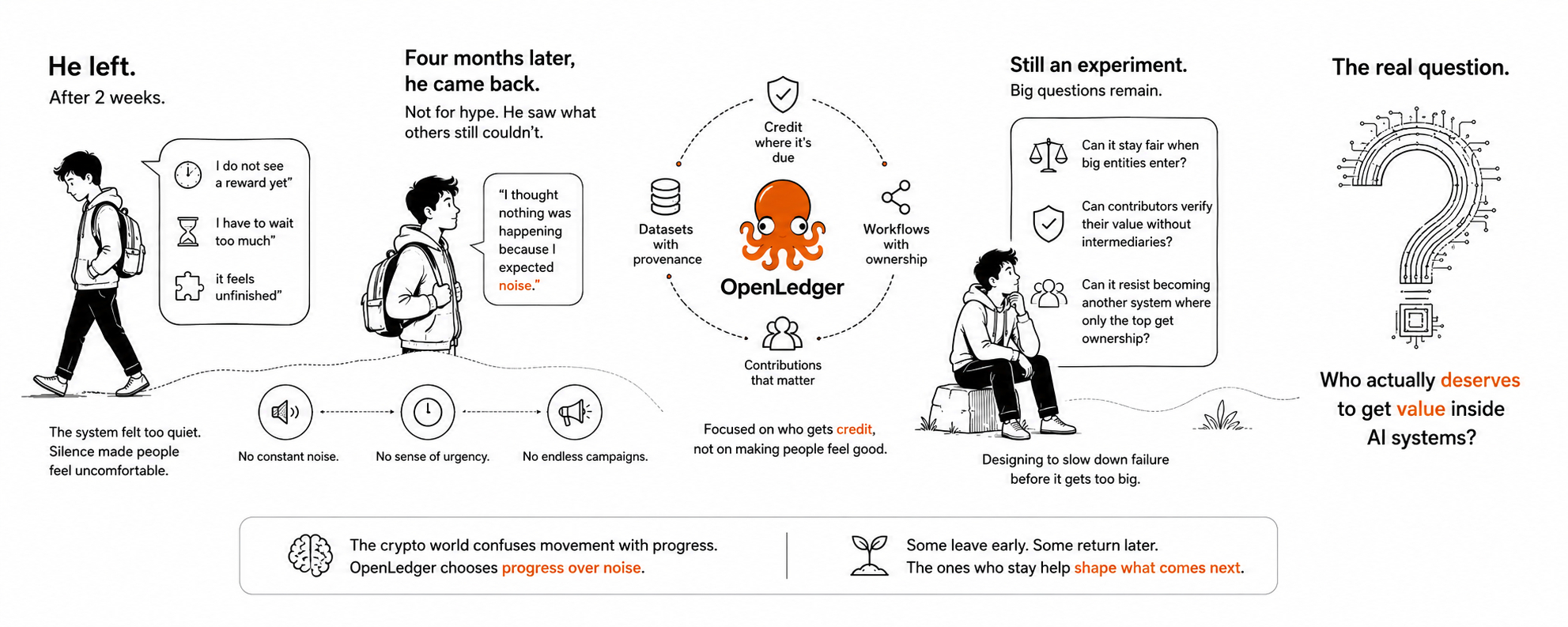
The guy left OpenLedger after two weeks.
I still remember what he said because it sounded really familiar. He said the things that a lot of developers say when things are moving slower than they expected.
He said things like "I do not see a reward yet" "I have to wait too much" and "it feels unfinished".
At that time I really understood why he felt that way.
OpenLedger was different from crypto ecosystems. It was really quiet. There was no constant noise pushing people to do things every day. There was no sense of urgency and no endless campaigns making it seem like every small thing you did would change the future overnight.
The system felt too quiet and that silence made people feel uncomfortable.
I watched him compare OpenLedger to networks where you get rewarded right away even if what you are doing does not really matter in the long run. On those systems people keep doing things because the platform is always telling them how important they are.
OpenLedger felt different from the start.
The protocol seemed to be more focused on who gets credit for what than on making people feel good.
That creates a problem.
A developer joins OpenLedger. Expects to see results right away.. Instead they enter a system where it takes time to see the value of what they are doing and sometimes it is hard to see it at all. It takes time for the importance of their work to become clear.
Most people are not patient enough to wait for that.
So the guy left OpenLedger.
For two months I barely heard his name again.. Meanwhile the ecosystem kept changing quietly. More people started talking about how to track contributions and more builders started testing how datasets and workflows connect to model ownership. There were improvements but none of them seemed dramatic from the outside.
That is probably why a lot of people still do not understand OpenLedger.
The protocol does not make a show about what it is doing.
It keeps making us think about an uncomfortable question.
Who actually deserves to get value inside AI systems?
That question gets complicated fast.
Most platforms behave like the person who creates the model deserves all the credit while the people who prepare the information are just background workers. OpenLedger at least tries to show that hidden layer of pretending it does not exist.
Does it solve the problem fully?
I do not think anyone can honestly say yes yet.
There are still things that're uncertain to me.
Systems that try to give credit fairly sound good in theory. When you try to make them big problems start to appear. It gets hard to measure who contributed what and if the incentives are not strong enough people can flood the system with low-quality work.. If the people in charge lose focus the reputation system can get manipulated over time.
I think OpenLedger knows these risks exist.
The design feels like an experiment that tries to slow down those failures before they get too big.
Experiments take time.
That is where the story gets interesting.
After four months the same developer came back to OpenLedger.
Not because of hype. Not because someone promised him easy rewards. He came back because he noticed something outside OpenLedger. Most AI ecosystems still could not explain who owns what clearly.
Everyone talks about decentralization until it is time to divide the value. Then suddenly the systems become centralized again around whoever controls deployment and distribution.
He realized OpenLedger was at least trying to address the part instead of avoiding it.
I asked him later what changed his mind. He said something "I thought nothing was happening because I expected noise".
That line stayed with me.
The crypto world has taught people to confuse movement with progress. OpenLedger moves enough that you can actually see the decisions it makes. That can. Build trust or destroy confidence depending on who is watching it.
Waiting has a cost though.
People ignore that side much. Waiting inside ecosystems creates mental exhaustion. You question your judgment and you wonder if you are wasting time while other projects get attention elsewhere. Some developers cannot tolerate ambiguity for periods.
I understand that completely.
Doubt also has a cost. Leaving early means you never stay long enough to understand why the system was designed the way it was. You judge the protocol by how it moves instead of how it is built.
I have done that myself in ecosystems before.
Sometimes I left because the project was genuinely weak. Sometimes I left because I expected clarity from systems that were still trying to solve difficult problems.
Those are not the thing.
When I look at OpenLedger now I still see questions. Can the system stay fair once big entities enter aggressively? Can contributors verify that they are getting the value they deserve without depending on intermediaries? Can the ecosystem resist becoming another system where only the people, at the top get ownership?
I do not know yet.
I think the interesting part is this: very few protocols are even asking those questions seriously. Most are still pretending that AI value appears magically at the end. Maybe that is why some developers leave early.. Maybe that is why some quietly return later after seeing how the rest of the market behaves.
