
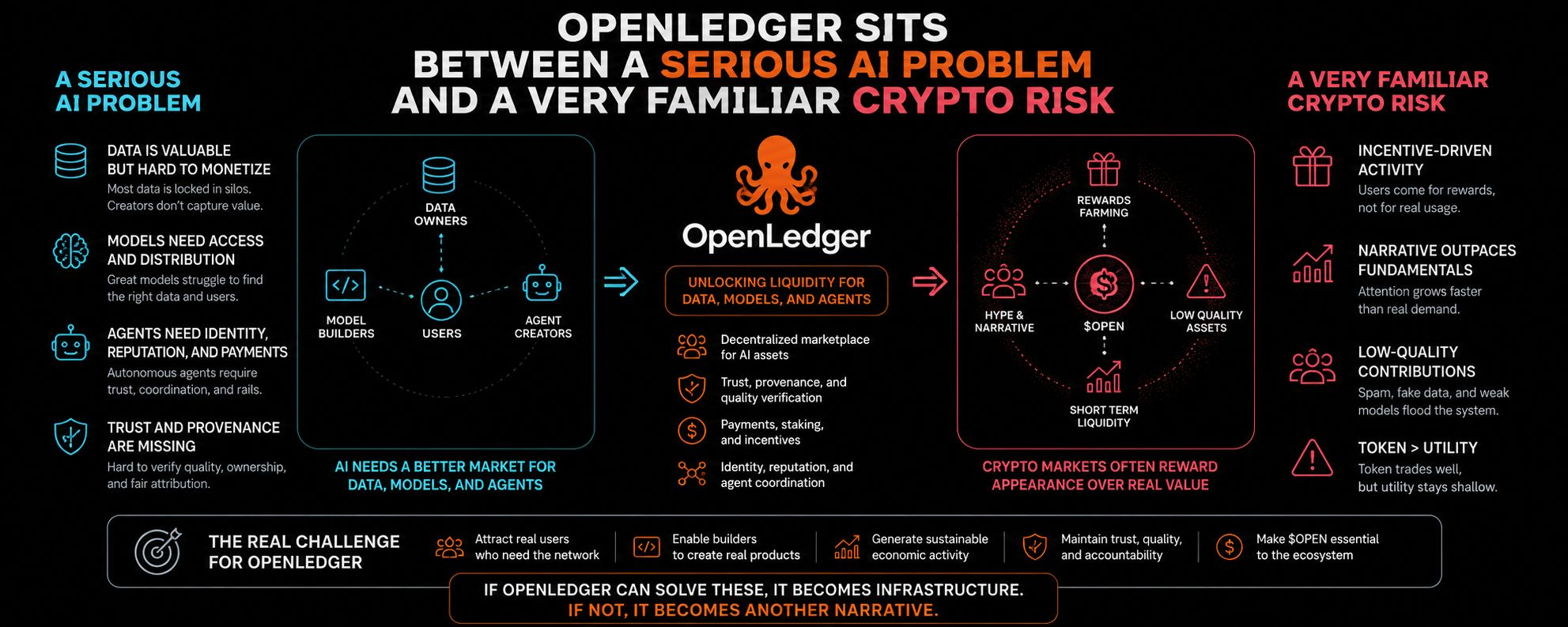
OpenLedger is still sitting in my tabs tonight, somewhere between curiosity and exhaustion, and I’m trying to decide whether it actually matters or whether I’m just looking at another well-timed crypto narrative wearing the clothes of the future. I’ve read too many whitepapers at this point to get excited just because a project puts AI, data, agents, liquidity, and blockchain in the same sentence. I’ve seen DeFi promise open finance, GameFi promise ownership economies, modular chains promise infinite scalability, and every cycle has had its own version of “this is the infrastructure everything else will be built on.” Some of those ideas were real. Some of them were early. Some of them were just liquidity events with better language. So when I look at OpenLedger, I don’t want to dismiss it, but I also don’t want to give it credit too early.
What keeps me interested is that OpenLedger is at least pointing at a real problem. Data is valuable, but most people who produce it never capture much of that value. Models are becoming more important, but monetizing them in a clean and transparent way is still messy. Agents sound like the next logical layer of the internet, but right now a lot of agent talk still feels ahead of actual demand. OpenLedger is trying to build around that messy middle, where data, models, and agents need liquidity, identity, coordination, and trust. That is not a small idea. It is also not an easy one. And maybe that is why I keep staring at it instead of closing the tab.
The part I keep circling is usage. Not the kind of usage that appears because people are farming points, chasing rewards, or trying to qualify for something later. I mean the boring kind of usage that continues when nobody is clapping. I want to know whether someone actually needs OpenLedger when incentives are lower and the market is not in a mood to reward every AI-related ticker. Does a developer need it because it makes model monetization easier? Does a data owner need it because it gives them a real path to earn? Does an agent need it because it provides identity, payments, reputation, or coordination that existing systems do not handle well? Or is most of the current interest simply because AI plus blockchain is one of the strongest combinations a project can present right now?
That question matters because crypto is very good at simulating demand. I’ve watched networks look alive because transactions were cheap, rewards were high, and users had a reason to keep clicking. I’ve watched ecosystems fill with dashboards, quests, testnets, badges, campaigns, and synthetic engagement, only to become quiet when the incentive layer changed. So with OpenLedger, I keep asking what remains after the obvious incentives disappear. If the answer is still developers, data providers, model builders, and agent activity, then there may be something real here. If the answer is mostly silence, then the project may have been borrowing attention from the AI narrative more than creating its own economy.
The token is another part I can’t ignore. OPEN has to be more than a liquid expression of the project’s story. A lot of tokens exist because crypto projects are expected to have tokens, not because the system truly needs them. If OPEN is used for access, settlement, staking, validation, rewards, governance, or some other core function, then I want to see that usage become natural over time. I want the token to sit inside the economic loop, not outside it as a speculative wrapper. A token economy becomes stronger when network activity creates demand for the token. It becomes weaker when the token’s main job is to keep attention moving.
Trust is probably the harder problem underneath all of this. A data market without trust becomes a landfill. A model market without trust becomes a collection of claims. An agent economy without trust becomes bots talking to bots and calling it adoption. OpenLedger has to deal with quality, provenance, identity, reputation, and accountability if it wants to become more than an idea. Who verifies that data is useful? Who proves that a model performs? Who decides whether an agent has a reliable history? Who prevents low-quality contributions from draining rewards? These are the kinds of questions that do not look as exciting in a pitch deck, but they decide whether liquidity is real or shallow.
I also keep thinking about who the first serious user is supposed to be. OpenLedger can speak to data owners, AI builders, developers, agent creators, and even institutions, but those are not the same people. They do not have the same needs. A developer wants tools and distribution. A data owner wants control and monetization. A model builder wants demand and attribution. An institution wants reliability, compliance, and auditability. An agent creator wants identity and transaction rails. The project may eventually serve all of them, but early adoption usually needs a sharper wedge. If the first user is too abstract, the whole thing risks becoming a broad vision without a clear pull from the market.
There is a version of OpenLedger that could be meaningful. In that version, useful data enters the system, models can access or monetize it, agents can coordinate around it, and the network helps settle value between participants. In that version, OPEN has a reason to exist because it is tied to access, incentives, verification, or liquidity inside the system. Developers build because the rails are useful. Users return because the network helps them do something they could not do as easily elsewhere. That version is worth paying attention to. But there is also another version, and I have seen that version many times. In that version, the language stays bigger than the usage, the ecosystem depends on campaigns, the token moves because the narrative is hot, and people call early activity “traction” before anyone has proved durable demand.
I’m tired enough from past cycles to respect both possibilities. DeFi taught me that real financial primitives can emerge from chaos. GameFi taught me that incentives can inflate fake economies until the game itself no longer matters. AI coins have already shown how fast capital moves toward a story before the product is ready. Modular chains showed that infrastructure can be genuinely important and still become overcrowded with projects fighting for the same developer attention. So with OpenLedger, I’m not trying to be cynical for the sake of it. I’m trying to stay sober. The market does not need another beautiful explanation. It needs evidence that the system is useful.
The agent part is probably where the imagination runs fastest. Everyone wants to talk about autonomous agents moving value, coordinating services, using models, buying data, and interacting across networks. That future may come in some form. But right now I still need to see what these agents actually do. Are they generating revenue? Are they improving workflows? Are they coordinating something that humans or existing software cannot handle efficiently? Are they creating transactions that represent real value, or are they just producing activity because the system rewards interaction? An agent with a wallet is not enough. A useful agent with reputation, demand, and accountability is where things get more interesting.
I also think regulation is going to matter more here than people want to admit. Data monetization is not a clean playground. There are questions around privacy, consent, ownership, intellectual property, and cross-border flow. AI already has governments paying attention. Add a token and an open network, and the complexity increases. If OpenLedger wants to interact with institutions or serious data providers, it cannot live only in the vague language of decentralization. It will need systems that make people comfortable using it in environments where legal risk matters. That may slow things down, but it could also separate serious infrastructure from short-lived speculation.
Liquidity is the word that keeps coming back, but I try to be careful with it. Liquidity can mean a token trades well. It can also mean assets inside the network are actually being priced and exchanged. Those are not the same thing. OPEN can have market liquidity while the underlying data, model, and agent economy is still thin. The stronger signal would be liquidity forming inside the system itself, where participants exchange value because they need what others are offering. That is harder to fake. It is also much more important.
So I’m left in this familiar late-night place, interested but unconvinced. OpenLedger is not something I would ignore, because the problem it is aiming at is real. AI needs better ways to handle data, attribution, model access, identity, and autonomous coordination. Crypto rails could help with some of that. But I’ve seen enough cycles to know that being near a real problem does not automatically make a project the solution. The hard part is turning the thesis into usage, usage into economic activity, and economic activity into sustainable token demand.
For now, I’m watching OpenLedger like I watch projects that might matter but have not earned full conviction yet. I want to see developer activity that survives beyond campaigns. I want to see users who are not only farming. I want to see data and models that people actually want. I want to see agents doing something more useful than creating noise. I want to see OPEN used because the network requires it, not because the market likes the story. Maybe OpenLedger becomes a real coordination layer for AI assets. Maybe it becomes another narrative that looked clean in the whitepaper and messy in execution. I do not know yet. And honestly, after enough cycles, that uncertainty is the most honest place to start.
