
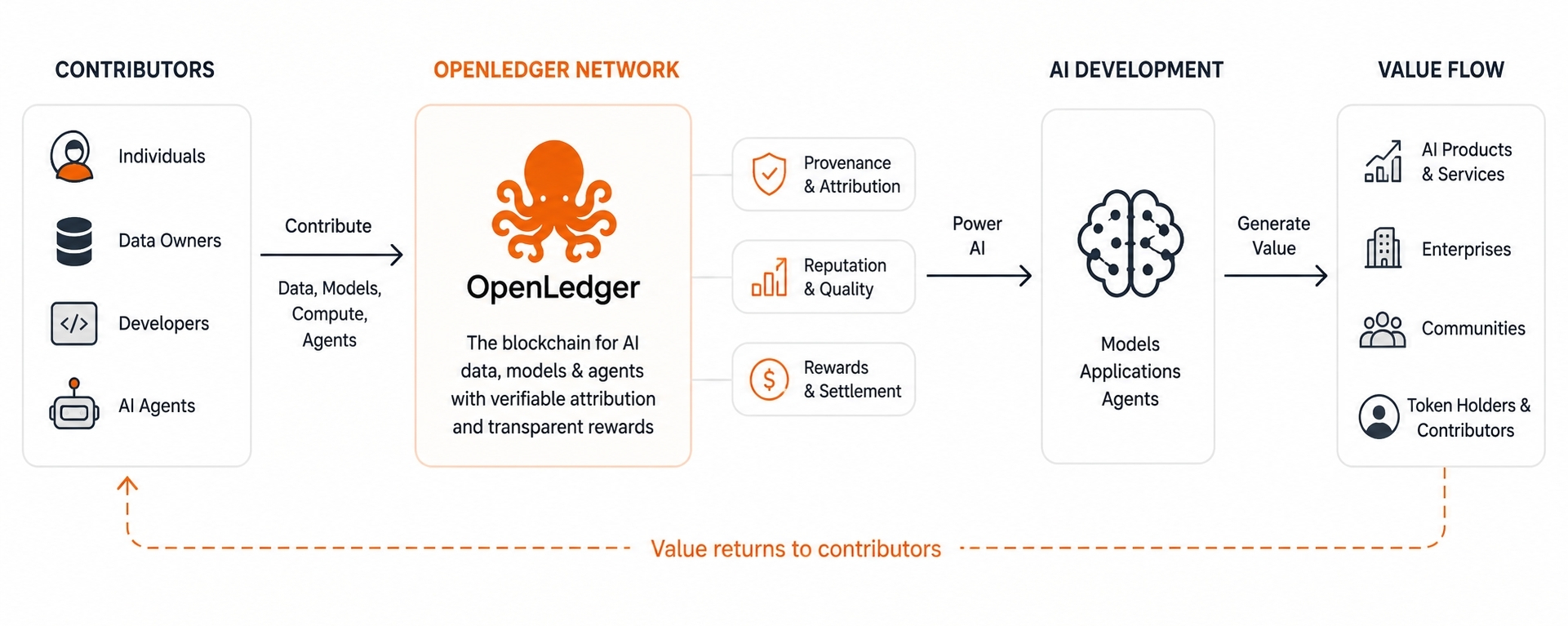

I think OpenLedger becomes more interesting when I stop looking at it as another AI-related crypto project and start looking at it as a reaction to a growing imbalance that has quietly developed beneath the AI economy.
For the past few years, most of the attention has gone toward models. Bigger models, smarter models, faster models. Every discussion seemed to revolve around who had the best technology and who could build the most capable systems. What rarely entered the conversation was the fact that these systems depend on an enormous amount of external input to exist in the first place.
AI often gets presented as if intelligence simply emerges from computation. The reality is much less elegant. Models are built on data, human behavior, human expertise, human conversations, and countless pieces of information collected from people who may never know where their contributions eventually end up.
That disconnect is where OpenLedger appears to be positioning itself.
What caught my attention is that the project is not really trying to solve an intelligence problem. The industry already has countless teams competing to build better AI. OpenLedger seems more interested in what happens around the intelligence. Who contributes. Who gets recognized. Who gets rewarded. Who gets forgotten.
The reason that matters is because AI is gradually turning data into something that looks less like information and more like an economic resource.
A few years ago, data was mostly discussed in abstract terms. Companies collected it because it improved products. Users generated it because that was simply part of using the internet. The value existed, but it was difficult to isolate.
AI changed that perception.
Now every dataset feels like a potential asset. Every interaction feels like a potential input. Every piece of knowledge suddenly carries a clearer economic purpose than it did before.
The market is beginning to realize that AI models are only as valuable as the information flowing into them. That sounds obvious, but I don't think we've fully absorbed the implications yet.
Because once data becomes valuable enough, people inevitably start asking questions about ownership and compensation.
Not because they're ideological.
Because incentives eventually force the conversation.
I've noticed that crypto often approaches these situations with the same instinct. If value is being created, then create a system that tracks it. If contributions matter, then measure them. If people generate something useful, then find a way to reward them.
Sometimes that logic works.
Sometimes it runs directly into human behavior.
That's the part I keep thinking about when I look at OpenLedger.
The project assumes that attribution matters. It assumes contributors want proof of participation and that markets will eventually care about where data originates.
I don't think that's an unreasonable assumption. In fact, I suspect the AI industry is moving in that direction.
But history makes me cautious.
The internet is filled with examples where identifying value creation turned out to be easier than assigning value fairly. Countless people contribute to products, networks, and platforms every day without receiving direct compensation. Open-source software is full of examples. Social media is full of examples. Even crypto itself has countless examples.
People create value together, but markets rarely reward everyone equally.
That's why I don't see OpenLedger as a project trying to solve a technical challenge. I see it as a project attempting to solve an economic coordination challenge.
The technology is only one piece of the equation.
The harder question is whether participants actually want the system being proposed.
Will businesses voluntarily share attribution data if it creates additional complexity?
Will developers prioritize transparent contribution tracking when speed is often more important?
Will users care enough about data ownership to change their behavior?
Those questions matter more than whatever technology stack sits underneath the project.
At the same time, I understand why something like OpenLedger is emerging now rather than five years ago.
The AI industry is reaching a stage where the inputs are becoming almost as important as the outputs.
When AI was experimental, nobody worried much about where the fuel came from. Everyone was focused on proving the technology worked.
Now the technology clearly works.
The conversation is slowly shifting toward who controls the resources that make it possible.
That's a different discussion entirely.
What makes OpenLedger interesting is not the idea that data has value. Most people already accept that.
The interesting part is the belief that value can be tracked, attributed, and distributed in a way that creates a healthier market around AI.
Maybe that's true.
Maybe future AI networks require transparent systems that connect contributors to the value they help create.
Or maybe the industry discovers that contribution is far messier than it appears from a distance.
The more intelligence becomes collective, the harder it becomes to separate one person's contribution from another's.
That tension keeps pulling me back to OpenLedger.
Not because I know whether the model succeeds.
But because it is one of the few projects that seems focused on a question the AI market still hasn't answered.
Everyone wants to talk about who owns the models.
Far fewer people are asking who owns the ingredients.