
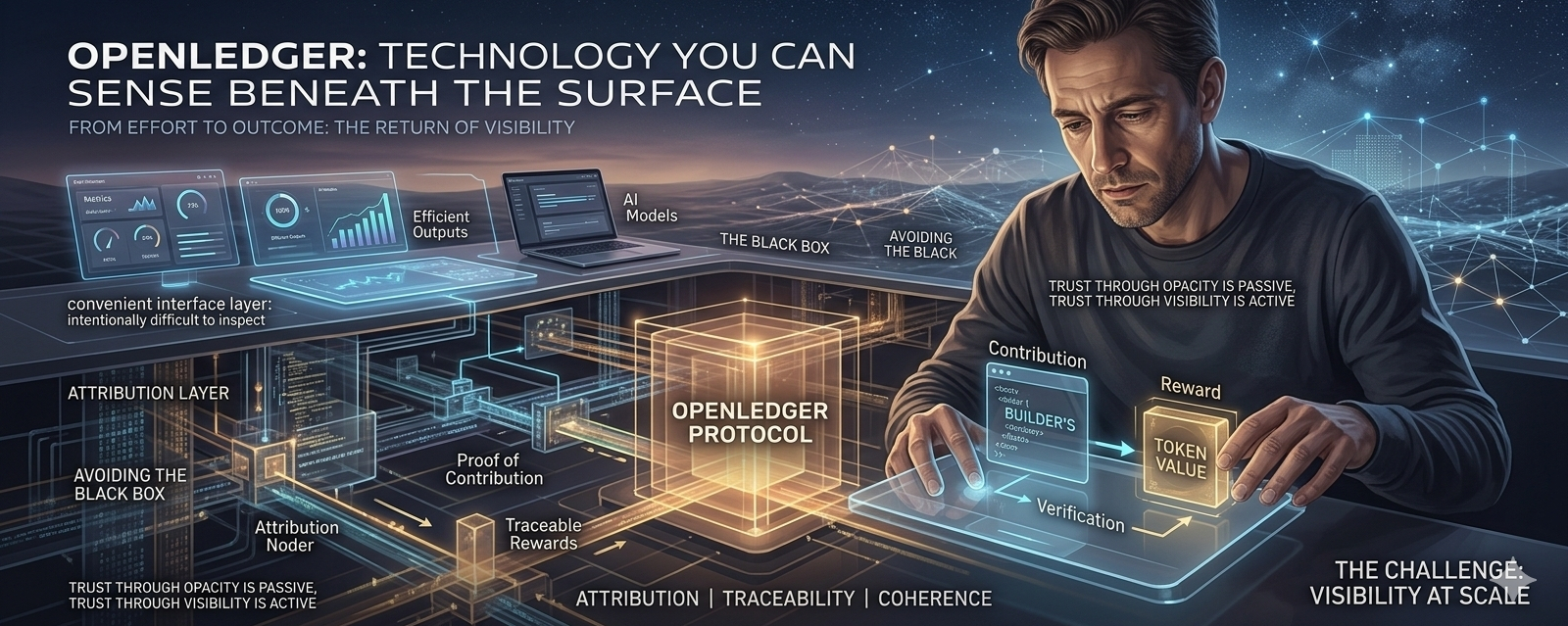
There are certain projects that do not immediately create excitement in me anymore. Usually the first feeling is distance, because after spending enough time around technology markets, especially in areas where infrastructure and AI are discussed with endless optimism, I have become more cautious about anything that looks too polished too quickly. I have seen too many systems designed to impress people at the surface level while quietly hiding the mechanisms underneath that actually determine where value goes, who benefits, and why the entire structure works in the first place. Over time that pattern changes the way you look at new products. You stop reacting to presentation alone and start paying attention to whether the system itself feels coherent beneath the appearance. That was the feeling I had while going deeper into Openledger. It did not strike me as something trying too hard to sell a futuristic image. Instead, it felt more like a serious attempt to reduce the growing distance between the technology operating in the background and the people interacting with it at the front. And honestly, that difference stayed with me longer than I expected.
What makes many modern systems feel strangely disconnected is not simply that they are technically complicated. Complexity by itself is not the real issue anymore. The bigger problem is that people have lost the ability to feel the relationship between their actions and the infrastructure processing those actions underneath. Users interact with outputs without understanding how they were formed. Builders contribute data, models, and effort into systems that often absorb everything silently, returning results without leaving behind any visible trail showing how value moved through the machine. Eventually the experience becomes smooth, but emotionally distant. People continue using the system because it functions, yet they stop feeling grounded inside it. That separation creates a subtle weakness which most projects underestimate. When participants cannot sense where they stand within the flow of value creation, trust slowly becomes passive instead of active. Users depend on the system, but they no longer truly understand it. Builders contribute, but they no longer feel recognized by the structure itself. Somewhere between convenience and opacity, the connection disappears.
What caught my attention with Openledger is that it seems to understand this problem at a deeper level than most projects currently do. Instead of treating infrastructure as something that must remain completely invisible for the experience to feel good, it appears to approach visibility with more balance. Not exposing technical complexity in a chaotic or overwhelming way, but allowing enough transparency for contributors and users to still feel connected to the operational logic beneath the surface. That is a very different philosophy from what dominates much of the market today. Most systems focus almost entirely on reducing friction at the interface layer while leaving the economic and verification structures underneath increasingly abstract. Everything becomes easier to click, faster to access, smoother to navigate, yet harder to meaningfully understand. Openledger feels different because it does not seem interested in hiding the machinery entirely. Instead, it tries to let the infrastructure show itself precisely where that visibility strengthens trust rather than weakening the experience.
The more I thought about it, the more I realized this is not simply a design decision. It feels closer to an attempt at reorganizing the relationship between contribution, verification, and reward inside digital systems. In many environments today, data enters the network quietly, models evolve somewhere behind closed walls, and contributors rarely gain a clear understanding of how their participation continues shaping outcomes afterward. The process works, but it often works in a way that feels detached from the people sustaining it. Openledger appears to push against that detachment by making attribution and traceability feel more central to the operational flow itself. That matters because people eventually stop trusting systems that continuously absorb value while revealing almost nothing about how that value is processed or redistributed. A structure may remain efficient for a while under those conditions, but efficiency alone rarely creates long-term alignment between builders, users, and infrastructure.
I think that is why this project stayed in my mind longer than many other AI narratives I come across. It feels less focused on presentation and more focused on preserving continuity between effort and outcome. Builders are not treated as invisible suppliers feeding raw material into a machine that erases their presence once the process begins. Users are not expected to consume outputs while remaining completely disconnected from the structures generating them. There is an attempt here to preserve orientation inside the system, allowing participants to feel that the outputs they receive are tied to visible principles rather than hidden extraction. And honestly, that creates a very different emotional texture around the experience. Technology begins to feel less like a sealed black box and more like an environment people can actually locate themselves within.
At the same time, I do not look at this idea with blind optimism because the difficult part begins exactly where the philosophy becomes most attractive. Any system that places serious importance on attribution, transparency, and contribution tracking eventually faces enormous pressure around execution. It must prove that meaningful participation can be separated from manipulation, that verification layers remain efficient instead of becoming burdensome, and that openness does not slowly collapse under spam, low-quality inputs, or reward farming behavior. In other words, the strongest part of the idea is also the part most vulnerable to failure if the operational discipline underneath is not strong enough. Many projects speak beautifully about transparency until scale begins introducing friction, incentives become aggressive, and maintaining fairness becomes far more difficult than describing it in theory. That is why I see Openledger less as an easy success story and more as a very serious structural test. The real challenge is not simply making infrastructure visible. The challenge is making it visible while still keeping the experience coherent, scalable, and trustworthy over time.
Still, I respect the direction because it moves against a habit the industry has normalized for years. Markets became too comfortable rewarding systems based almost entirely on surface quality while paying far less attention to how value actually circulates underneath. Smoothness became easier to market than accountability. Interfaces became easier to optimize than contribution flows. Entire ecosystems learned how to perfect appearance while leaving the deeper mechanics intentionally difficult to inspect. And eventually that imbalance created products people could use efficiently without ever truly feeling connected to them. The older I get around these systems, the more I realize that long-term trust does not emerge from convenience alone. People need to feel that the structure responds according to understandable principles rather than invisible decisions occurring somewhere beyond their reach.
After sitting with Openledger for a while, what remains with me is not the usual excitement the market tends to chase. It is something quieter and probably more important. The feeling that this project is trying to return attention to a question technology should have never ignored in the first place. If infrastructure becomes so abstract that nobody can feel how contribution transforms into outcome anymore, then eventually even the smoothest experience starts losing depth. But when a system allows people to sense the relationship between effort, operation, verification, and reward without drowning them in unnecessary complexity, technology begins feeling less distant and more human again. And honestly, that may be far rarer today than most people realize.
