
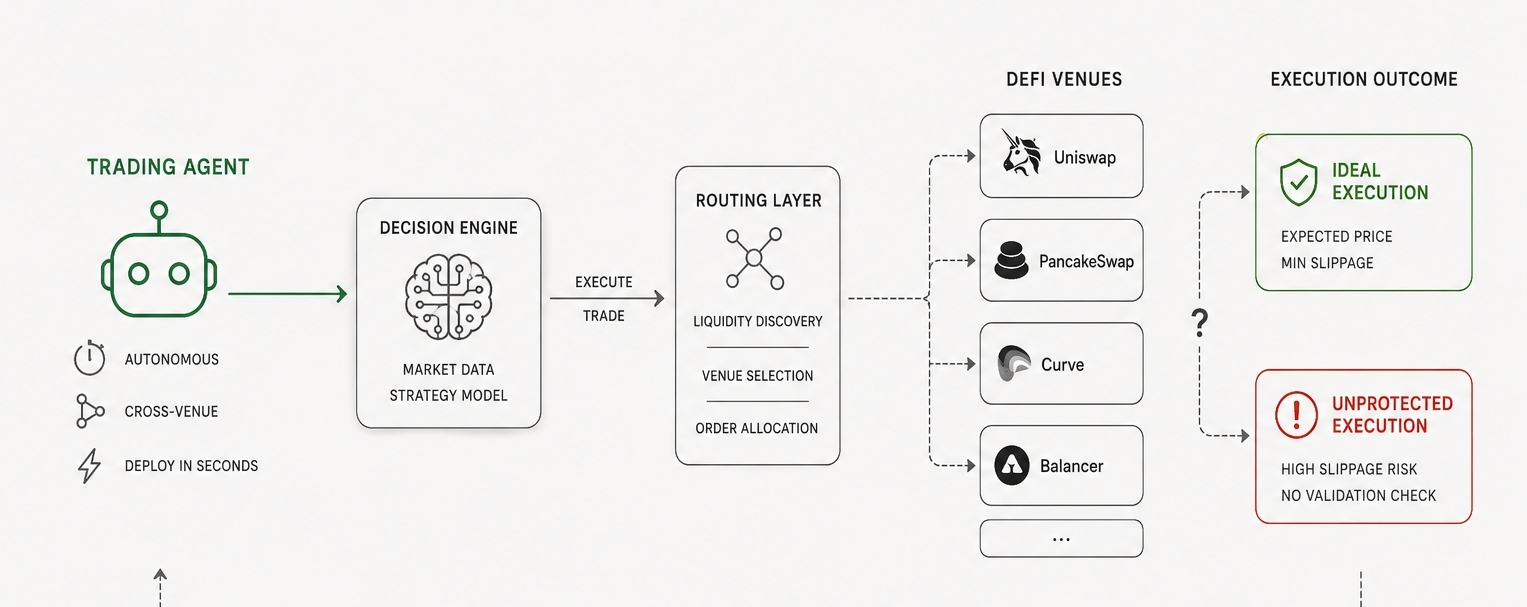
I was reading through OpenLedger's trading agent documentation the other day, the kind of reading you do when you are genuinely curious rather than looking for a verdict.... and I kept arriving at the same sentence. "Deploy in seconds across DeFi venues." It is a clean line. Efficient. The kind of thing that sounds immediately useful if you have ever tried to manually coordinate a position across multiple protocols and felt the operational weight of that process. I understood the appeal immediately.
But I also kept reading past it, looking for the next sentence.... the one that explains what happens after the deployment.
- - - - - - - - -
The word that tends to travel through agent-based DeFi products right now is "automation." It shows up in almost every pitch, every framing document, every ecosystem announcement. And I do not think it is cynical to notice that.... because the problem it points to is real. The operational friction of DeFi participation is genuinely high. Monitoring positions, timing entries, managing exits across venues with different liquidity profiles and fee structures.... that is work. Meaningful work. The kind that has historically required either dedicated attention or expensive infrastructure. So when a system says it can absorb that complexity, the instinct to lean in is reasonable.
But here is what I keep thinking about.... automation, in a trading context, is only as good as its execution layer. The decision to enter or exit a position is one thing. What happens in the milliseconds between that decision and the on-chain settlement is something else entirely. That gap is where slippage lives. It is where execution quality either holds or degrades. And it is the part of the system that, under normal conditions, you almost never have to think about.... until you do.
- - - - - - - - -
So let me try to work through what the trading agent feature actually describes, and where the description gets quieter than I would like it to be.
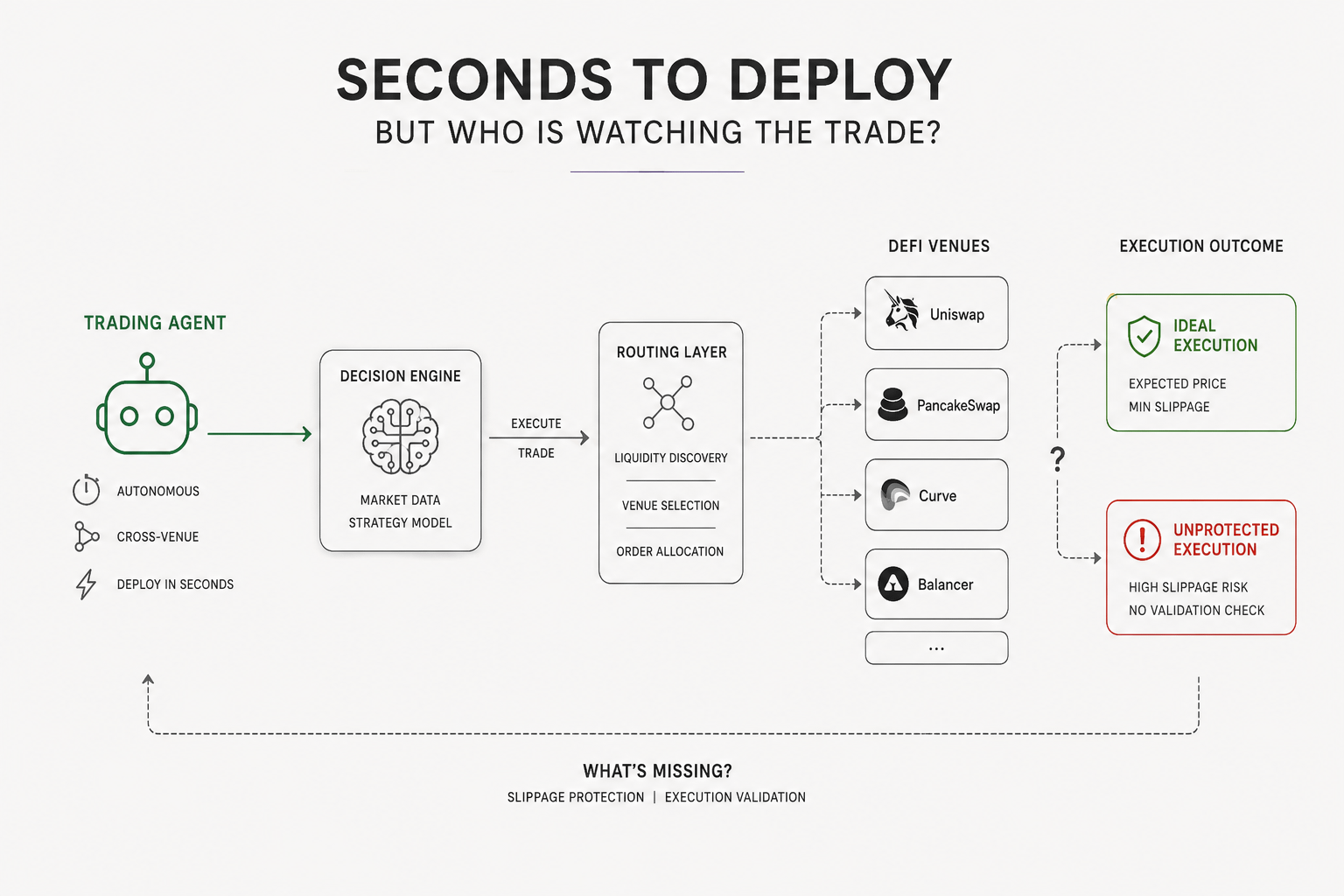
First is the deployment speed. The system promises that an agent can be positioned across DeFi venues in seconds. That is the entry point, the thing that makes the feature feel accessible and powerful. The implication is that the agent can move faster than a human operator, which in volatile markets is often the difference between a clean entry and a costly one.
Second is the cross-venue reach. The agent does not operate inside a single protocol. It moves across venues, which suggests some kind of routing logic underneath.... a layer that identifies where execution is available and allocates accordingly. That is not a trivial piece of infrastructure to build, and if it is working well, it adds genuine value by expanding the surface area of available liquidity.
Third is the autonomy. The agent acts without requiring per-trade human confirmation. This is where the speed and reach combine into something that is either very useful or very exposed, depending entirely on what is sitting between the agent's decision and the transaction's settlement.
What I cannot find described, anywhere in the available framing, is a slippage protection layer. I cannot find a described mechanism for execution validation.... something that checks whether the conditions under which the agent decided to act still hold by the time the transaction is actually submitted. Those two things are not edge-case concerns. They are the operational foundation of any execution system that touches live markets.
- - - - - - - - -
And this is where I want to slow down a little, because I think the absence is worth examining carefully rather than just flagging.
In calm market conditions, slippage is often small enough that it does not matter much. A position executes close to the modeled price, the yield or return is approximately what the agent expected, and the whole system feels like it is working. The speed advantage is visible. The cross-venue reach is visible. The absence of a validation layer is invisible, because nothing has tested it yet.
Volatile conditions change that picture completely.... and they tend to change it quickly, which is exactly when an agent operating without slippage protection becomes most exposed. A position that made sense at the price the agent observed can stop making sense in the time it takes for the transaction to clear, particularly if the venue's liquidity depth is thinner than it appeared at the moment of observation, or if another large order hits between the agent's decision and the settlement. The agent, operating autonomously, has no described mechanism for recognizing that the terms of the trade have shifted. It executes anyway. The slippage is absorbed, silently, into the outcome.
The absence of an execution validation layer compounds this. Validation, in this context, would mean something like: before submitting the transaction, confirm that the current execution conditions are still within acceptable parameters relative to the conditions that triggered the decision. That check is what separates a system that is fast from a system that is both fast and safe to run without supervision. OpenLedger's broader infrastructure, built around data quality and model reliability, seems oriented toward exactly this kind of verification at the intelligence layer. Whether that orientation extends into the execution layer of the trading agent specifically is something the current documentation leaves open.
- - - - - - - - -
I want to be careful here about what I am actually saying.... because I think there is a version of this observation that slides into unfair critique, and I do not want to go there.
OpenLedger is describing infrastructure that is still being built and articulated. The absence of a described slippage protection mechanism is not necessarily the absence of one. It may reflect documentation that has not yet caught up with implementation. It may reflect a design decision to surface that layer later, once the core deployment mechanics are established. It may mean that the team considers it part of a broader execution stack that is not yet public.
What it means for a user or analyst reading the current framing, though, is that a gap exists between what is promised and what is explained.... and that gap becomes a real operational risk under the conditions where the agent's autonomy is most valuable and most dangerous simultaneously. The seconds-to-deploy promise is compelling precisely in volatile moments. Those are the same moments when unprotected execution is most likely to produce outcomes nobody modeled.
So I find myself sitting with something that is neither enthusiasm nor dismissal.... which is probably the right place to sit with most infrastructure that is genuinely early and genuinely ambitious.
The trading agent feature points toward something worth building. Autonomous execution across DeFi venues, if it works well, changes what is operationally possible for a wide range of participants. But "works well" carries more weight than the deployment speed framing suggests. It includes what happens when markets move against the agent mid-execution. It includes whether the system can recognize bad execution conditions and respond to them before the transaction is irreversible.
The speed is visible. The protection layer, if it exists, is not yet....
And in a space where the gap between a fast trade and a safe trade can be measured in seconds, that is the part I would want to understand before I let the agent run.