
I’ve been around this market long enough to know that every cycle eventually finds a new story to sell. A few years ago it was DeFi changing finance forever. Then NFTs became the future of culture. After that came metaverse worlds that people barely visit now. Today the spotlight belongs to AI.
And somewhere inside that growing noise sits OpenLedger.
Late at night, while scrolling through wallets, token flows, community activity, and scattered discussions online, I kept asking myself the same thing. Is this actually infrastructure, or is it another polished narrative wrapped around market excitement?
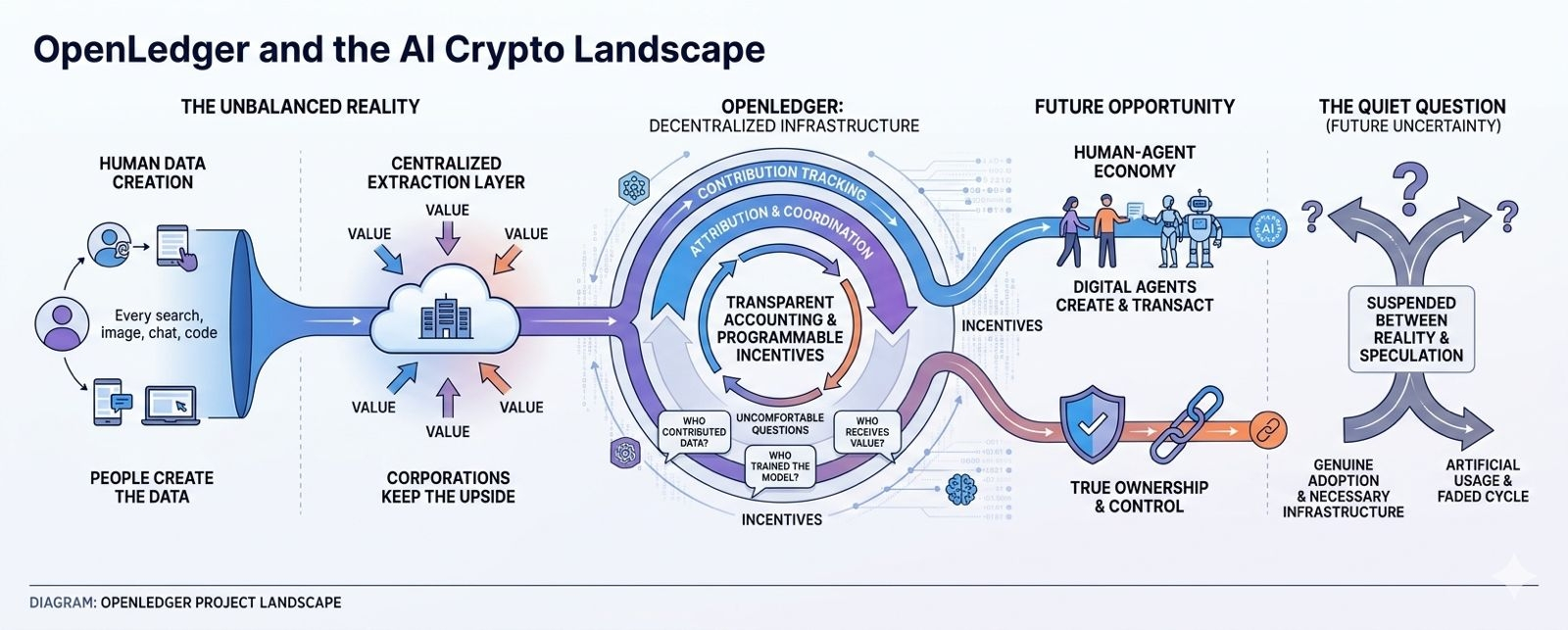
That question matters more now because AI is no longer just a tech trend. It’s quietly becoming part of everyday digital life. Every search, every image, every conversation, every piece of code people post online becomes fuel for machine learning systems somewhere in the background. Humans are constantly producing value, but most of that value disappears into centralized platforms that own the entire extraction layer.
People create the data. Corporations keep the upside.
That imbalance feels real. Probably more real than most crypto narratives I’ve seen recently.
This is where OpenLedger caught my attention. Not because it promises “AI + blockchain.” Honestly, almost every new project says that now. The words have started losing meaning. Everyone claims decentralization. Everyone talks about ownership. Everyone says they are building the future economy.
But very few projects explain how value actually moves.
What OpenLedger seems to focus on is attribution and coordination. Who contributed data? Who trained the model? Who receives value when AI systems produce output using that information? Those are uncomfortable questions because the current internet barely tracks any of it fairly.
At least the project appears to recognize the problem.
Still, recognizing a problem and solving it are two completely different things.
Crypto has always been good at manufacturing activity. Incentives create movement very quickly. Wallet numbers rise. Transactions increase. Communities suddenly appear everywhere. But a lot of that activity disappears once rewards slow down. I’ve seen entire ecosystems go silent the moment free money stopped flowing.
That’s why I keep looking beyond the surface.
Some of the activity around OpenLedger feels genuine. Developers experimenting. Curious users testing systems. Conversations that don’t look entirely forced. But there’s also behavior that feels familiar in a different way. Sudden wallet clusters. Short-term participation spikes. Patterns that look more incentive-driven than naturally adopted.
Maybe that’s normal for an early-stage network. Maybe every infrastructure project starts this way. Speculators usually arrive before real users do. Crypto history proves that repeatedly.
But it still matters.
Because eventually every project reaches the same moment where incentives stop carrying the entire system. That’s when reality shows up. Either people continue using the network because it solves something meaningful, or activity slowly fades into another forgotten cycle.
That future question hangs over OpenLedger too.
The token model itself also raises difficult thoughts. If participation depends too heavily on emissions and rewards, then usage can become artificial. Real infrastructure survives because people need it, not because they are temporarily being paid to appear active.
And AI infrastructure is expensive by nature. Coordination systems are difficult to build. Attribution sounds powerful in theory, but most users historically choose convenience over ownership. People talk about privacy and control, then hand over their data instantly for smoother experiences.
That’s the uncomfortable reality most crypto projects eventually collide with.
OpenLedger is not only competing against other chains or AI protocols. It’s competing against massive centralized companies that already control distribution, products, users, and capital at a scale crypto still struggles to match.
That’s not an easy environment to survive in.
Still, I can’t fully dismiss what’s happening here.
Something bigger may be forming underneath the speculation. AI systems are slowly becoming participants in the economy rather than simple tools. Digital agents will eventually create, transact, negotiate, and interact across networks without constant human involvement. If that future develops even partially, systems that track attribution, ownership, and value distribution could become important.
Maybe even necessary.
And blockchain networks, despite all their flaws, are still one of the few environments designed around transparent accounting and programmable incentives. That part keeps pulling my attention back.
The uncertainty is what makes projects like OpenLedger difficult to judge honestly right now.
Execution risk is everywhere. Adoption risk too. Regulation remains unclear. Competition grows daily. And there’s always the possibility that users simply won’t care enough about ownership to change their behavior.
Markets often mistake attention for permanence.
I’m not convinced OpenLedger has already solved anything. But I’m also not comfortable dismissing it entirely. Sometimes real ideas arrive wrapped inside speculative cycles. Other times speculation simply imitates importance long enough for people to believe it.
Right now, OpenLedger still feels suspended somewhere between those two outcomes.