

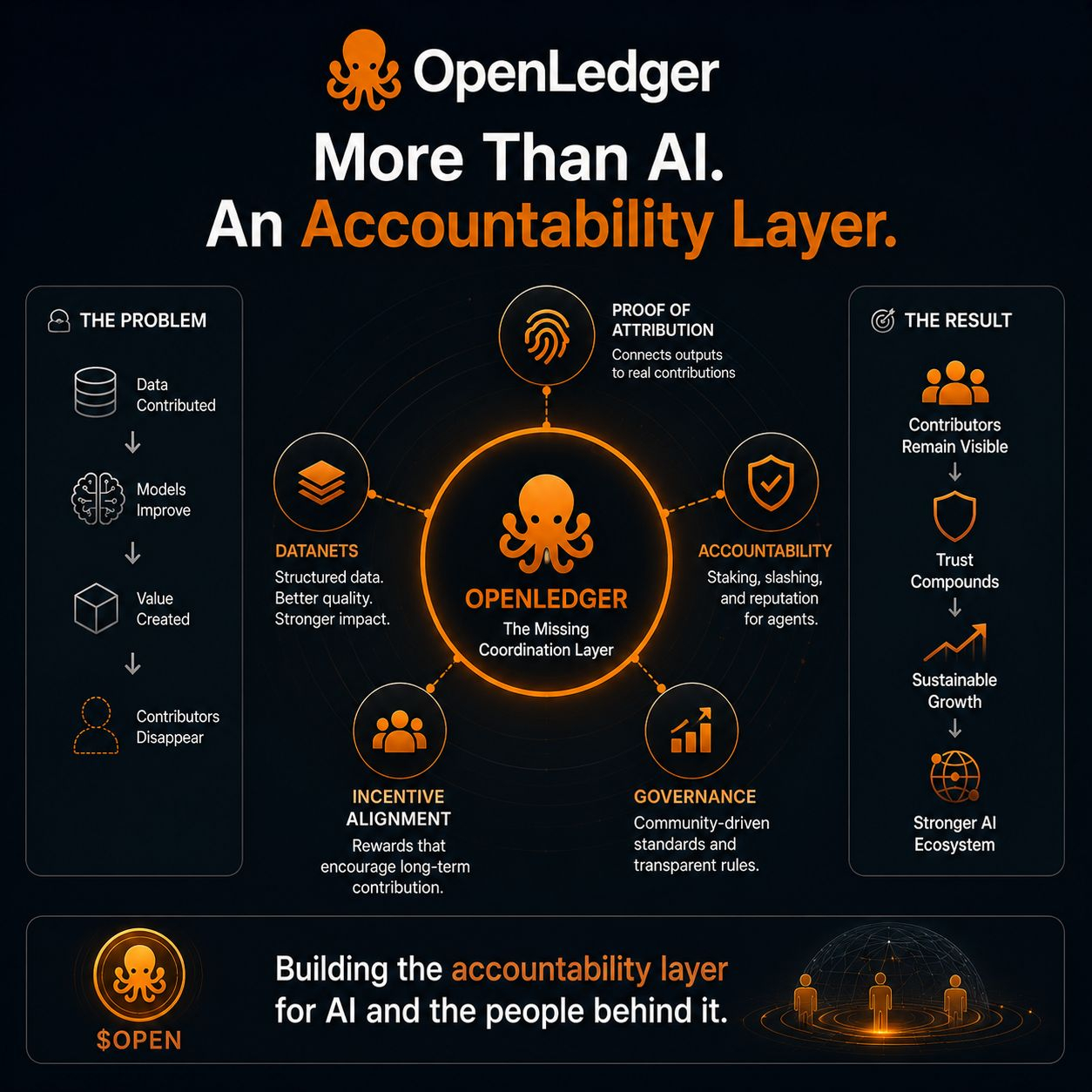
The longer I watch the AI space evolve, the more I feel like the real problem is not intelligence itself. Models already generate impressive outputs. The uncomfortable part is that the systems behind them still struggle to remember where the value actually came from.
Data gets collected.
Models improve.
Products become more powerful.
And somewhere along the way, the contributors disappear into the background.
That’s the part OpenLedger keeps pulling my attention toward.
The project does not feel built around the idea that AI simply needs more scale or more compute. It feels more focused on the missing coordination layer underneath intelligence itself — attribution, provenance, contribution tracking, and the ability for systems to recognize the people and datasets shaping outcomes over time.
What interests me is that OpenLedger seems to approach this less like a marketing concept and more like infrastructure discipline.
The idea behind Proof of Attribution sounds simple on the surface: connect model behavior back to the data and contributions that influenced it. But once you think about how complicated modern AI systems actually are, you realize attribution is not a cosmetic feature. It changes incentives completely.
If contributors believe their inputs remain visible after the model becomes useful, behavior naturally shifts.
People care more about quality.
Datasets become more organized.
Builders think longer term.
Participation stops feeling purely extractive.
That’s probably why systems like Datanets and attribution tracking matter more than most people currently realize. They are not only technical layers. They shape the social behavior around the network itself.
I also think OpenLedger is interesting because it doesn’t seem obsessed with removing every form of friction. A lot of crypto projects chase growth by making participation instant and incentives aggressive. But infrastructure built too quickly usually inherits fragile behavior later.
OpenLedger feels more restrained than that.
Things like staking, governance thresholds, attribution records, slashing mechanisms for agents, and verifiable contribution systems all suggest the project understands that openness without accountability eventually breaks coordination quality.
And honestly, that tension might become one of the biggest problems in AI infrastructure over the next few years.
Everyone wants autonomous agents, collaborative models, and permissionless participation. But once those systems start interacting economically, trust becomes critical.
Who verifies quality?
Who absorbs failure?
Who proves that outputs are reliable?
That’s where OPEN starts becoming more interesting to me.
Not only as a utility token, but as part of a broader coordination layer connecting incentives, participation, reputation, and accountability together.
Still, I think the real test is much simpler than the architecture diagrams.
Do people continue contributing after the excitement fades?
Do developers keep building when incentives normalize?
Do integrations survive beyond campaign cycles?
That’s usually where infrastructure either matures or quietly collapses.
And honestly, OpenLedger feels like one of the few AI-related crypto projects currently trying to think seriously about that stage before it arrives.
Maybe that discipline becomes its advantage later.
Because real infrastructure rarely wins by being the loudest thing in the room.
Usually it wins by becoming dependable enough that people slowly stop imagining alternatives.