
I used to think yield vaults were simple. Deposit USDC. Earn yield. Withdraw later. Clean.
Then I tried to build something on top of them. An aggregator that moves funds across three different strategies. A dashboard that tracks performance across ten vaults. An AI agent that rebalances based on market conditions.
Every vault broke the pattern. Different deposit functions. Different share accounting. Different withdrawal logic. What should have taken a day took a week. What should have been composable wasn't.
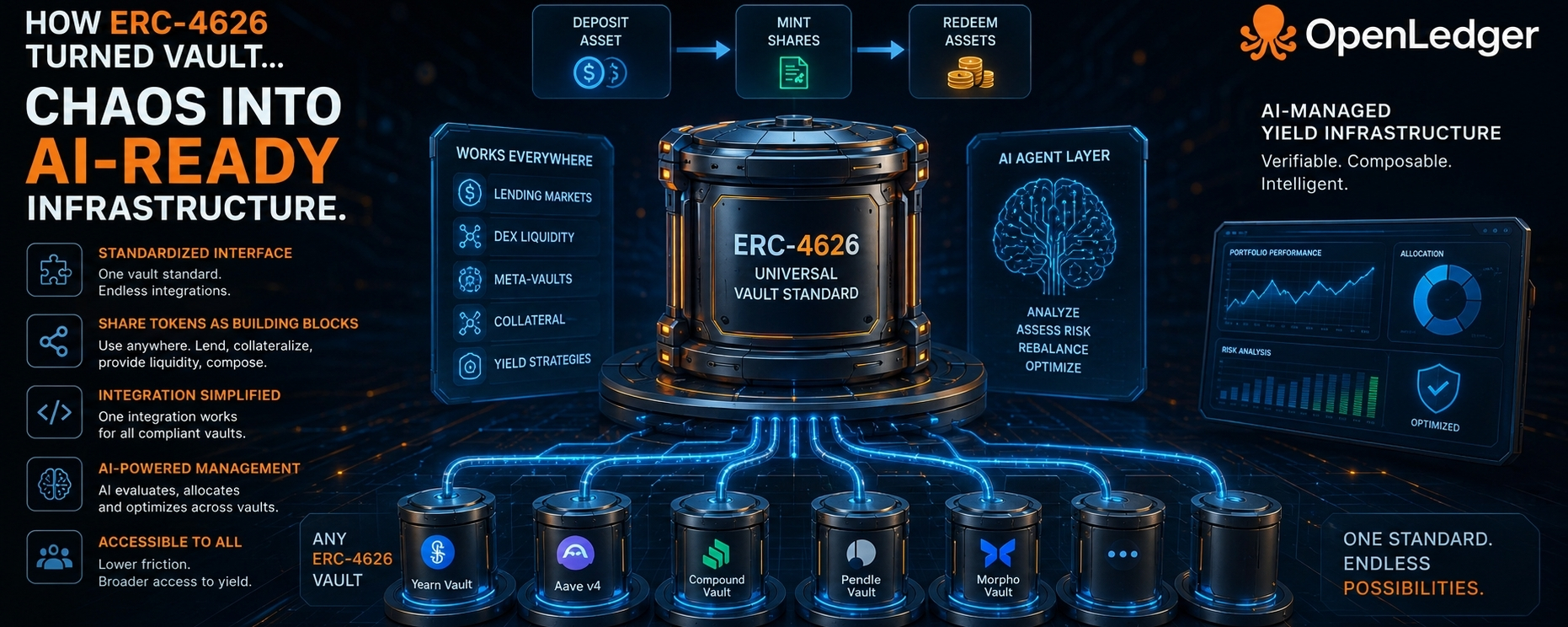
ERC-4626 solves that by creating a universal interface for tokenized vaults. You deposit an asset, you receive shares. The exchange rate starts at one-to-one. As the vault generates yield, the share price rises. When you exit, you redeem shares for your proportional assets. Same math, every time.
That sounds technical. But watch what it enables.
First, share tokens become building blocks. An ERC-4626 share can go anywhere a normal ERC-20 can. Collateral in lending markets. Liquidity in pools. Input into higher-order vaults. Lending markets already accept these shares as collateral — you can borrow against a position that's still earning yield.
Second, integration complexity collapses. Aggregators and risk tools no longer need custom code for each vault. They just read the standardized functions. One integration works for all compliant vaults.
This is where OpenLedger enters.
The platform officially adopted ERC-4626 in March 2026, integrating the vault model to advance AI-managed yield-bearing assets in DeFi. Rather than each protocol building its own vault logic, builders can now depend on a continuous interface that enhances compatibility across applications.
I keep thinking about the AI agent use case. An agent managing liquidity across DeFi needs to evaluate multiple vaults quickly. With ERC-4626, it can — because every vault speaks the same language. The agent calculates expected yields, assesses risk profiles, executes rebalancing. All without custom integrations for each destination.
Standardized vault rails enable automatic capital allocation. Funds deploy efficiently across strategies without constant manual observation. That's not just convenient. It's necessary for AI at scale.
The other layer is accessibility. Retail users who don't have the technical expertise to manually manage diverse DeFi positions benefit from automatic vault management. The friction decreases. Yield becomes more accessible to a broader audience.
But there's a nuance the standard doesn't solve. Two fully compliant ERC-4626 vaults can carry entirely different risk profiles. A simple lending vault and a leveraged multi-strategy vault both meet the technical standard. ERC-4626 guarantees consistency of interaction, not quality of management.
That's where OpenLedger's AI layer adds value. Not just executing yield strategies, but evaluating them. Assessing risk. Monitoring performance. The AI becomes the filter on top of the standard.
The ERC-4626 vault model has gained wider traction with the introduction of combined structures targeting tokenized vaults to generate yield and manage assets. Meta-vaults built on this standard can distribute deposits across multiple compliant vaults and rebalance automatically. The user sees only one deposit interface, regardless of how many underlying strategies are running.
OpenLedger is positioning itself at the intersection of two trends: standardized vault infrastructure and AI-led capital management. The merger could lead to new, practical, scalable, and accessible yield products for a broader audience.
The question isn't whether ERC-4626 will be adopted. It already has been, from Yearn to Aave V4. The question is who builds the smartest layer on top of it.
OpenLedger's bet is that AI agents, running on verifiable infrastructure, managing standardized vaults, will outperform manual strategies. Not because the AI is magic. Because the rails are finally standardized enough for automation to work at scale.
That's the future ERC-4626 enables. Not just better vaults. A DeFi ecosystem where AI can actually navigate without breaking on every custom integration.
And that future, if it arrives, changes how capital moves. Not dramatically. Just systematically. One standardized vault at a time.....
#OpenLedger @OpenLedger #openledger $OPEN
