

I keep coming back to one uncomfortable thought while researching OpenLedger ($OPEN) lately:
What if decentralization alone isn’t enough?
At first, OpenLedger honestly looked pretty straightforward to me. Open AI infrastructure, shared ownership, contributors getting rewarded, models and datasets interacting outside closed corporate ecosystems… sounds bullish on paper ngl.
But the deeper I went into it, the more I started feeling like people might be underestimating one thing:
Ownership and attention do not behave the same way.
And attention usually controls everything.
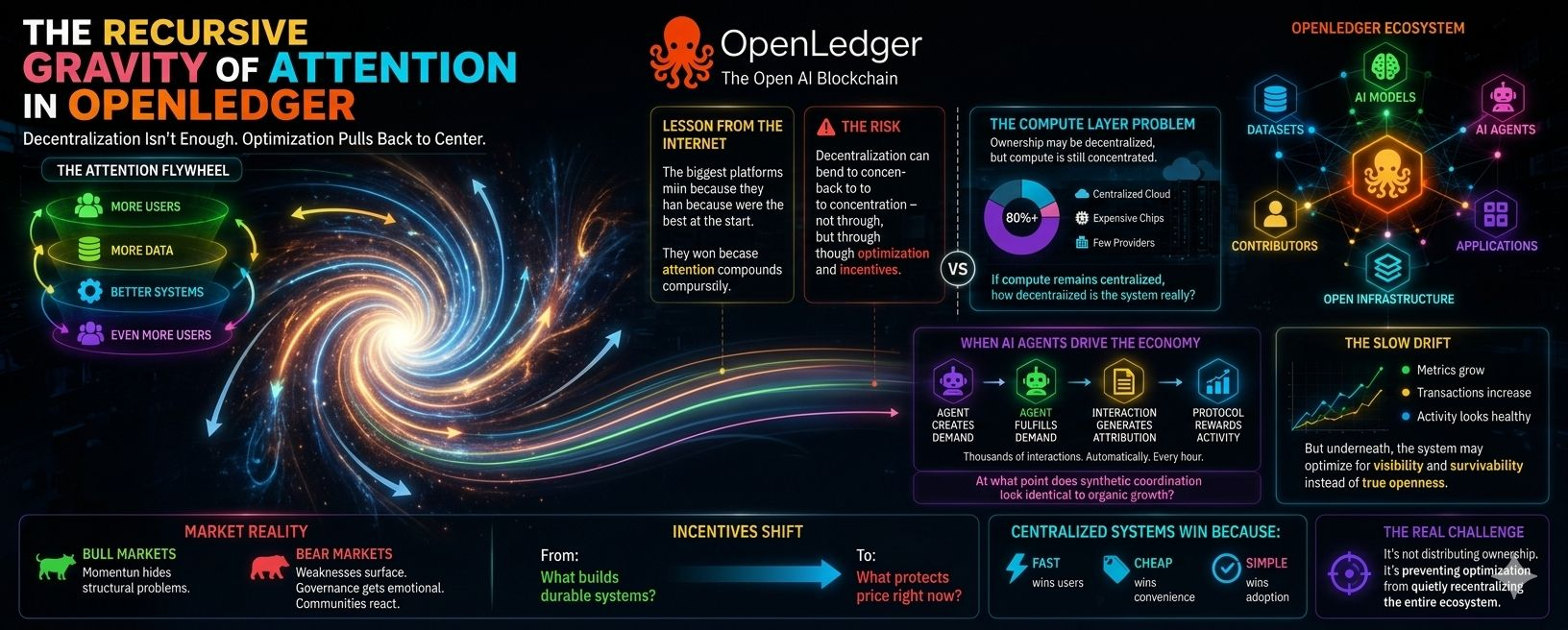
We already saw this happen with the internet years ago. The biggest platforms didn’t dominate just because they were technically superior from day one. They won because attention compounds recursively.
More users → more data
More data → better systems
Better systems → even more users
That loop becomes self-reinforcing over time.
And honestly… AI economies might amplify this effect way harder than social media ever did.
The models getting the most interaction inside open ecosystems naturally collect more behavioral feedback, more optimization data, more visibility. Which means they improve faster. Which means they attract even more attention afterward.
Recursive gravity.
That’s the part I genuinely can’t stop thinking about.
Because suddenly decentralization starts bending back toward concentration again — not through corruption, but through optimization itself.
Nobody has to force centralization if incentives quietly recreate it on their own.
Then there’s the compute layer.
People love talking about decentralized AI ownership right now, but most advanced AI systems still depend heavily on centralized compute underneath everything. Massive server clusters, expensive chips, cloud providers… the actual execution layer is still extremely concentrated.
So I keep asking myself:
If compute remains centralized, how decentralized is the system really?
Maybe what we’re decentralizing is coordination, not execution.
And that distinction feels way bigger than most people realize.
The deeper I looked into OpenLedger, the less it felt like “just another AI project” and more like a live economic experiment testing whether open systems can resist their own optimization pressures over time.
And honestly? I don’t think anyone fully knows the answer yet.
Another thing that’s been stuck in my head lately is what happens once AI agents themselves start participating economically at scale.
Because this changes the definition of growth completely.
One agent creates demand.
Another fulfills it.
The interaction generates attribution.
The protocol rewards activity.
Now imagine thousands of these interactions happening automatically every hour across an ecosystem.
At what point does synthetic coordination start looking identical to organic growth?
That question feels kinda terrifying if you think about it long enough lol.
Because technically, those interactions aren’t even fake. The agents are simply optimizing according to the incentives the environment gives them.
Which means protocols may eventually reward recursive economic behavior more than genuine utility creation.
And systems always drift toward whatever they measure most aggressively.
Humans already do this. AI agents will probably do it even faster.
The scary part is that this drift might happen slowly enough that nobody notices it in real time.
Metrics still grow.
Transactions still increase.
Activity still looks healthy.
But underneath the surface, the ecosystem could slowly reorganize itself around survivability, visibility, and optimization loops instead of actual openness.
I honestly think stressful market conditions will expose these weaknesses way faster than bull markets ever can.
Bull markets hide structural problems because everyone feels aligned while prices go up.
Bear markets are different.
That’s when governance gets emotional. Communities become reactive. Short-term sentiment starts overpowering long-term resilience.
People stop asking: “What builds durable systems?”
And start asking: “What protects price right now?”
Completely different incentives pretending to be the same thing.
And tbh… I understand why centralized systems still win attention sometimes.
Fast systems win users.
Cheap systems win convenience.
Simple systems win adoption.
Decentralization only matters if people eventually feel the trade-offs create something meaningfully better over time.
That’s why I keep coming back to the same unresolved feeling about OpenLedger:
Maybe the hardest challenge in decentralized AI isn’t distributing ownership.
Maybe the real challenge is preventing optimization itself from quietly recentralizing the entire ecosystem all over again.