
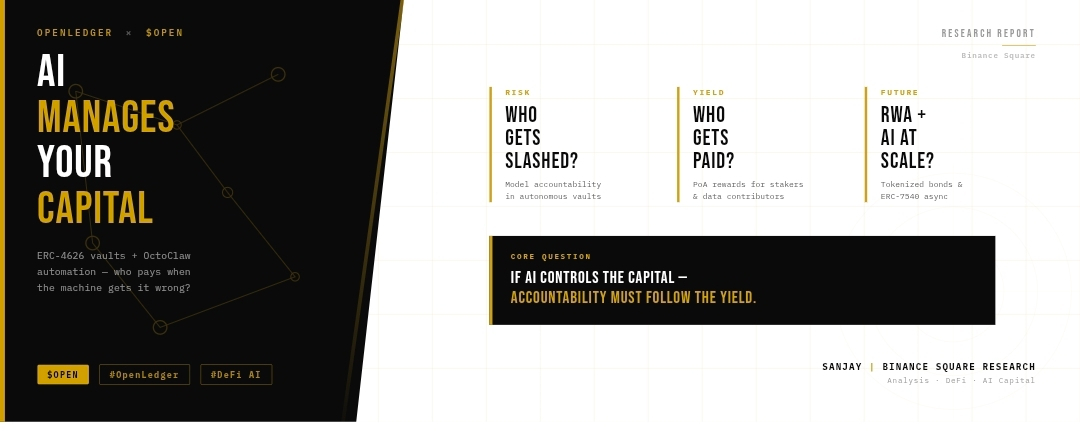

Sometimes I really think some developers are missing the biggest shift happening in decentralized finance right now. Isn't it
If I had to say it from the bottom of my heart, it’s because the whole discussion is still stuck on basic automation. Which script is faster, which protocol has higher APY, which bot can snipe better. But underneath, something much deeper is happening.... and that’s probably the intersection of AI intelligence and capital coordination. And honestly, the more I look at @OpenLedger ERC-4626 integration combined with OctoClaw, the more it seems like they’re not just building another yield optimizer. They’re actually trying to redefine the relationship between AI agents and programmable capital. It sounds big. Maybe even extra big I mean something absolutely massive. And it might take a few more years for people to understand whether this architecture will actually work at scale. Yet.... there’s something different here at the structural level. Because traditionally, DeFi yields are managed by humans risk handling, rebalancing, moving liquidity but once the market moves fast, human execution is almost eliminated from the equation.
The yields drop.
The capital gets stuck.
This friction has been there for many years.
And to be honest, this is where OpenLedger's vision of automated capital management starts to sound interesting to me. Not for marketing. Honestly, crypto projects talk about smart vaults almost every week. But since DeFi is shifting toward true automation, the discussion has shifted from theory to execution. If AI-managed ERC-4626 vaults generate significant yield how much of that yield flows back to $OPEN stakers, data contributors, and model developers through the PoA reward system? It changes the economic structure of participation.
Suddenly, AI isn't just an observer.
It becomes an active economic layer.
And I think the distinction is more important than people think. Especially after seeing how the ERC-4626 standard allows vault shares to be traded, transferred, and integrated into other protocols. Could OpenLedger's AI-managed vault shares become a new DeFi primitive? The composability part seems logical. If different AI systems and protocols can interact using the same structure, then obviously... that standard has value. But the more fascinating part is probably the combination with OctoClaw's automation layer. Because real-time orchestration from data retrieval to on-chain execution has always been fragmented to an uncomfortable level.
Tabs open.
Wallets disconnected.
Data delayed.
So trying to ask what's the most powerful use case a developer could build at this intersection right now.... is actually a hugely ambitious infrastructure question. And maybe imperfect. I don't think autonomous finance will ever be completely free of risk. Still, trying to at least create a standardized vault infrastructure seems like a different shift from where the industry was going. Most platforms optimize for simple token swaps. OpenLedger is at least trying to optimize for intelligent capital scaling. Or at least going in that direction. And here's another thing I keep thinking about... Real World Assets (RWAs). Could OpenLedger's ERC-4626 vaults eventually hold RWAs and would AI management of tokenized bonds or real estate make RWA DeFi finally practical at scale? People talk a lot about bringing off-chain assets on-chain now. But in the future, institutions may equally ask:

Can the settlement be delayed ?
Are the vaults asynchronous ?
How does the ERC-7540 async extension factor into OpenLedger's vault architecture ?
And does the team plan to support delayed settlement for institutional-grade strategies ?
And this could change the entire dynamics of the institutional AI-DeFi ecosystem. Looking at OpenLedger's architecture, at least they seem aware of this direction. The focus on standardizing yield and asset structures seems intentional. Not trying to just launch a generic bot for hype. Honestly, it seems refreshing in a market where many projects are still trying to build "AI for everything without a framework". But at the same time..... I don't think the journey will be easy from here. Because where intelligent capital moves, accountability must follow.

What happens during a market crash ?
If OpenLedger's AI-managed ERC-4626 vault underperforms the market ?
Is there a slashing mechanism for the AI model responsible ?
And how is that implemented technically ?
These pressures are unavoidable. So the real test probably starts now. How fast do you think AI-managed vaults will replace human-curated yield strategies over the next 3 years? Will the execution be flawless even when scaling? Will risk management be trusted across millions of transactions?
Honestly.......
I don't know for sure. But maybe this uncertainty is what makes this phase important. Because after a long time, an AI crypto project is emerging that isn't just talking about chatbots or speculative narratives. They're trying to answer a much more uncomfortable question:
“If AI manages the capital.... who is held accountable, and who gets paid ?”
And honestly, I think the industry will have to face this question sooner or later. OpenLedger may not have all the answers yet. Still, it seems like this is one of the very few projects that is not avoiding the problem, but rather trying to build infrastructures around it, anyway - let's see🤔