
@GeniusOfficial Lately, it feels like every crypto conversation eventually turns into AI. New agents, smarter bots, automated trading systems, AI-powered dashboards — the entire space is chasing the narrative as if AI alone is going to define the next era of crypto.
But honestly, the deeper I look into the market, the more I think the real battle is happening somewhere else entirely.
It’s happening around privacy.
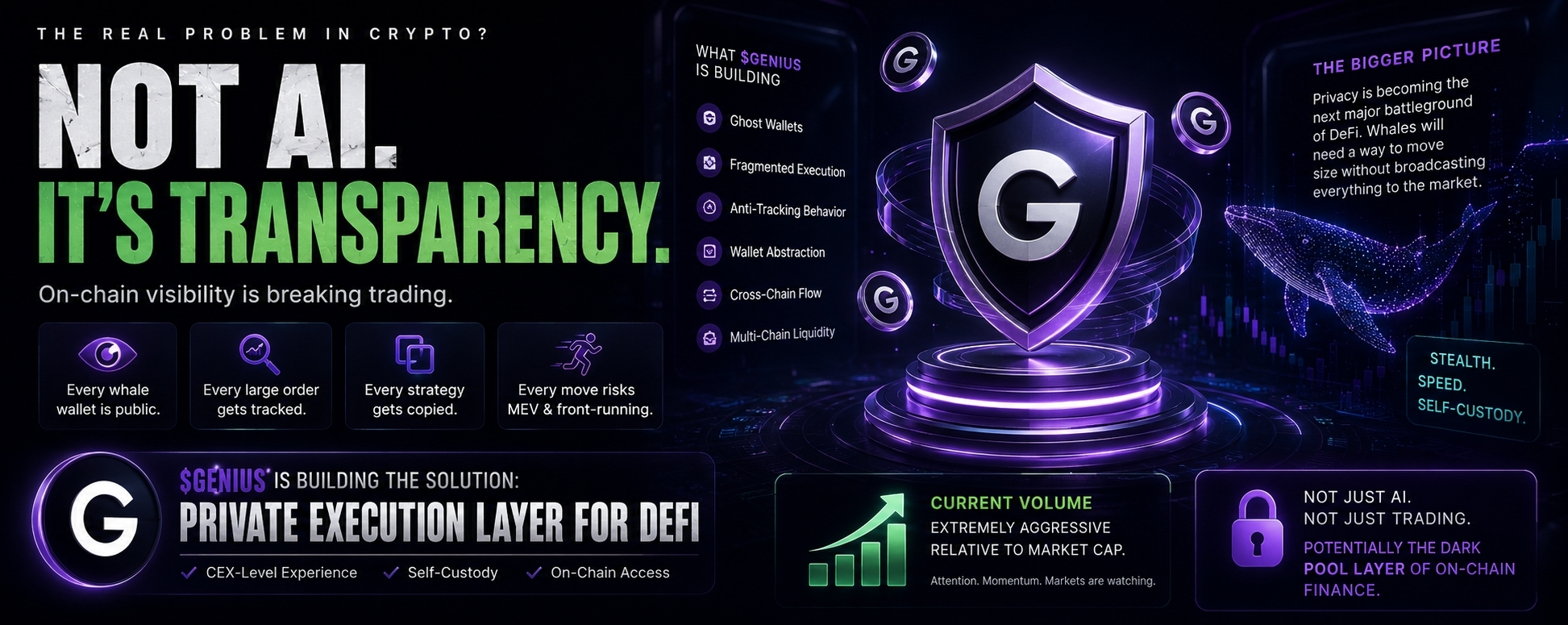
One thing most people still underestimate about DeFi is how exposed everything becomes once real money starts moving. Every wallet can be tracked. Every large buy gets noticed within seconds. Every profitable strategy eventually becomes public information. The moment someone trades size on-chain, bots begin circling around it before execution is even complete. Front-running, MEV extraction, wallet monitoring — these aren’t side issues anymore. They’re becoming structural problems inside on-chain markets.
And that’s why I think a lot of people may be misunderstanding what @GeniusOfficial is actually trying to build.
Most retail traders still look at it and immediately think:
“another AI trading project.”
But the infrastructure underneath tells a much more interesting story.
The project seems heavily focused on execution itself — not just analytics or automation. Things like ghost wallets, fragmented execution, anti-tracking mechanics, wallet abstraction, and cross-chain routing suggest something bigger than a normal retail trading terminal. It starts looking less like a flashy AI product and more like an attempt to solve one of DeFi’s biggest weaknesses: how to trade on-chain without exposing your entire strategy to the market.
That’s a very different narrative.
Because at the end of the day, users don’t actually want to choose between centralized exchanges and DeFi forever. What people really want is the best part of both worlds. They want self-custody. They want permissionless access. They want multi-chain liquidity. But they also want smooth execution, speed, privacy, and protection from getting hunted every time capital moves.
Centralized exchanges already solved that experience years ago.
DeFi still hasn’t.
And if on-chain adoption keeps growing, this problem only becomes bigger. The more money that enters decentralized markets, the more valuable private execution becomes. Serious capital cannot operate efficiently in an environment where every move becomes public before completion.
That’s why I think the “AI narrative” around $GENIUS might actually be hiding the more important thesis underneath.
The real opportunity may not be AI trading.
It may be private on-chain execution infrastructure.
Even the market activity around it feels interesting right now. Volume expansion relative to market cap has been unusually aggressive, which normally signals more than random retail speculation. It often means attention is accelerating fast, market makers are stepping in, and narrative momentum is beginning to form beneath the surface before the broader market fully understands the category.
And I think that category matters.
Because eventually the crypto industry will reach a point where transparency stops feeling revolutionary and starts becoming a limitation. When that happens, protocols capable of offering stealth execution, liquidity access, and privacy-preserving infrastructure could become incredibly important pieces of the entire DeFi ecosystem.
Not saying #GENIUS already owns that future.
But I do think many people are still analyzing this project from the wrong angle.
They see another AI token.
What they might actually be looking at is the early idea of a dark-pool layer for on-chain finance.