
There’s a misunderstanding in how most people still frame AI.
They think the competition is about models — who trains the largest system, who ships the smartest agent, who reaches better benchmarks first.
That’s the surface layer.
But underneath it, something more structural is forming, and it’s easy to miss because it doesn’t look like innovation in the usual sense.
It looks like accounting.
When I started looking into @OpenLedger and the idea behind $OPEN, what stood out wasn’t another “decentralized AI” narrative. It was a different question entirely:
What happens to value when intelligence is no longer traceable to a single source?
Because that’s what modern AI quietly introduces.
Every output is a composite.
Every response is built on layers of prior human input — datasets, corrections, labeling, niche expertise, informal knowledge, and countless small contributions that were never designed to be monetized at scale.
Once those signals enter a model, they stop behaving like individual artifacts. They become part of a statistical system that no longer distinguishes clean ownership boundaries.
And that is where the real tension begins.
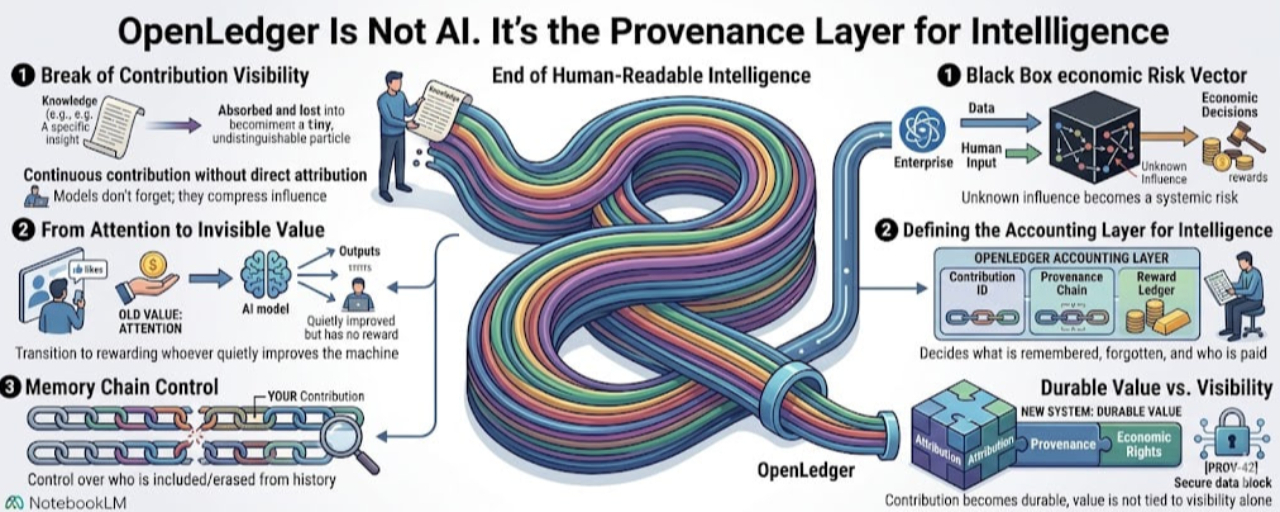
The internet already broke the link between creation and reward by prioritizing visibility. Attention became currency, and algorithms reinforced whoever could capture it most effectively.
AI breaks something deeper.
It breaks the visibility of contribution itself.
A person can produce knowledge that meaningfully improves a system, and that improvement can persist indefinitely without any direct attribution to them. Not because of malice — but because the system is not designed to remember lineage, only patterns.
That creates a blind spot in the entire AI economy.
If intelligence is built from aggregated human input, but that input is not continuously attributed or tracked, then value is being generated without a stable feedback loop back to its source.
OpenLedger’s framing becomes interesting here because it pushes directly against that blind spot.
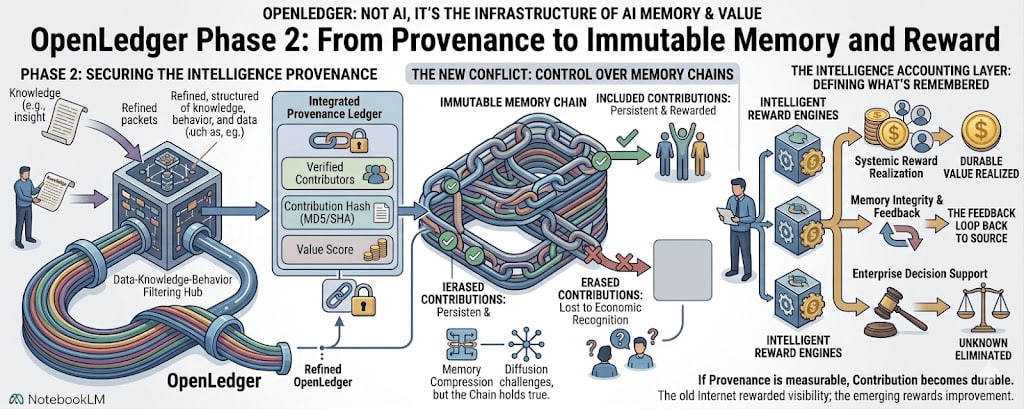
Instead of treating AI as a black box that magically produces intelligence, it tries to reintroduce structure around contribution itself — tracking how data, behavior, and human input flow into model outcomes.
Not as metadata.
As economic infrastructure.
That difference is subtle but important.
Because once AI systems begin influencing financial decisions, enterprise operations, and autonomous workflows, “unknown influence” stops being a theoretical issue and becomes a systemic risk vector.
Models don’t forget like humans do. They don’t discard influence cleanly. They compress it, diffuse it, and carry it forward in ways that are difficult to reverse-engineer later.
Which means the future conflict in AI may not be about capability at all.
It may be about control over memory chains:
who gets included in training history,
whose contributions persist,
and who gets erased from economic recognition despite shaping outcomes.
Seen through that lens, OpenLedger is not building around intelligence.
It’s building around provenance — the ability to reconstruct how intelligence was formed in the first place.
And that shifts the center of gravity.
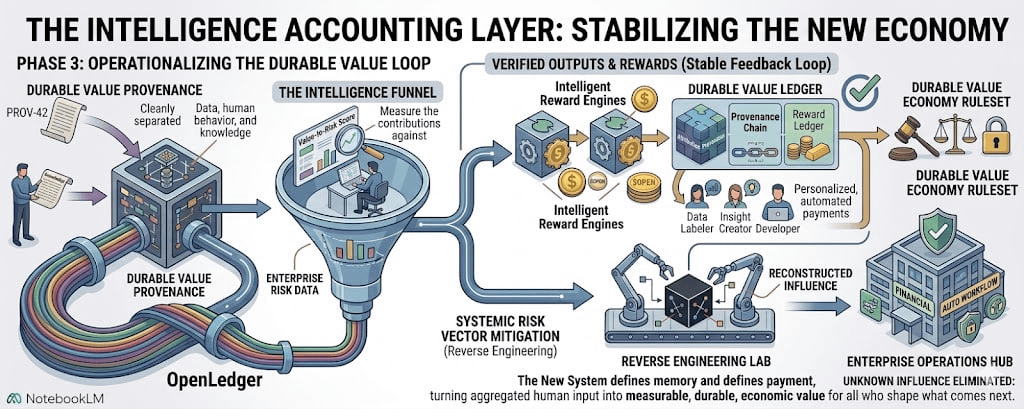
Because if provenance becomes measurable, then contribution becomes durable. If contribution becomes durable, then value stops being tied to visibility alone.
That is a very different internet than the one we have now.
The old system rewarded whoever could be seen.
The emerging system may reward whoever quietly improves the machine.
And if that transition fully stabilizes, OpenLedger is not just participating in AI infrastructure.
It is attempting to define the accounting layer for intelligence itself — the layer that decides what the world remembers, what it forgets, and who gets paid for shaping what comes next.