
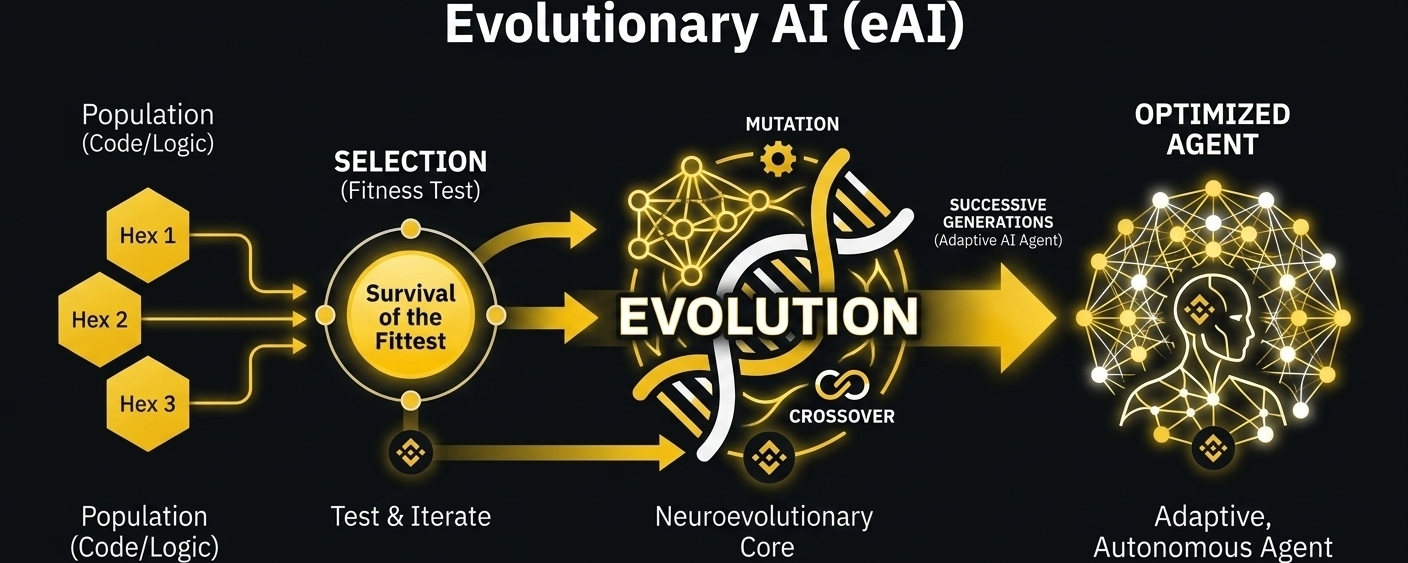
The intersection of Artificial Intelligence and Web3 is evolving at breakneck speed. We’ve moved past simple chatbots and static algorithms. Today, the spotlight is shifting toward a revolutionary concept: Evolutionary Artificial Intelligence (eAI).
If you are tracking the future of decentralization and autonomous systems, understanding eAI isn't just optional—it’s essential.
What is Evolutionary AI (eAI)?
Unlike traditional AI models that rely strictly on static training data and manual fine-tuning by human engineers, Evolutionary AI borrows a page from biology. It utilizes concepts inspired by Charles Darwin’s theory of natural selection—such as genetic algorithms, mutations, crossover, and survival of the fittest—to evolve code and logic autonomously.
Instead of a developer hardcoding every single rule, an eAI system generates thousands of variations (a population of solutions), tests them against a specific goal, eliminates the weak ones, and mutates the successful ones to create a superior next generation.
In short: It is AI that learns how to optimize and rebuild itself over thousands of digital generations.
Why eAI Matters for Web3 and AI Agents
The true power of eAI unlocks when it is deployed within decentralized ecosystems. In Web3, environments are highly dynamic, volatile, and unforgiving. This is where static AI falls short, and where eAI thrives:
1. Self-Optimizing Market Intelligence
Imagine an AI-driven market intelligence agent (like a whale-tracker or smart-money monitor) that doesn't just execute predefined scripts. An eAI-backed agent can dynamically adjust its own evaluation parameters based on shifting liquidity, routing, and on-chain metrics to stay ahead of the curve.
2. Adaptive Cybersecurity & Auditing
Smart contracts and DeFi protocols are constantly exposed to new attack vectors. Traditional static audits only capture a single moment in time. eAI can be used to generate adaptive defense mechanisms, mutating defensive code to patch vulnerabilities and predict exploit patterns before they happen.
3. True Autonomy (Unstoppable Agents)
When infrastructure is hosted locally or via decentralized networks, eAI allows autonomous agents to achieve native resilience. If a certain logic path fails due to a network upgrade or a liquidity pool migration, the agent can "evolve" its operational logic to bypass the hurdle without requiring a human developer to push a hotfix.
Neuroevolution: Designing the Perfect Network
One of the most exciting subsets of eAI is Neuroevolution. Instead of human architects spending months configuring neural network layers and hyperparameters, the evolutionary algorithm tests and crafts the network architecture itself.
For decentralized AI orchestration, this means infrastructure can automatically scale, prune, and adapt its brainpower based on the hardware constraints it is running on—whether it's a high-end cloud server or localized edge-computing hardware.
The Bottom Line
The combination of decentralized architecture and Evolutionary AI represents the ultimate paradigm shift. We are moving away from tools that we operate, and moving toward self-sustaining digital organisms capable of learning, surviving, and evolving in the Web3 space.
As architects and observers of this space, the goal is no longer just to build fixed code—it's to set the initial parameters and let the code perfect itself.
What are your thoughts on the integration of Evolutionary AI in Web3? Will self-evolving agents dominate the next cycle?
#CryptoAI #ArtificialIntelligence #eAi #TechDeepDive #AIAgents