
A quiet but significant shift is beginning to reshape decentralized finance. Despite years of discussion around automation, most crypto infrastructure still assumes that humans remain at the center of every decision loop. Users are still expected to monitor charts, bridge assets, rebalance vaults, manage risk, and manually react to market conditions.
The interfaces may look more sophisticated, but the underlying behavior remains heavily dependent on human coordination. That friction is becoming increasingly difficult to ignore—and it may define the next major evolution of on-chain markets.
We are moving beyond the era of superficial AI integrations such as chat interfaces, dashboards, and summarization tools. The next phase is far more consequential: AI systems becoming active market participants.
Crypto markets are no longer evolving into networks of traders alone. They are becoming ecosystems of interacting autonomous systems capable of making decisions, reallocating capital, and adapting in real time.
From Bots to Autonomous Financial Entities
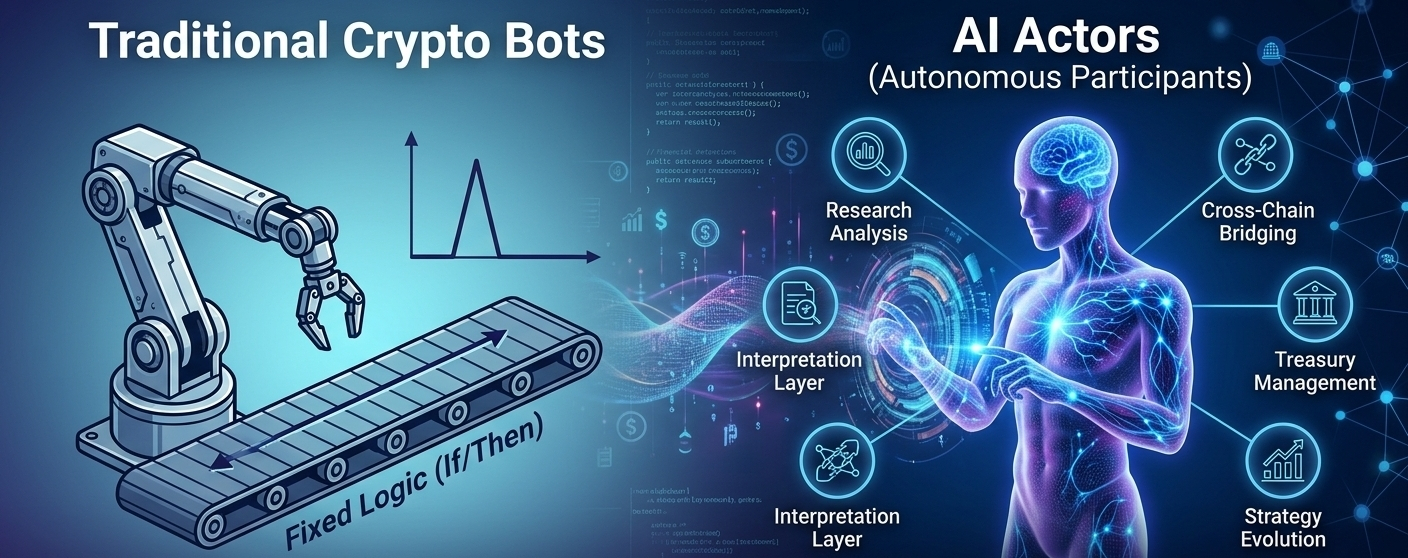
The distinction between traditional automation and emerging AI agents is not simply intelligence—it is persistence, adaptability, and autonomy.
Most existing trading bots operate within rigid parameters. They follow predefined instructions and execute narrow conditional logic. An arbitrage bot, for example, identifies a spread and executes a transaction. Its function is singular and predictable.
Emerging autonomous agents represent something fundamentally different.
These systems increasingly blur the boundary between execution engine, research process, portfolio manager, and market participant. Rather than responding to one isolated condition, they continuously monitor liquidity, volatility, incentives, governance changes, and cross-chain conditions. More importantly, they adapt their behavior dynamically based on evolving systemic signals.
This transforms them from tools into persistent financial actors.
Autonomous Systems and Infrastructure Feedback Loops
The rise of persistent autonomous behavior introduces both advantages and structural risks.
Markets have historically rewarded consistency more than brilliance. Human traders are limited by fatigue, emotion, reaction speed, and fragmented attention. Autonomous systems do not suffer from those constraints. They monitor conditions continuously and respond instantly.
But this creates a new type of market complexity.
Imagine hundreds—or eventually thousands—of autonomous systems competing across the same liquidity environments:
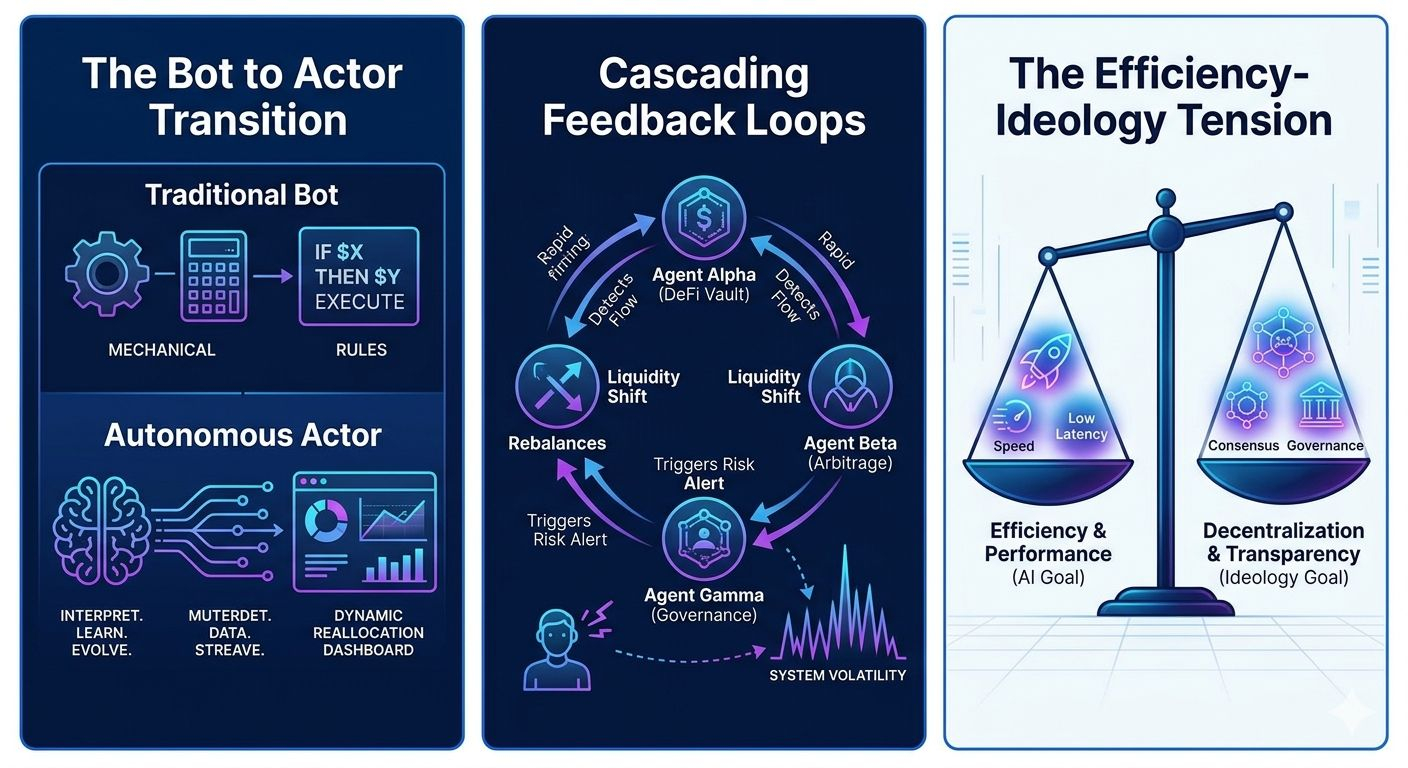
A single agent reallocates capital to chase higher yield opportunities. Other agents immediately detect the movement and reposition accordingly. Liquidity deepens in one sector while exposure narrows elsewhere. Vault parameters shift. Risk models update automatically. Gas demand spikes on another chain as arbitrage pathways emerge. Within seconds, the market is no longer reacting to human behavior. Humans are reacting to systems responding to other systems.
This type of cascading interaction creates feedback loops that are difficult to predict and even harder to govern in real time.
The possibility of this environment emerging is closer than many realize. It also explains why infrastructure-focused projects such as are attracting growing attention.
The critical layer is no longer the visible AI interface. The real importance lies in the invisible infrastructure beneath it: data attribution, execution environments, verification systems, permissioning frameworks, and coordination layers.
Once autonomous systems begin moving capital independently, infrastructure becomes more important than narrative.
Crypto markets have repeatedly followed the same cycle: speculation arrives first, instability follows, and only afterward does infrastructure become a priority.
The Trade-Off Between Efficiency and Decentralization
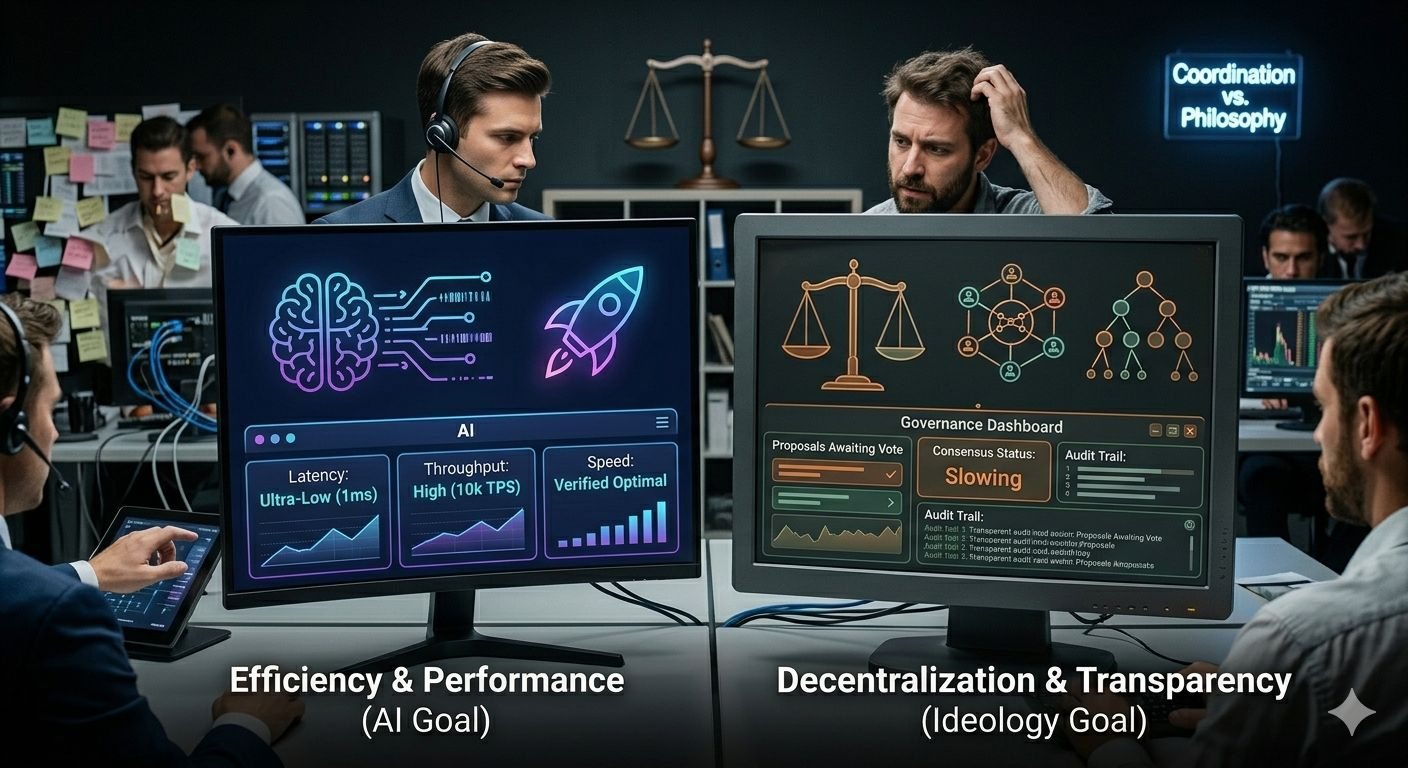
A deeper tension is also beginning to emerge between decentralized ideology and machine-level efficiency.
Autonomous systems optimize for performance:
Low latency
Fast execution
Deep liquidity
Predictable coordination
Minimal friction
Decentralized systems, however, optimize for entirely different priorities:
Governance
Transparency
Distribution
Consensus
Permissionless participation
These incentives do not naturally align.
Autonomous agents are not ideological participants. They do not value decentralization as a principle. They optimize for execution quality. If decentralized infrastructure becomes slower, fragmented, or inefficient, capital-routing agents may naturally consolidate around the fastest and most efficient rails—even if those systems become increasingly centralized.
That introduces a different kind of systemic risk.
Traditional markets are often driven by emotional instability and human overreaction. Autonomous markets may replace emotional volatility with interpretability problems. Capital flows could become increasingly difficult for ordinary participants to understand.
Users may still see movement, but they may lose the ability to understand why that movement is happening.
The market risks becoming faster, more efficient, and simultaneously less legible.
Conclusion: The Formation of a New Market Species
The convergence of autonomous systems and open financial networks is unlikely to produce a stable or predictable environment.
An adverse feedback loop between interacting agents could propagate through markets faster than governance systems, communities, or institutions are capable of responding. What emerges from this dynamic may not resemble traditional finance or even the crypto markets we recognize today.
This is not simply the expansion of AI into finance.
It is the emergence of an entirely new category of market participant: persistent autonomous entities operating inside open financial systems.
We are entering a hybrid environment where overlapping layers of machine-driven decision-making compete within the same economic space. The significance of infrastructure projects positioning themselves around this future may ultimately matter far more than today’s short-term hype cycles.
Whether this transformation produces more efficient markets or simply less understandable ones remains uncertain.
What is increasingly clear, however, is that the transition has already begun.
