

There is something I realized quite late about how I think about blockchain projects.
I used to evaluate everything from the infrastructure side. Transaction speed. Fee structure. Developer tooling. Consensus mechanism. All the things that matter technically. And I was good at it — I could read a whitepaper and find the gaps faster than most people. But somewhere along the way I started noticing that my analysis kept missing the same thing over and over again.
I was never asking about behavior.
Not the system's behavior. Human behavior. What actual people do when you put a new incentive structure in front of them. How they respond, how they adapt, how they find ways to extract value from systems that were designed with different intentions. That gap in my thinking — treating users as rational actors following protocol design rather than humans responding to incentives in ways nobody predicted — that gap cost me more than a few bad calls.

I keep thinking about this when I try to understand what OpenLedger is actually building.
Most coverage treats it as infrastructure. An AI blockchain. Data attribution rails. Model training coordination. All technically accurate. But I find myself circling back to a different question that feels more important and also more uncomfortable.
What happens to human behavior when you make data contribution economically visible for the first time ?
Because right now data contribution is invisible. You search something. You click something. You write something. You react to something. All of that behavior flows into systems that become more valuable because of it and you receive nothing. Not because someone decided to steal from you. Because the architecture was never built to record what you contributed or route value back to you for it.
OpenLedger's Proof of Attribution is trying to change that architecture at the infrastructure level. Track which data contributed to which model output. Record it on chain. Make the compensation flow automatically. Turn invisible contribution into visible economic activity.
The idea is clean. I understand it immediately.
But here is where I slow down and get genuinely uncertain.....
When you make something economically visible that was previously invisible, you do not just create a reward mechanism. You create a new set of behaviors around that mechanism. And some of those behaviors are exactly what the system intended. And some of them are not.
I have watched this pattern play out in crypto enough times that it makes me cautious without making me dismissive.
Content platforms rewarded engagement and got engagement farming. Liquidity protocols rewarded TVL and got mercenary capital that left the moment incentives changed. DeFi yield systems rewarded participation and got bots running strategies that extracted value without contributing any.
Every time a system makes something economically visible that was previously invisible, the first wave of participants includes genuine contributors. And the second wave includes people who figured out how to mimic genuine contribution without actually providing it.
OpenLedger's attribution system has to solve a version of this problem that is genuinely harder than anything the above examples faced. Because mimicking genuine data contribution is easier than mimicking genuine liquidity provision. You can manufacture datasets. You can create synthetic behavioral signals. You can build systems that look like valuable contributors to a model training process while actually providing noise.
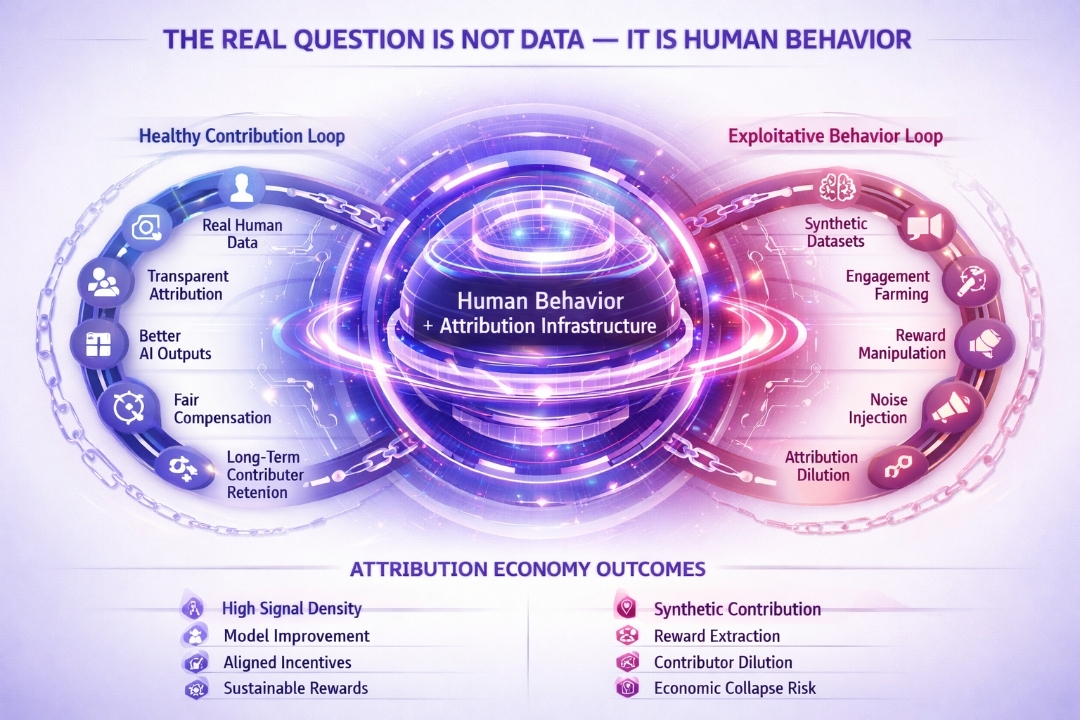
And if that happens at scale the attribution economy does not just weaken. It inverts. The people providing real value get diluted by the people providing synthetic value and the compensation flowing to genuine contributors becomes meaningless.
I am not saying this is inevitable for OpenLedger. I am saying it is the hardest problem they have to solve and I do not see it discussed seriously in most coverage.
Looking at the numbers today — OPEN is trading around $0.19, market cap roughly $54 million on CoinMarketCap, circulating supply about 290 million, FDV at $185 million against a max supply of 1 billion. Volume at $9.6 million in 24 hours. The token is still down roughly 89% from its all-time high of $1.82. At $54 million market cap, if attribution quality filters actually work and genuine data contributors keep returning, a re-rating toward $100-120 million is not unreasonable — that implies somewhere around $0.34-0.41 on current supply. But if the contribution economy fills with noise and the attribution measurement cannot reliably distinguish signal from synthetic signal, the current market cap may already be pricing in adoption that never fully materializes.
The retention question is where I keep landing.
Not retention of token holders. Retention of genuine contributors. Do the people providing actually valuable data — the kind that makes models meaningfully better rather than just larger — do they come back after the first reward cycle ? Do they come back when the OPEN price compresses and the dollar value of attribution rewards drops ? Do they come back when it becomes clear that synthetic contributors are competing for the same reward pool ?
Those questions cannot be answered from architecture diagrams. They can only be answered by watching what happens to contribution quality over time. Not total contribution volume — quality. Whether the models being trained on OpenLedger's attributed data are actually better than models trained on unattributed data scraped from the same sources.
That is the signal worth following.
Not the token price. Not the campaign metrics. Not the wallet activity numbers that look healthy on a dashboard and mean nothing if the underlying contribution quality is declining.
Watch whether genuine contributors keep showing up when the incentives are not the only reason to click. That is where the real story is.