
In today’s digital world, ownership has become one of the biggest concerns for creators, developers, researchers, and even everyday internet users. Every day, millions of pieces of content are uploaded online — articles, images, music, code, AI models, datasets, and creative ideas. The problem is not only about creating something valuable anymore. The real challenge is proving who created it first. Traditional systems of ownership depend on centralized platforms, legal paperwork, or trust between parties. But these methods are often slow, expensive, and vulnerable to manipulation. This is where blockchain technology changes the conversation completely.
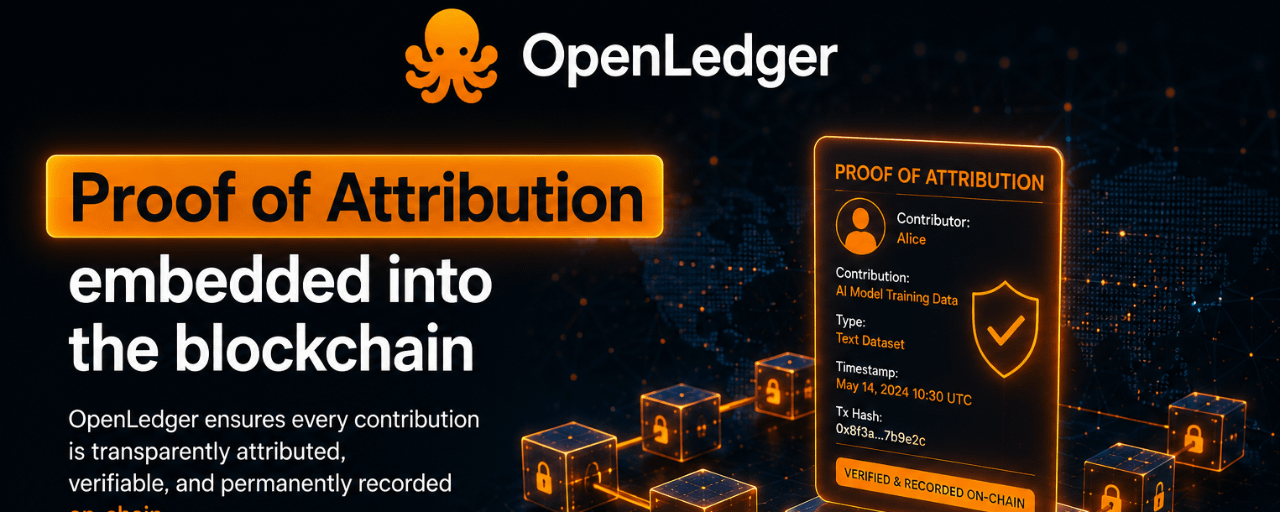
Proof of attribution embedded into the blockchain introduces a new way to secure authorship and ownership permanently. Instead of relying on third parties, the blockchain acts as a transparent and immutable ledger that records the origin of content. Once information is stored on-chain, it becomes nearly impossible to alter or fake. This creates a system where creators can publicly prove that a piece of work belongs to them at a specific moment in time.
The idea of attribution is not new. Artists have always signed paintings, writers have published under their names, and inventors have filed patents. However, the internet made copying and redistribution incredibly easy. A design can be stolen within seconds. An article can be reposted without credit. AI-generated content can be remixed endlessly with no clear source. Because of this, digital attribution has become more important than ever before.
Blockchain solves this issue by creating a timestamped proof of origin. Every transaction recorded on-chain carries unique cryptographic verification. This means that when a creator uploads content or registers ownership through blockchain technology, there is a permanent record tied to their wallet or identity. Even if the content spreads across the internet, the original proof remains visible and verifiable.
One of the most interesting projects working toward this future is OPEN. The vision behind Open Ledger is much larger than simple data storage. It focuses on building an ecosystem where attribution, transparency, and ownership become foundational parts of the digital economy. In many existing online systems, platforms control data, and users have little power over how their work is used. Open Ledger aims to change this dynamic by giving ownership back to creators and contributors.
The rise of artificial intelligence has made attribution even more critical. AI systems are trained on massive amounts of information gathered from across the internet. Often, creators whose work contributes to these systems receive no recognition or compensation. This creates ethical and economic concerns. Writers, designers, musicians, and developers are asking an important question: if AI learns from my work, how do I prove my contribution?
This is where blockchain-based attribution systems become extremely valuable. By embedding proof of contribution directly into decentralized networks, projects like Open Ledger create a transparent record of participation. Every dataset contribution, every creative asset, and every model interaction can potentially be tracked and verified. Instead of creators disappearing into anonymous data pools, they become visible participants within the ecosystem.
Another important aspect of blockchain attribution is trust. In traditional systems, verification often depends on centralized authorities. Governments issue copyrights, companies manage databases, and platforms decide whose claims are valid. Blockchain removes the need for a single controlling entity. The network itself validates records through consensus mechanisms. This decentralized structure increases transparency and reduces the possibility of manipulation.
For independent creators, this could become revolutionary. Imagine a photographer uploading original work to a blockchain-based system. The image receives a permanent proof of attribution instantly. Later, if someone uses that image commercially without permission, the creator has verifiable evidence showing ownership and upload history. The same concept applies to writers, musicians, software developers, and researchers.
Open Ledger stands out because it recognizes that the future internet will revolve around data ownership and verifiable contribution. As decentralized technologies continue to grow, digital identity will become deeply connected to blockchain attribution systems. Reputation may no longer depend on centralized profiles controlled by corporations. Instead, it could be built directly on-chain through transparent records of work, collaboration, and innovation.
Another major advantage of embedding attribution into blockchain systems is permanence. Traditional databases can be edited, hacked, or deleted. Companies shut down. Servers fail. Records disappear. Blockchain networks, however, distribute information across multiple nodes, making data far more resilient. Once proof of attribution is recorded, it remains accessible and verifiable for the long term.
This technology could also reshape education and research. Academic plagiarism has become a growing concern in the digital era. Blockchain attribution systems can help researchers prove originality of work, document revisions, and establish clear contribution histories in collaborative projects. Scientific transparency could improve dramatically when research records are stored on decentralized systems instead of isolated institutional databases.
The economic implications are equally important. In the creator economy, attribution is directly connected to monetization. If creators cannot prove ownership, they struggle to protect revenue opportunities. Blockchain-based systems open the door for automated royalty structures, transparent licensing, and decentralized payment systems. Smart contracts can ensure creators are compensated automatically whenever their work is used or licensed.
Open Ledger’s focus on attribution aligns strongly with this direction. The project understands that the next generation of the internet will require systems where ownership is programmable, transparent, and decentralized. In a world increasingly driven by AI and digital assets, proof of contribution may become one of the most valuable forms of digital identity.
Critics sometimes argue that blockchain technology is too complex for mainstream users. While this concern is understandable, technology often becomes simpler over time. The average person using the internet today does not fully understand how web servers or data packets work, yet they use digital platforms daily. The same evolution may happen with blockchain attribution systems. Users may eventually interact with these systems seamlessly without needing technical knowledge.
Security is another important factor. Blockchain attribution systems rely heavily on cryptographic integrity. This creates stronger protection against fraud and unauthorized modification. Unlike traditional records that can sometimes be manipulated internally, decentralized systems distribute trust across networks rather than concentrating it in one institution.
As AI-generated content becomes more widespread, society will likely place greater importance on authentic human contribution. People may begin demanding transparent proof showing where information, artwork, and datasets originated. Blockchain attribution could become the standard method for establishing authenticity in digital environments.
Open Ledger represents an important step toward this future because it combines decentralization with accountability. Rather than allowing contributions to disappear into invisible systems, it creates structures where participation can be verified and recognized. This approach supports a more ethical and transparent digital ecosystem.
The future of the internet may not simply be about who creates content but who can prove creation in a trusted and decentralized way. Proof of attribution embedded into the blockchain offers a solution that fits the needs of an increasingly digital society. It protects creators, improves transparency, strengthens trust, and creates new economic opportunities.
As technology continues evolving, ownership will become one of the defining issues of the digital age. Blockchain systems like Open Ledger are helping build the foundation for a future where creators no longer lose control over their work. Instead, attribution becomes permanent, verifiable, and secured by decentralized technology itself.