I have been watching how people move around OpenLedger for a while now and something started feeling different the more I paid attention.
Crypto marketplaces still feel temporary.
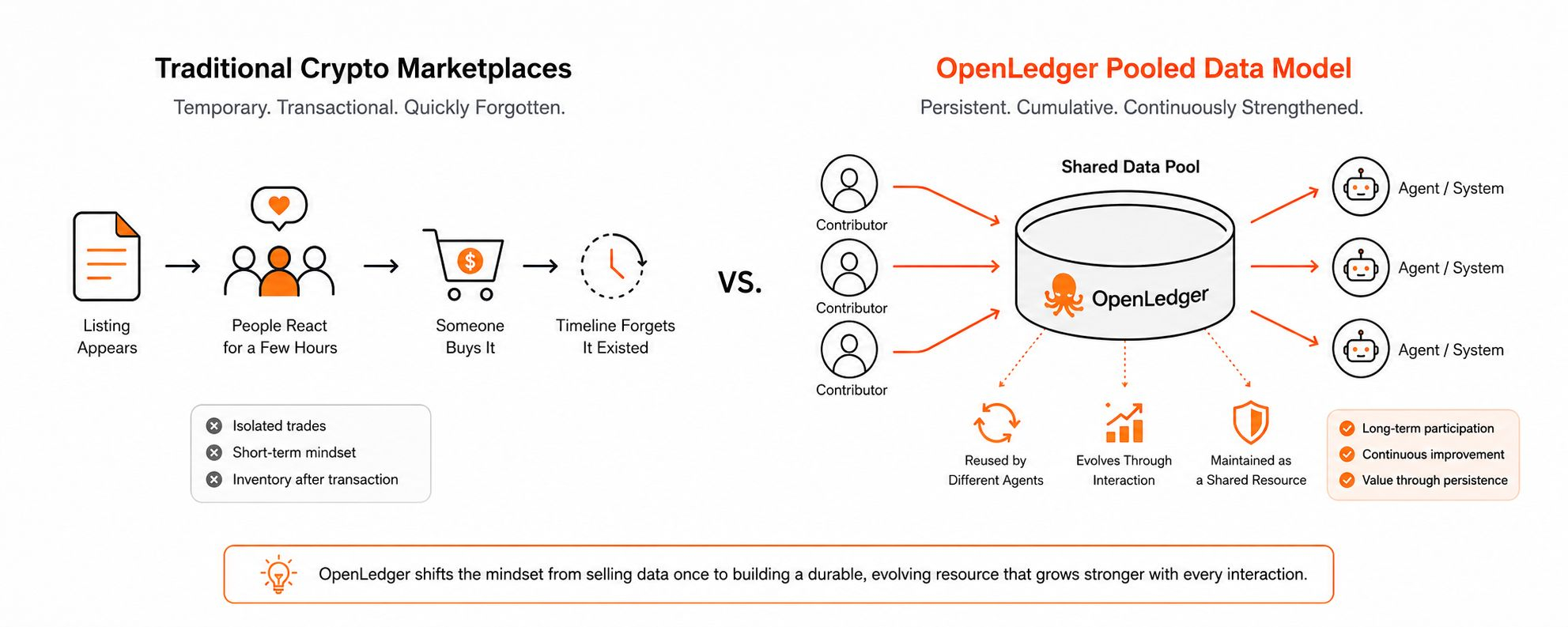
A listing appears people react for a hours someone maybe buys it then the timeline forgets it existed.
Everything moves fast. Nothing really settles long enough to build weight inside the ecosystem.
OpenLedger does not completely escape that cycle but the pooled data model changes the feeling a bit.
I noticed this after seeing one data pool get reused by different agents over a short period.
Not the buyer returning, different systems entirely.
That caught my attention because normally individual data listings behave like isolated trades.
Once the transaction finishes the listing becomes inventory almost immediately.
Pools seem to resist that decay
Not because they are perfect mostly because they stay active inside the network longer than single uploads usually do.
That changes contributor behavior in ways.
When people upload listings they often think short term, fast reward, fast visibility, quick transaction.
The mindset feels transactional from the beginning.
You can almost feel contributors trying to package something enough to survive one brief attention cycle.
Pools create an atmosphere.
Contributors start acting like participants maintaining a shared resource instead of sellers protecting a single product.
I think that changes incentives psychologically even before it changes economics.
You stop asking only whether your OpenLedger dataset can sell once.
You start wondering whether your contribution improves the usefulness of the OpenLedger pool over time.
That shift matters more than people think.
Decentralized data systems struggle because they treat data like static property.
Useful data rarely behaves like that in reality.
Good OpenLedger datasets usually improve through repeated interaction.
Corrections happen, structure evolves weak entries become obvious after usage.
OpenLedger pools allow that process to happen naturally.
Least in theory.
The uncomfortable part is that OpenLedger pooled systems also introduce weaknesses that individual listings avoid.
Quality dilution becomes harder to control.
Once incentives appear people start optimizing for contribution volume of long term utility.
I already noticed some OpenLedger pools filling with information that technically matches requirements but feels hollow when you inspect it closely.
Repetitive formatting, synthetic patterns, data that looks generated mainly to satisfy contribution mechanics than actual downstream usefulness.
That creates tension inside the OpenLedger system.
Because agent activity can make a OpenLedger pool look healthy from the outside even while the signal quality quietly weakens underneath.
Usage numbers alone do not prove durability.
Automated systems keep consuming mediocre data simply because enough structure exists for basic tasks.
The real question is whether OpenLedger outputs improve consistently over time.
Still not fully sure anybody has solved that yet.
Another thing that feels different on OpenLedger is how the value starts shifting from individual ownership.
Traditional crypto marketplaces usually reward exclusivity scarcity becomes the source of perceived value.
OpenLedger seems to lean more toward persistence and accessibility
That is a design choice honestly.
Scarcity creates incentives, shared infrastructure creates messier ones.
OpenLedger contributors may eventually wonder whether their best data should remain inside an OpenLedger pool where everybody benefits equally.
Especially if rewards flatten as participation increases.
I can already imagine that becoming a problem later.
Some experienced OpenLedger contributors will probably begin protecting their quality inputs privately once optimization pressure increases.
That could slowly leave OpenLedger pools crowded with average material while premium OpenLedger datasets disappear behind closed systems.
Maybe that is unavoidable in every network.
Even with those doubts the OpenLedger pooled structure still feels more durable than isolated listings right now.
Not stronger more durable socially.
People return to OpenLedger pools repeatedly agents revisit them OpenLedger contributors monitor them longer.
Discussions around them last beyond one transaction cycle.
That persistence creates the feeling that something cumulative is forming underneath the surface of endless disconnected trades floating through the timeline.
Honestly that feeling is rare in crypto systems.
Most ecosystems talk about infrastructure while behaving like marketplaces.
OpenLedger, at least seems to understand that durable systems usually come from repeated usage patterns not from one time transactions.
Whether the OpenLedger pools can survive long term incentive pressure without collapsing into noise is still unclear though.
That part probably decides everything later.