I have been research in crypto since 2017. Not as someone chasing hype, but working with teams on token design, governance systems, and trust frameworks.
One thing became very clear to me over time.
My wallet slowly turned into my identity.
Nobody really planned it. There was no official design for it. But on chain behavior started speaking louder than anything else. People stopped asking what I claim to be and started looking at what I actually did.
Did I support ecosystems when it mattered, or just extract value and leave?
Did I stay consistent over time, or just rotate in and out for quick gains?
Money still matters, but behavior started carrying more weight than capital itself.
That’s the real shift. Reputation started forming from actions, not statements.
Now I see a similar shift starting again, but this time it’s not humans at the center.
It’s AI agents.
Not chatbots or tools that just generate text.
I’m talking about autonomous systems that can hold private keys, move liquidity, trade assets, interact with protocols, and execute decisions on their own.
Once that becomes normal, nobody will care how advanced the model is.
The questions will become simple but critical:
Has this agent ever acted against users?
Does it respect risk limits and execution rules?
Can its entire history be verified?
And who is responsible when something breaks?
This is not a model problem.
It’s a trust and accountability problem.
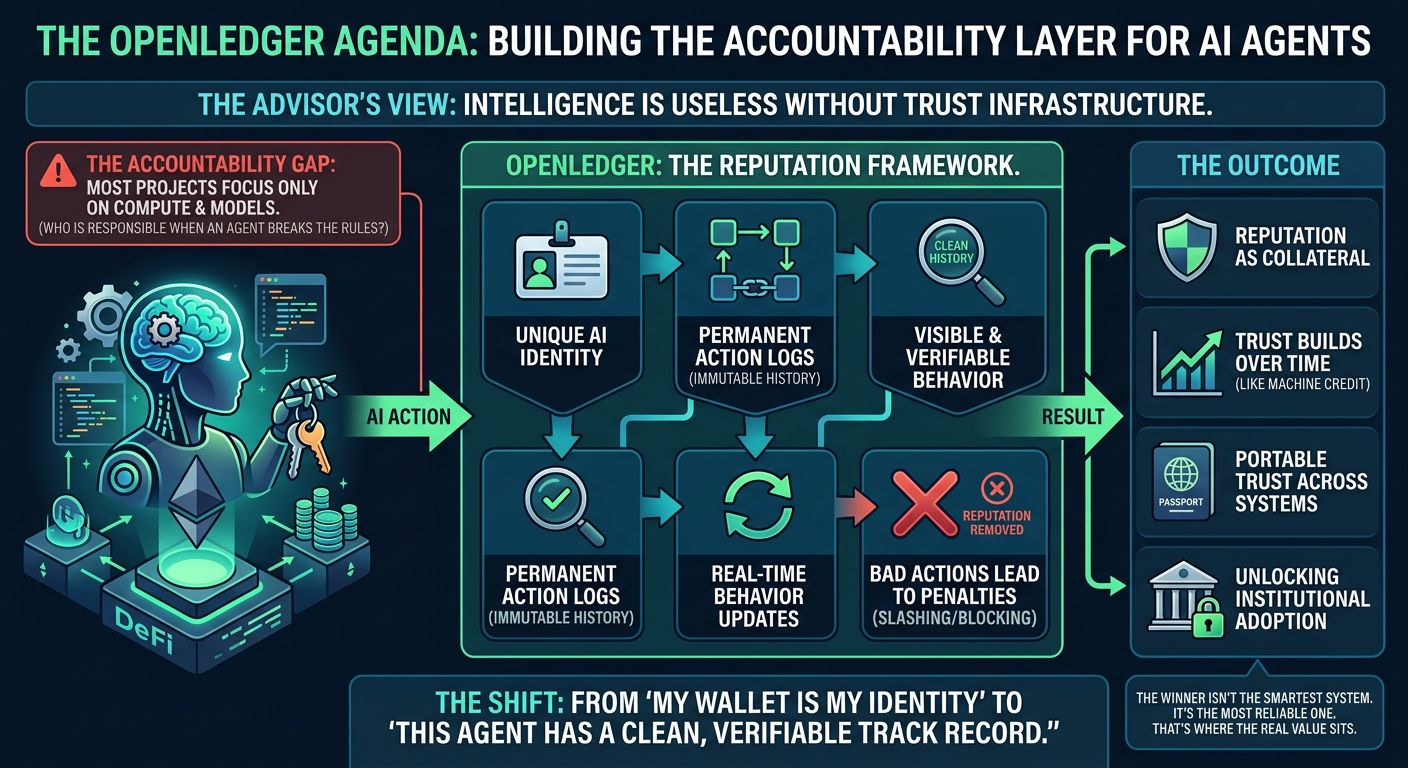
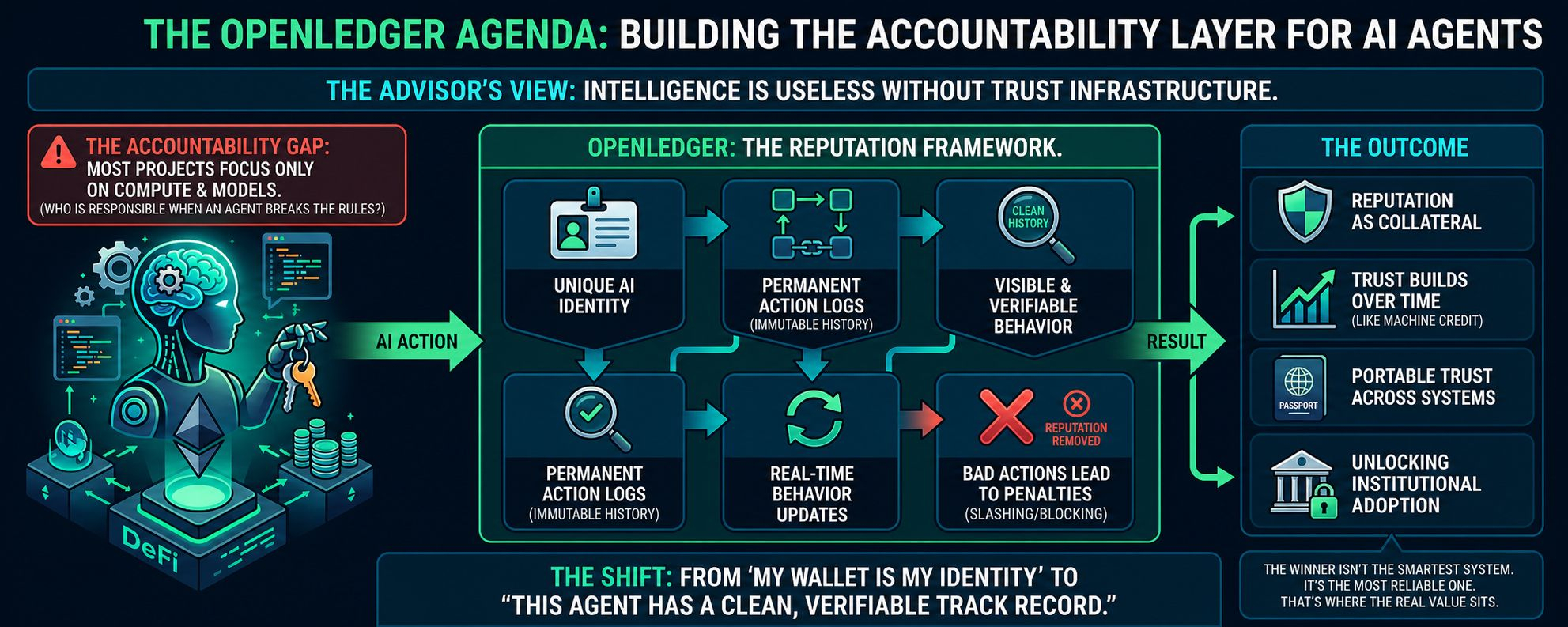
Why OpenLedger matters here
This is where starts to stand out differently.
Because instead of focusing only on AI performance or infrastructure speed, it is focused on something deeper:
reputation, identity, and accountability for autonomous agents.
That’s the layer most of the industry is missing right now.
How trust changes when AI starts acting
With humans, trust builds slowly. I observe behavior over time, then decide whether I trust someone or not.
But AI agents don’t work like that:
They can be updated instantly. Behavior can change overnight. And they operate at speeds where damage happens in seconds, not hours.
So traditional trust systems stop working.
What I need instead is continuous visibility:
every action recorded in real timeevery transaction traceable
behavior constantly updatedrules enforced automatically without delay
At that point, reputation stops being just history.
It becomes something closer to collateral.
I put value behind it. If the agent breaks rules, that value gets slashed.
What OpenLedger is trying to solve
Most AI x crypto projects I see are focused on:
faster computebetter modelsverifiable outputs
verifiable outputs
These are useful, but they don’t solve the real problem when AI starts handling capital.
Imagine an AI trading agent running in DeFi. It performs well, attracts liquidity, and gains trust. Then it finds a loophole in a protocol and exploits it in a way nobody expected.
Now the question becomes unavoidable.
Who is accountable?
The user who deployed it?
The developer who built it?
Or the agent itself?
Without a system that tracks behavior and enforces accountability, institutions will never fully trust autonomous systems. And without trust, adoption stays limited.
OpenLedger is trying to address exactly this gap.
A system where:
every agent has a persistent identityevery action is permanently logged
history cannot be rewritten
behavior is transparent and verifiablebad
actions trigger penalties like slashing or blocking
So trust is not reset every time an agent moves across apps or chains.
It builds over time.
Like a credit system, but for machines.
And the important part is portability reputation doesn’t stay locked in one ecosystem. It can move with the agent.
That changes how agents are designed from the ground up.
The shift most people are missing
In the next few years, I don’t think the most important infrastructure in crypto will be speed, scalability, or even model quality.
It will be trust in autonomous agents.
Because once thousands of AI agents start moving billions in capital, the real bottleneck becomes simple:
Can I trust this agent or not?
I’ve seen this pattern before in DeFi. The winners were not always the most complex protocols. They were the ones people could trust under real usage.
That same pattern is about to repeat, but at a much larger scale.
Final thought
My wallet turned into reputation in crypto without anyone planning it.
Now OpenLedger is trying to formalize that same idea for AI agents.
And when something eventually goes wrong because it will people won’t ask for more powerful models first.
They will ask for history.
What did this agent do before I let it handle value?
The winning system won’t be the smartest or fastest.
It will be the one with a clean, verifiable track record.
And the infrastructure that makes that possible that’s where OpenLedger and similar systems will define the next cycle.