
At first, I didn’t really understand why “AI + blockchain” narratives suddenly started appearing again with so much confidence. It felt like another cycle reusing an old pattern with a new label.
I’ve seen this before in crypto. Every major wave gets absorbed into infrastructure storytelling. DeFi, GameFi, AI agents… and now “AI chains.” So my initial reaction to OpenLedger was simple skepticism. It sounded like another attempt to repackage attention rather than solve something real.
But that assumption started to weaken once I focused less on the label and more on the underlying structure they were pointing at.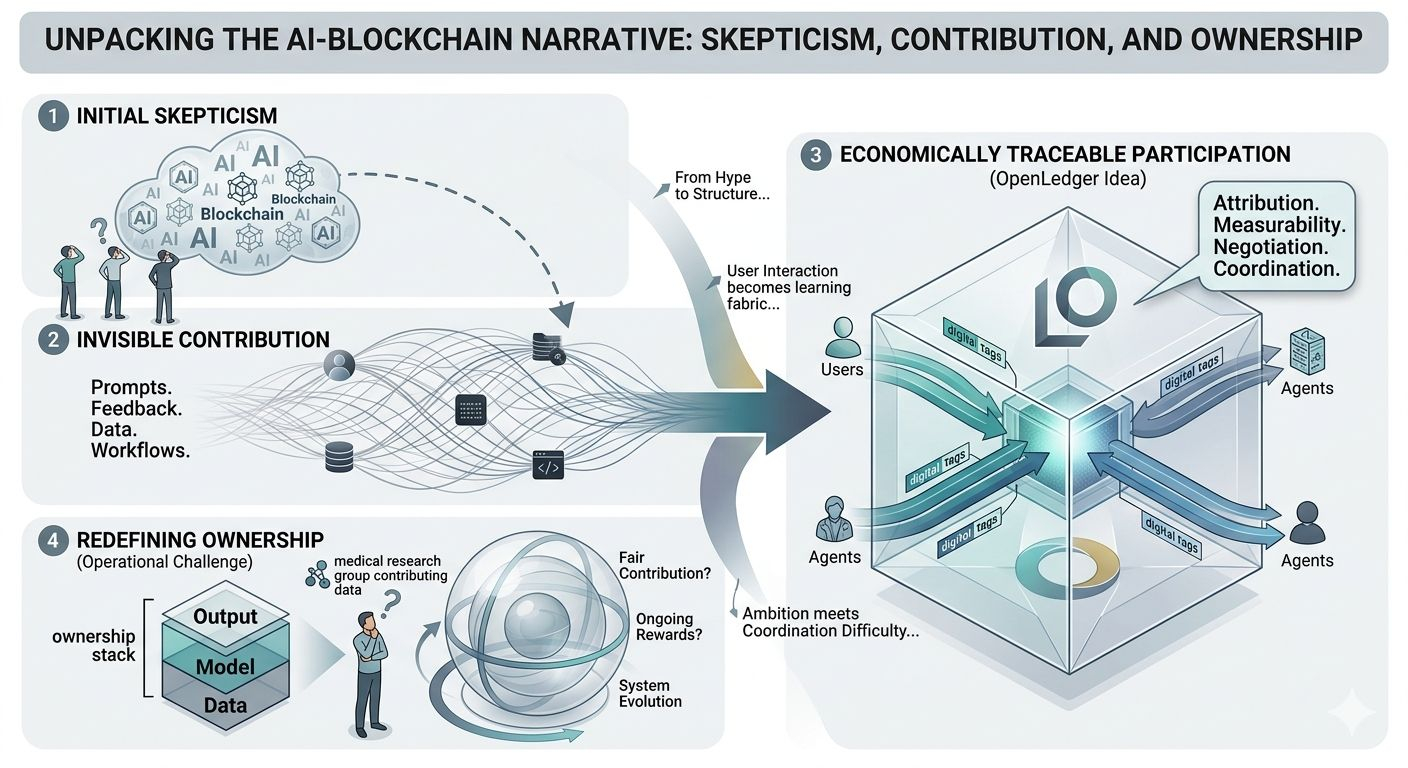
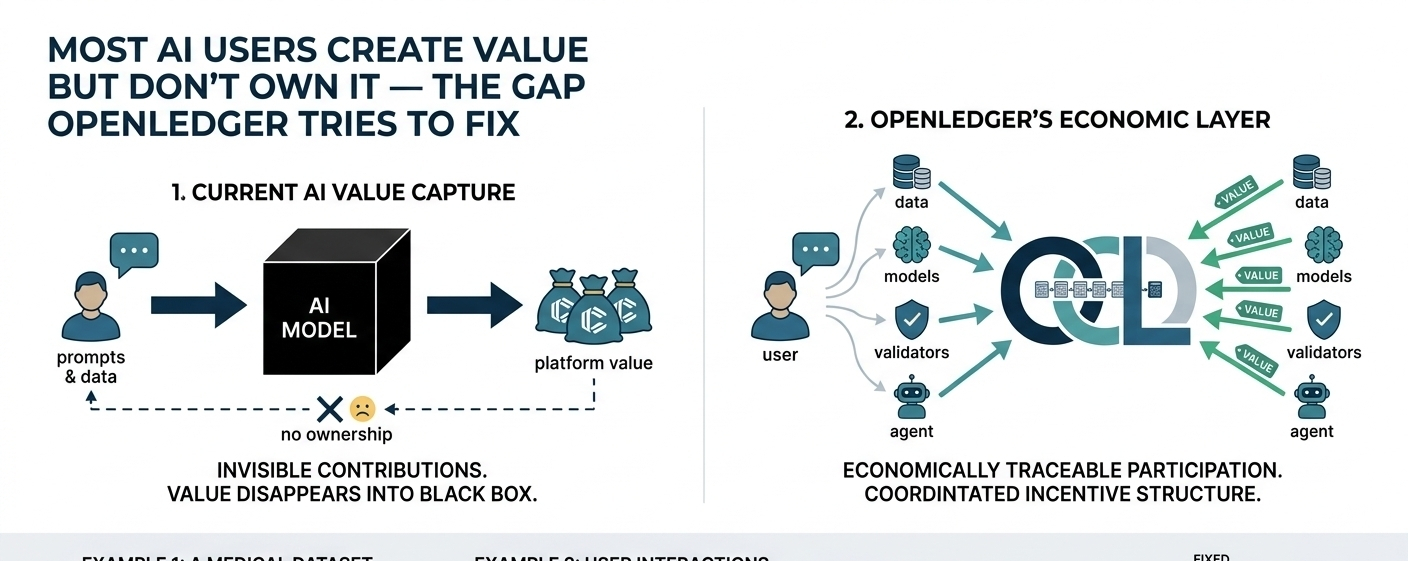
What stood out to me is how invisible AI contribution actually is today. People interact with systems constantly through prompts, corrections, datasets, workflows but the economic layer rarely reflects that participation.
At first, I thought that was just normal platform behavior. Centralized systems capture value, users provide input. That imbalance has always existed.
But AI feels different. It made me realize that user interaction is no longer just usage it becomes part of the system’s learning fabric. And yet, ownership doesn’t move with contribution.
That’s where OpenLedger’s idea becomes interesting. Not as “AI on-chain,” but as an attempt to make participation economically traceable. Data providers, model builders, validators, and agents all existing in one coordinated incentive structure where contribution can be tracked instead of disappearing into a black box.
Here’s the hidden tension: the moment contribution becomes measurable, it also becomes negotiable. Attribution stops being passive and starts becoming something that can be optimized, contested, or even manipulated.
In a real scenario, imagine a medical research group contributing datasets that improve a diagnostic model. Today, value extraction is mostly front-loaded. With a system like this, the same contribution could, in theory, generate ongoing rewards as the model is used. That changes the entire relationship between data and ownership.
But it also opens a harder question—how do you define “fair contribution” when outputs come from layered, overlapping inputs across millions of interactions?
That uncertainty is where most systems struggle.
I’ve seen similar patterns in earlier crypto infrastructure attempts. The vision is usually clear, but coordination breaks down when real usage begins. Either adoption stays shallow, or incentives drift, or governance becomes too complex to maintain balance.
AI adds another layer of difficulty because the system itself evolves while being measured. That makes stability even harder to define.
Still, something has changed compared to previous cycles.
AI is no longer experimental. It is already embedded in real workflows and decision systems. That shifts ownership from a philosophical question into an operational one.
And blockchain infrastructure in 2026 feels slightly more prepared for this than before better interoperability, more mature execution layers, and more practical agent-based systems.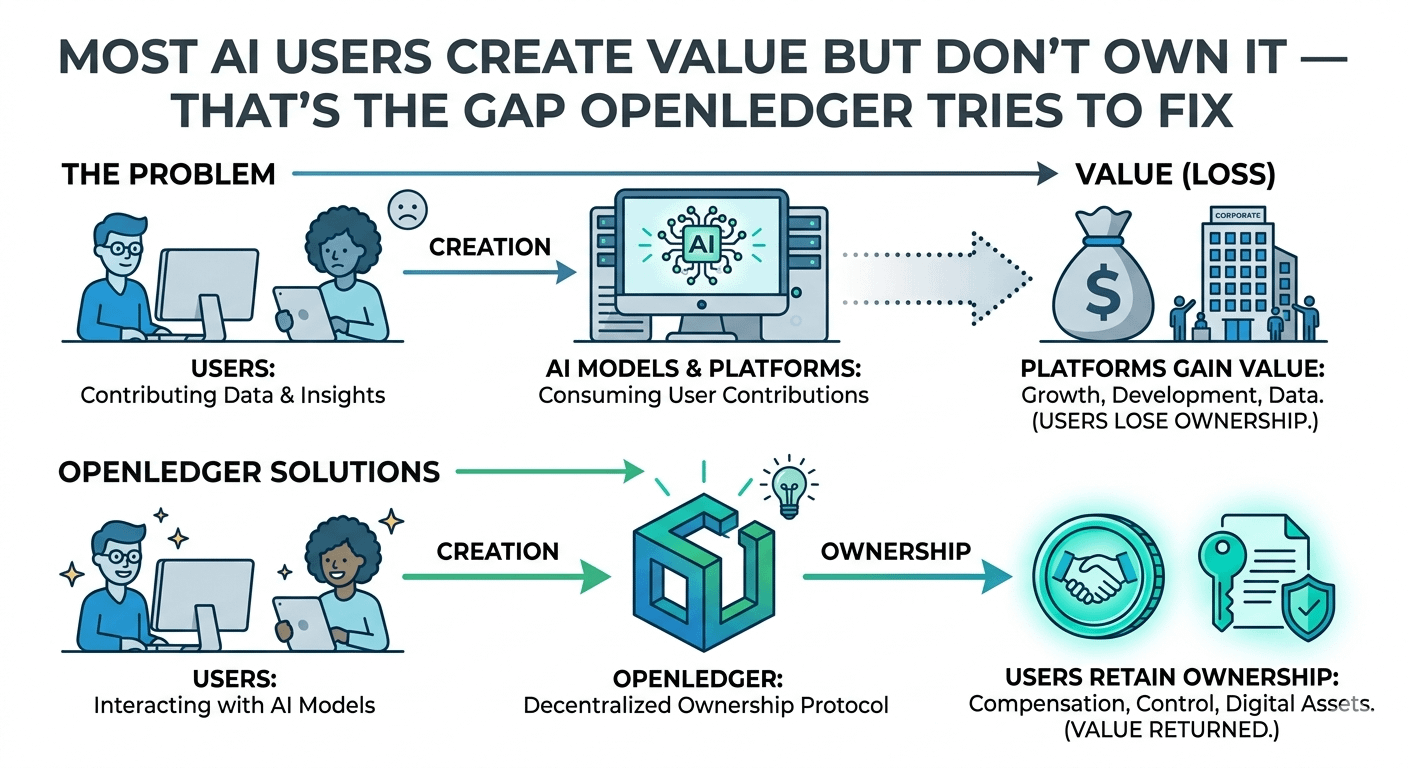
OpenLedger seems to be positioning itself not just as a protocol, but as an operational layer where AI coordination, deployment, and value flow can exist in the same system.
That’s a much larger ambition than it first appears.
But I keep coming back to one uncertainty.
If intelligence is continuously shaped by distributed human input and machine feedback, then what does ownership even mean in that environment?
Is it something fixed that can be assigned, or something fluid that constantly shifts as the system evolves?
I’m not sure there’s a stable answer yet. Or maybe the system itself is still figuring out what it wants to become.