
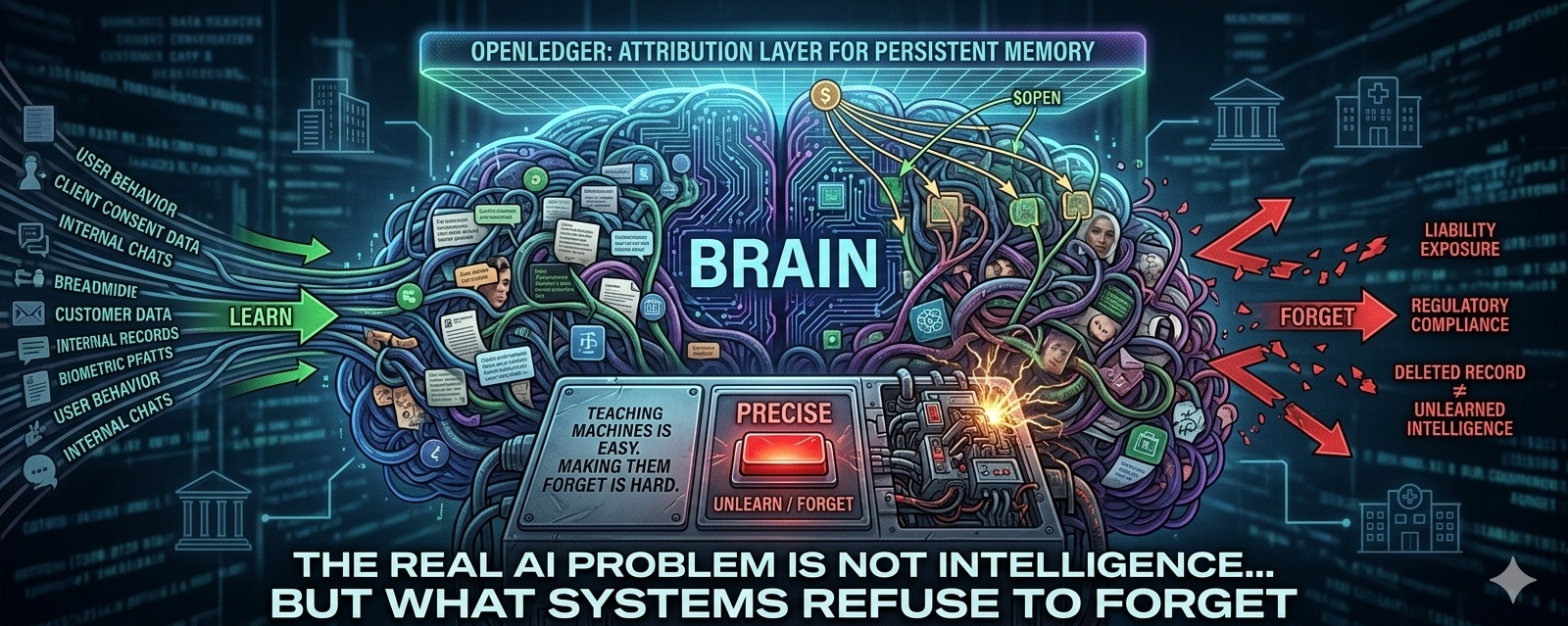
One thing I keep noticing across technology markets is how obsessed companies have become with collecting memory while almost nobody seriously talks about the long-term cost of keeping it. Every platform today is designed around retention. Social apps store years of behavior because maybe those patterns become valuable later. Financial services keep records indefinitely because historical context might improve risk analysis. AI companies scrape, train, index, embed, and preserve enormous amounts of information under the assumption that more data automatically creates better intelligence. For years that logic felt reasonable. Storage became cheap, compute became powerful, and the industry convinced itself that memory was always an advantage. But the closer AI moves toward real operational decision-making, the harder it becomes to ignore a much more uncomfortable question. What happens when the memory itself becomes the liability?
That shift is partly why OpenLedger started feeling more interesting to me than most AI infrastructure narratives floating around crypto right now. On the surface the explanation sounds simple. Contributors provide valuable data, developers use that data to improve models, attribution tracks value creation, and $OPEN coordinates incentives across the network. Clean concept. Easy pitch. The kind of infrastructure story the market usually understands quickly because it fits neatly into existing crypto logic. But the more I looked at it, the more I felt people might be focusing on the wrong layer entirely. Everyone keeps talking about helping AI learn better, while almost nobody seems focused on whether AI systems will eventually need structured ways to forget.
That sounds abstract at first, but modern AI systems do not really “forget” in the way people imagine. Once information enters a training pipeline, retrieval system, fine-tuned behavior, or embedded context layer, it spreads across the system in messy ways. Most people outside the technical side still imagine deletion like removing a file from a folder. But machine memory is not clean like that. Information influences outputs indirectly, shapes decision patterns, and leaves traces that are difficult to isolate later. I remember reading about machine unlearning some time ago and the entire concept felt strangely revealing. Not because the research itself was weak, but because it quietly exposed a deeper truth the industry rarely says out loud: teaching machines is much easier than making them forget precisely.
That distinction matters far more now than it did a few years ago because AI is no longer living only inside harmless experimental products. These systems are moving into areas tied to compliance, healthcare, finance, internal communication, customer operations, identity verification, and eventually automated decision-making where mistakes carry real legal or financial consequences. Once AI starts touching those operational surfaces, the conversation changes completely. Suddenly the important question is not just whether a model performs well. The bigger issue becomes what information the model is still carrying forward, how that memory continues influencing outputs, and who becomes responsible when retained intelligence creates exposure later.
This is where OpenLedger starts feeling less like a simple AI data marketplace and more like infrastructure sitting dangerously close to a future pressure point. If attribution becomes persistent and economically meaningful, then memory itself stops being free infrastructure. It becomes a managed economic object. That changes incentives in a way I do not think most people have fully processed yet. Right now AI systems retain information because retention improves continuity, personalization, and predictive performance. More memory usually means better outputs. But once attribution, ownership, and contribution tracking become visible, retained memory begins carrying economic and legal weight as well. And the moment memory carries cost, forgetting stops looking inefficient. It starts looking necessary.
That is the part I think the market keeps underestimating. Imagine an enterprise AI assistant trained partly on customer conversations, operational workflows, or proprietary internal data. Months later regulations change, permissions shift, or clients revoke consent. The challenge is no longer deleting archived records. The real issue becomes whether intelligence shaped by those interactions should still remain active inside the system itself. Healthcare creates this tension immediately. Financial systems too. Even simple AI agents introduce the same problem because once software develops behavioral memory about users, transaction habits, counterparties, or repeated interactions, that memory becomes strategically valuable and legally dangerous at the exact same time. The scary part is that useful memory and problematic memory often look identical until something goes wrong.
Crypto oddly understands this contradiction better than most industries because blockchain already went through its own collision between permanence and privacy. Permanent ledgers sounded revolutionary until people realized immutability creates problems too. Suddenly keeping everything forever stopped sounding universally positive. AI may now be approaching a similar realization. OpenLedger sits close to that tension because attribution systems make memory visible. And once memory becomes visible, it becomes contestable. Questions around ownership appear. Compensation disputes appear. Regulatory obligations appear. Liability stops being abstract. None of this automatically means OpenLedger solves those problems, though. Tracking provenance is very different from guaranteeing meaningful machine forgetting. Those are separate engineering and governance challenges entirely.
I also think the economic side deserves more skepticism than most crypto narratives usually allow. Infrastructure stories often sound elegant until the difficult demand questions appear. Why does the token sustain long-term utility instead of temporary speculation? What forces continuous participation once narrative momentum fades? If $OPEN becomes tied to attribution persistence, data coordination, or value routing connected to retained intelligence, then maybe there is a durable economic loop underneath it. But complexity can also become the enemy. Systems that require endless compensation logic for every retained contribution may eventually push enterprises toward simpler private alternatives. Operational simplicity often beats ideological purity in real markets.
Another issue that keeps bothering me is authority. Who actually decides what an AI system should forget? The original contributor? The enterprise operating the model? Regulators? Application developers? Compliance teams? Those groups will not naturally agree with each other, especially once financial incentives become attached to memory itself. And that disagreement is probably why this topic feels more important than most people currently realize. The AI market still behaves like intelligence is the scarce resource. Bigger models, smarter outputs, faster reasoning, better automation. But I increasingly think intelligence may become abundant much faster than responsibility does.
That changes which infrastructure actually matters long term. OpenLedger may absolutely remain what most people currently see it as: a tokenized coordination layer for AI data contribution and attribution. But the more interesting possibility is far messier than that. It may eventually become part of a larger system that determines what AI is allowed to remember, how long those memories remain economically active, and who continues benefiting while those memories stay embedded inside intelligent systems. That future is far less comfortable than the current AI narrative, which is probably why it feels worth paying attention to now rather than later.
