
I’m watching OpenLedger late at night with that familiar feeling I get after reading too many whitepapers and too many promises about the next layer of crypto infrastructure. OPEN sits in the AI blockchain category, which already makes me slow down because I’ve seen what happens when a real technological shift becomes a market narrative. I’ve seen DeFi turn into liquidity wars, GameFi turn into empty economies, modular chains turn into architecture debates, and AI tokens turn into a race where every project tries to sound inevitable before proving it is needed. So with OpenLedger, I’m curious, but I’m also tired in the way crypto makes you tired when you’ve watched enough cycles repeat with different vocabulary.
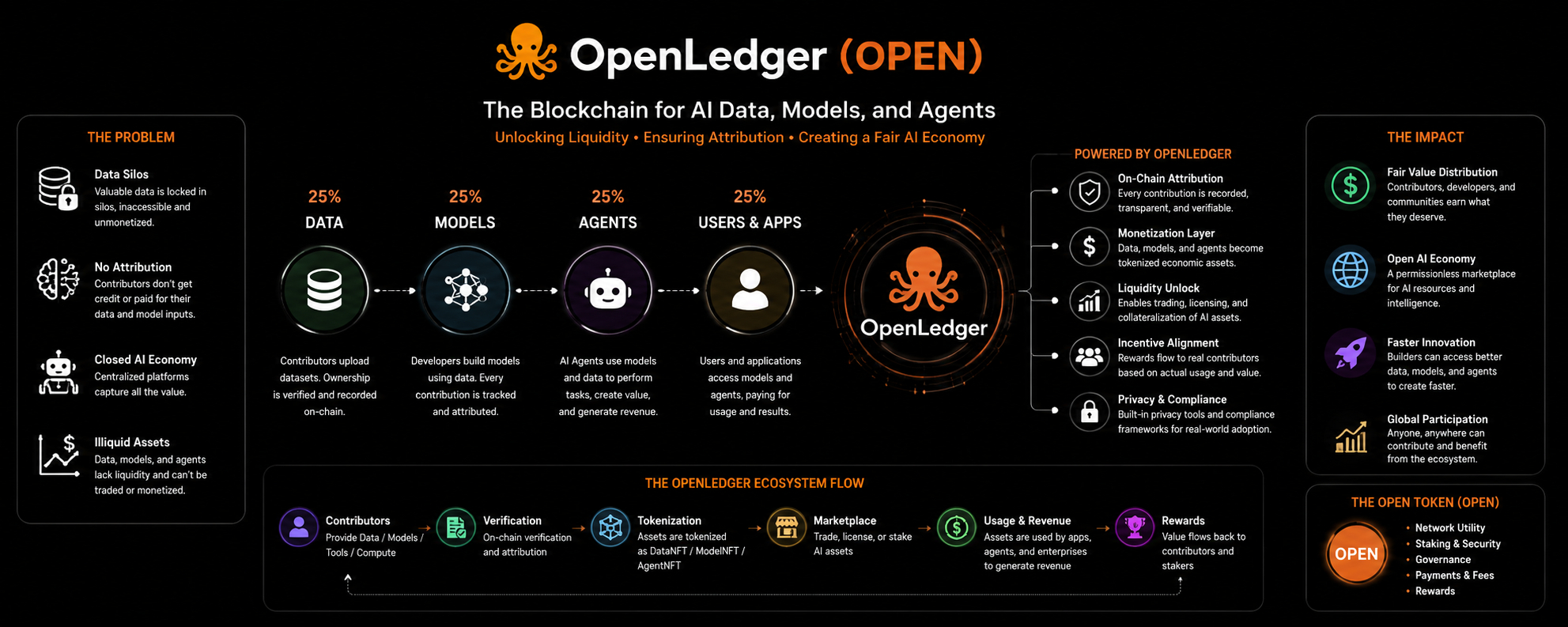
What keeps me looking at OpenLedger is that the problem it points toward is not fake. AI does have a data problem. Models do need better inputs. Contributors often do get ignored. Attribution is messy. Value gets captured by platforms, not always by the people who create the raw material. Agents, if they become more than demos and dashboards, will need identity, coordination, payment rails, and some kind of reputation. So I can understand why OpenLedger exists on paper. It is trying to make data, models, and agents part of an open economic system instead of leaving everything inside closed AI platforms. That is not a bad idea. It is actually one of the cleaner ideas inside the AI-crypto overlap. But I’ve learned not to stop at the idea.
I keep asking myself the same boring question because the boring question usually survives the hype: who actually needs this badly enough to use it when the incentives are gone? Not who signs up for a campaign. Not who farms points. Not who trades OPEN because AI coins are moving. I mean who wakes up and says, I need OpenLedger because without it I cannot build this model, monetize this data, verify this contribution, coordinate this agent, or access this market. That is the line I’m trying to find. Until I find it, I can’t treat the project as proven infrastructure. I can only treat it as a thesis that still needs pressure.
I’ve noticed that a lot of crypto infrastructure starts by sounding reasonable. There is always a coordination problem. There is always a market inefficiency. There is always some hidden value waiting to be unlocked. The whitepaper language makes it feel like the system is almost obvious. Then reality shows up. Developers are busy. Users are impatient. Liquidity is mercenary. Token rewards distort behavior. Data quality is hard to verify. Governance gets weird. And suddenly the clean diagram becomes a messy economy full of people optimizing around incentives instead of contributing to the mission. That is the part I’m thinking about with OpenLedger.
The core of OpenLedger seems to be about turning data, models, and agents into economic assets that can be tracked, used, rewarded, and coordinated. I like that direction more than vague AI branding. At least it is close to something real. If someone contributes useful data and that data improves a model, there should be a way to recognize that contribution. If a model becomes valuable because of community input, the value should not disappear into one centralized owner. If agents start doing work across networks, they probably need identity and payment systems that are more open than today’s API keys and private dashboards. There is a real argument here.
But then I pause, because crypto always turns real arguments into token systems, and token systems always need deeper inspection. OPEN needs to be more than a symbol for exposure to an AI story. It has to carry actual usage inside the network. If OPEN is used for fees, model access, rewards, governance, agent activity, or data markets, then I can start mapping token demand to network demand. But I still need to know whether users want that token in the middle of the experience. Does it make the system more efficient, or does it add another step? Does it align people, or does it simply create a market around future expectations? The difference is not small.
I’m also thinking about the contributor side. Data sounds valuable until everyone starts uploading whatever they can to chase rewards. I’ve seen this movie in different forms. Liquidity mining brought capital, but a lot of it left the moment yields dropped. Play-to-earn brought users, but many were employees of the incentive system rather than players of the game. SocialFi brought engagement, but some of it became performative farming. If OpenLedger rewards data and model contributions, it has to fight the same gravity. People will optimize for whatever the reward mechanism measures. If the system measures activity poorly, it will get bad activity at scale.
That is where trust becomes the real infrastructure. Not the chain itself, not the token ticker, not the AI language, but trust. Can OpenLedger tell the difference between useful data and junk data? Can it track attribution in a way that is actually meaningful? Can it prevent low-quality contribution from diluting the economy? Can model improvements be measured honestly? Can developers and users trust that the system is not just creating a nice-looking ledger of questionable inputs? These are not small details. They are the whole thing.
I keep coming back to agents too, partly because every AI project now seems to mention them, and partly because agents could actually matter if they stop being a narrative and start becoming economic actors. For OpenLedger, agents only matter if they do work that requires identity, payments, memory, reputation, or coordination across participants. If an agent can perform tasks, get paid, prove its history, and interact with data or models in a way that creates value, then OpenLedger’s infrastructure becomes more interesting. But if agents are mostly a branding layer, then the project is just standing near a hot keyword and hoping the market fills in the blanks.
I don’t want to sound cynical for the sake of it. I’m still curious. There is something compelling about a network where specialized datasets can support specialized models, where contributors are not invisible, and where AI value does not only flow upward into large platforms. That matters, especially because the AI economy is becoming more centralized around compute, data access, and distribution. A project like OpenLedger is trying to imagine a different flow of value. I respect that. I just know that imagining the flow and sustaining the flow are two completely different things.
The developer question matters a lot to me. If OpenLedger becomes real infrastructure, developers should be able to build on it without needing to believe in the narrative every morning. The tools should be good enough. The data should be useful enough. The models should be worth integrating. The network should give them something they cannot easily get elsewhere. Grants and incentives can help at the start, but they cannot be the whole reason people build. I’ve seen too many ecosystems with beautiful grant announcements and very little durable usage after the first wave. I want to see developers stay because OpenLedger gives them leverage.
Then there is the user side, which crypto often talks around. Who is the end user here? Is it a model builder looking for better data? Is it a company that needs attribution and provenance? Is it a community monetizing niche knowledge? Is it an AI application that needs agent coordination? Is it an institution that wants audit trails? The answer can be more than one, but it cannot be everyone in a vague way. The more specific the user becomes, the easier it is to judge whether OpenLedger is working. Right now, I’m watching for that specificity.
Liquidity is another word I don’t trust immediately anymore. Every cycle has its favorite word for making something sound inevitable. Liquidity sounds clean, but unlocking liquidity around data and models is very hard. Data is not a simple asset. It has rights, quality issues, duplication problems, privacy concerns, context, and uneven usefulness. Models are not simple either. They need performance, maintenance, distribution, and trust. Agents are even more uncertain because the market is still figuring out what they are beyond automated workflows with a better name. So if OpenLedger says it can unlock liquidity here, I don’t reject the idea, but I need to see the market design do real work.
What would make me take it more seriously is not a bigger announcement. It would be boring evidence. More useful datasets. More models that people actually use. More developers integrating because the infrastructure helps them. More agent activity that looks like real work instead of staged demos. More token usage tied to actual services. More users returning without needing constant rewards. I’ve reached the point in crypto where boring evidence excites me more than loud narratives. Boring evidence is harder to fake over time.
I’m also thinking about what happens when incentives disappear, because that is usually when the truth comes out. If data contributors stop showing up when rewards slow down, then the network was renting contribution. If developers leave when grants dry up, then the ecosystem was renting development. If users disappear when subsidies end, then the system was renting adoption. None of that means OpenLedger cannot work, but it means the project has to prove that incentives are a bridge, not the foundation. A sustainable network can use incentives to start the engine, but the engine has to run on real demand eventually.
There is also a bigger economic angle here. AI is pulling capital toward infrastructure, compute, data, and automation. Most of that capital is not naturally crypto-native. It is going to cloud providers, chip companies, enterprise AI platforms, and private model labs. For OpenLedger to matter, it has to find the part of the AI economy where decentralization is not just philosophically attractive but practically useful. Maybe that part is attribution. Maybe it is community-owned data. Maybe it is specialized model markets. Maybe it is agent identity. I can see several possible paths, but I do not want to pretend all of them will happen.
Regulation sits in the background too. Anything involving data, AI, payments, and token incentives can become complicated fast. Data provenance sounds great until legal rights become unclear. Open contribution sounds powerful until privacy rules enter the room. Agent payments sound futuristic until accountability becomes necessary. If OpenLedger wants to serve serious users, it eventually has to deal with these questions. The projects that survive are usually the ones that understand the real-world constraints instead of acting like code automatically removes them.
I’m watching OPEN as a token, but I’m trying not to let the token be the whole analysis. Price can move before fundamentals. It can also ignore fundamentals for a long time. In an AI cycle, OPEN can attract attention simply because it belongs to the right theme at the right moment. That does not mean the project is working. It also does not mean the project is empty. It just means market behavior and network reality can separate for a while. My job, if I’m being honest with myself, is to notice when they start converging.
The part that still holds my attention is the possibility that OpenLedger becomes a coordination layer for useful AI resources. If data contributors, model builders, application developers, and agents can interact in a way that creates value and distributes it more fairly, then there is something here. Not something guaranteed, but something worth studying. The part that keeps me skeptical is that every piece of this system has to work under real incentives. The data has to be good. The attribution has to matter. The models have to be useful. The developers have to stay. The users have to pay. The token has to support the economy without becoming the only reason the economy exists.
I think that is where I land for now. OpenLedger is not a project I would dismiss casually, but it is also not one I would accept at face value. It has a real problem space, a timely narrative, and a design that points toward actual AI economic coordination. But it still has to prove that the market needs this specific system. It has to prove that activity is not just incentivized motion. It has to prove that OPEN is connected to usage, not just belief. It has to prove that when the AI narrative cools, the network still has something people want.
So I keep watching. Not with excitement exactly, and not with cynicism either. More like tired curiosity. The kind that comes after too many cycles, too many decks, too many token launches, and too many promises that sounded obvious until they weren’t. OpenLedger might matter if it can turn data, models, and agents into a real economy with trust and repeat usage. It might fade if the incentives create activity before demand arrives. I don’t know yet. That is why I’m not rushing. I’m just reading, comparing, questioning, and waiting for the part of the story that only real usage can write.
