
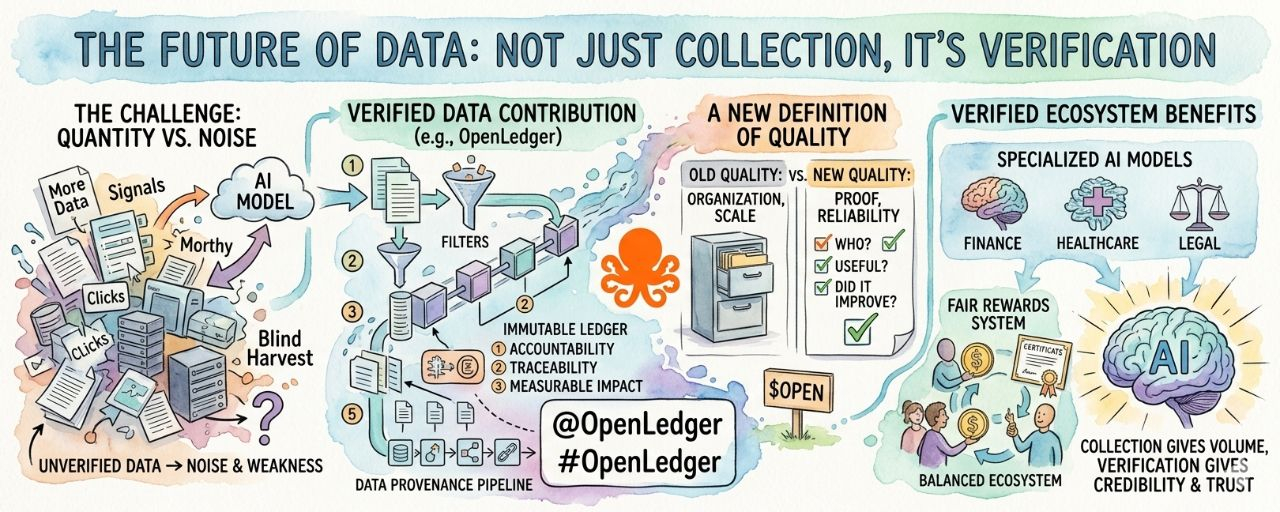
For a long time I believed the biggest advantage in technology came from having more data. More users, more clicks more records m0re conversations more signals. Everywhere I looked, companies were racing to collect information at massive scale as if quantity alone could create intelligence. But the more I studied how modern AI systems actually evolve the more I realized that data by itself is no longer enough. A huge amount of information can appear valuable from the outside but if nobody knows where it came from how reliable it is or whether it truly improved an AI model then that data slowly becomes noise instead of value.
This is exactly why projects like @OpenLedger are becoming increasingly important in the future of AI infrastructure. What makes #OpenLedger interesting to me is that it focuses on something the industry desperately needs but often ignores: verified data contribution. Instead of treating data like an endless resource to harvest blindly OpenLedger introduces the idea that every contribution should have accountability, traceability, and measurable impact. In my 0pinion this changes the entire conversation around artificial intelligence.
Today the internet already produces more information than any system can fully process. The issue is not scarcity. The issue is trust. Can we verify where a dataset originated? Can we prove whether certain information improved a m0del or introduced bias? Can contributors be rewarded fairly for providing useful knowledge? These questions are becoming critical because AI is moving deeper into finance healthcare, automation education research and decision making. If the data powering these systems cannot be verified then confidence in the outputs will always remain limited.
This is where I think OpenLedger’s direction becomes powerful. The project is not simply talking about AI growth. It is addressing the missing layer of transparency behind AI development itself. The idea that data contributors model builders and ecosystem participants can all 0perate within a framework of verification creates a much stronger foundation than the current system where massive platforms collect information with very little accountability.
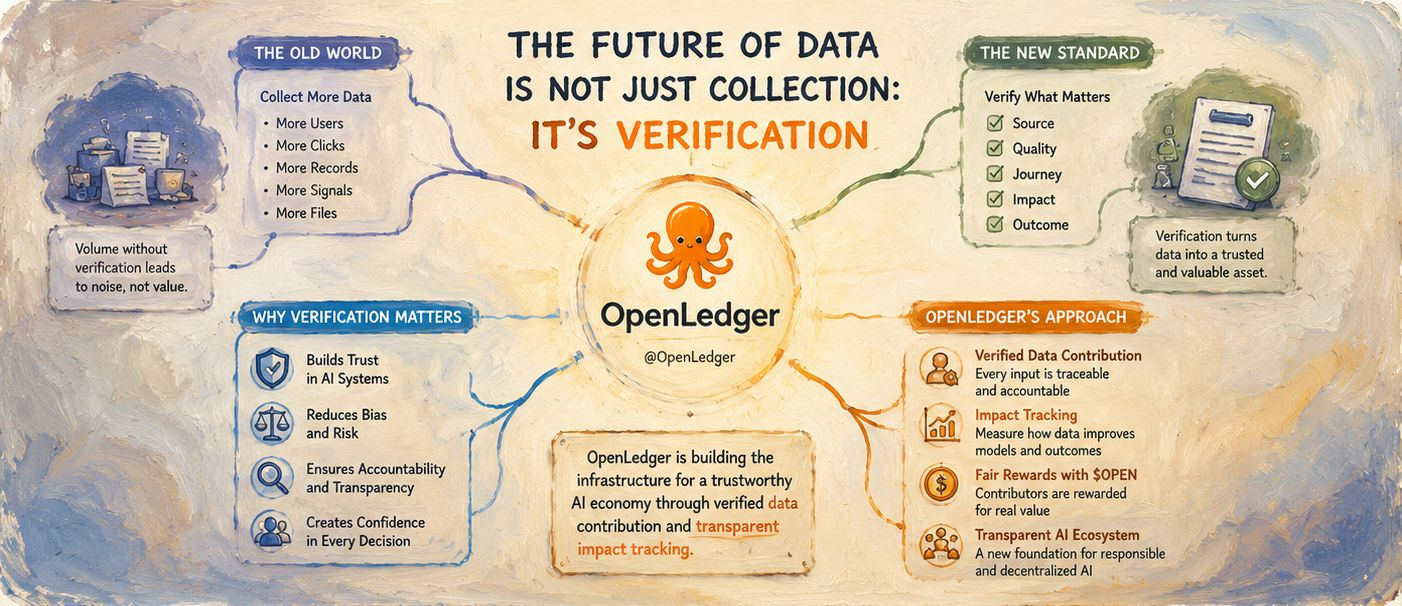
One thing I personally find interesting is how verification completely changes the meaning of “high quality data.” In older systems quality mostly meant organization formatting scale, or relevance. But moving forward, quality will also mean proof. Who contributed the information? Was it useful? Did it improve outcomes? Was it reliable over time? These questions are becoming essential for AI systems that people actually trust.
To me, OpenLedger represents this transition from simple data c0lection toward data accountability. It feels like a shift away from the old internet model where platforms endlessly absorb information without properly measuring contribution or credibility. Instead verified AI ecosystems create a structure where data has context history ownership and measurable value.
I also think this matters because the future AI economy will likely become extremely specialized. Different industries will require different models trained on highly reliable inf0rmation. Financial AI cannot afford weak datasets. Healthcare AI cannot rely on uncertain sources. Legal automation cannot function on unverifiable information. In all these areas the ability to trace and validate data pipelines becomes more important than simply increasing scale.
That is why I believe projects like @OpenLedger could become increasingly relevant as AI infrastructure evolves. The next generation of AI platforms may n0t be the ones with the largest raw datasets. They may be the systems that can actually prove the credibility and usefulness of the knowledge they use. Verification may become more valuable than collection itself.
Another reason this idea stands out to me is because OpenLedger connects incentives with contribution quality. In many traditional systems, contributors provide value while centralized platforms capture most of the rewards. But verified contribution models create the possibility for a more balanced ecosystem where useful participation can actually be recognized and rewarded. That feels much more sustainable for the long term AI economy.
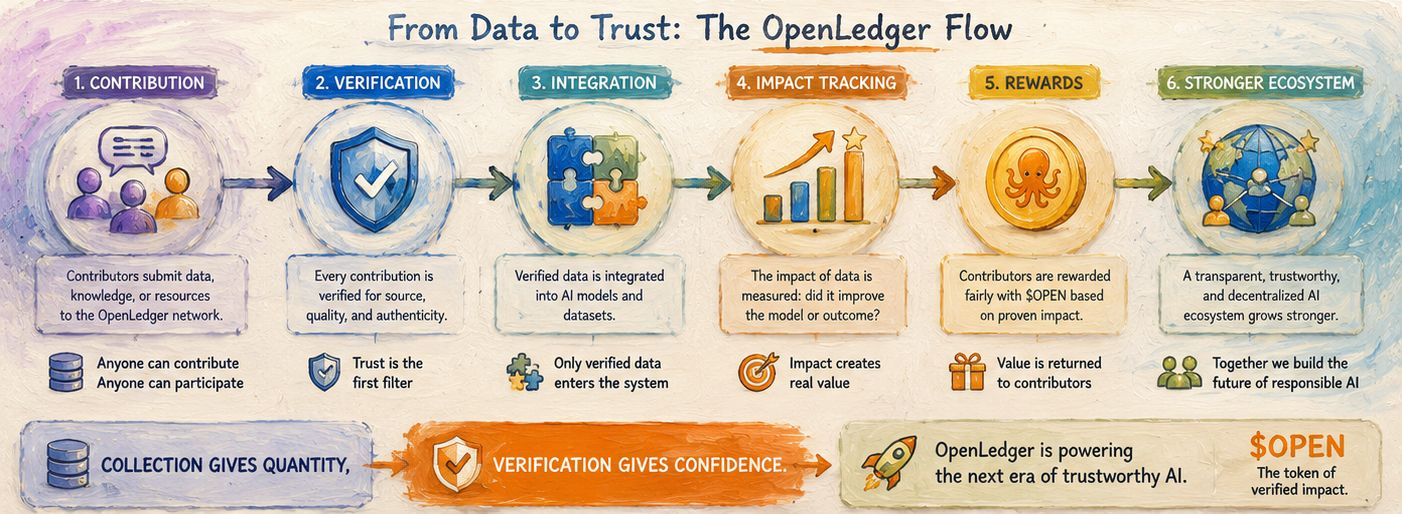
From my perspective, the future of data is not about endless accumulation anymore. The internet already solved quantity. The next chalenge is confidence. Confidence in where information comes from confidnce in how it is used and confidence that the systems built on top of it can be trusted.
That is why the concept behind #OpenLedger feels Important to me. Colection gives AI systems v0lume but verification gives them credibility. Collection fills databases but verification creates trust. And as AI becomes more integrated into everyday life trust will eventually become more valuable than scale alone.
In the end, I believe the future belongs to systems that do not just gather knowledge but can pr0ve why that knowledge matters. That is the real shift happening in AI right now, and projects like #OpenLedger together with $OPEN are positioning themselves directly around that transition.
#OpenLedger
$OPEN
